SILENCE IS COMPLICITY

Today we are joining our voices to countless others who are refusing to stay silent about Israel’s ongoing genocide in Gaza. We call on all European institutions and governments to break from their inaction and make every effort to prevent the continued massacre of Palestinians in Gaza and their arrest and intimidation in the West Bank. Silence is complicity.

As artists, curators, and cultural workers associated with the Institute of Radical Imagination, we urgently call for an immediate ceasefire and the swift deployment of international aid to halt the mounting loss of life in the Gaza Strip. Over the past 16 years, long before October 7, Israel has increasingly turned the Gaza Strip into a horrific siege where Israel determines all minor details of life, what goods enter and exit the enclave, who can travel or get urgent medical treatment. We join countless others in their commitment to end the century-long colonial oppression of Palestine and the dismantling of Israel’s apartheid regime.

We stand with protesters around the world, as well as inside Israel, that call for an end to the Zionist occupation.

We stand against the worldwide perpetuation of a colonial industrial complex that reproduces itself through the suppression of freedom of speech and democratic assembly, and the employment of various forms of censorship that have infiltrated our political and cultural institutions.

Where hatred and ethnic cleansing prevail, the path of struggle is r/existence. We join our voices in calling for the decolonization of Palestine.

  1. Institute of Radical Imagination
  2. Sara Buraya Boned, cultural worker Madrid, Spain
  3. Gabriella Riccio, artist, Naples, Italy
  4. Emanuele Braga, artistt and researcher, Milan, Italy
  5. Madu, artist and feminist militant researcher, Milan/London, Italy/UK
  6. Marco Baravalle, researcher and curator, Venice, Italy
  7. gregory sholette, artist/writer/educator/troublemaker, NYC USA
  8. Philip Rizk, film-maker, Berlin/Cairo
  9. Theo Prodromidis, artist, Athen, Greece
  10. Federica Timeto, antispeciesist feminist., Venice, Italy
  11. Zdenka Badovinac, Slovenia
  12. Ana Škegro, curator, Zagreb, Croatia
  13. Debra Solomon, University of Amsterdam / Urban Planning, Amsterdam, the Netherlands
  14. Alja Gudzevic, literary translator, editor, Athens, Greece
  15. Gloria Luca, Artist, Spain
  16. Simona Barbera, Artist, Oslo / Genova
  17. Gemma Medina, Curator and art educator, Eindhoven/The Netherlands
  18. Marija Šević, Visual artist, Serbia
  19. Özge Açıkkol, artist, Berlin / Germany
  20. Carola Spadoni, Artist and Filmmaker, Berlin, Germany
  21. Ana Campillos Sánchez-Camacho, Cultural worker, Madrid, Spain
  22. Dimitra Laina, visual artist, Greece
  23. Nina ter Laan, Postdoctoral Researcher, Utrecht, the Netherlands
  24. Agnese Politi, PhD – CSM ual, London
  25. Anja Dimitrijević, Iuav University in Venice, coordination in theatre and performing arts, Italy/Serbia
  26. Liviana Angeloni, Artist, Italy
  27. Manuela Pedrón Nicolau, Researcher, curator, Madrid/ Spain
  28. Carolina Ruiz, Programadora musical, España
  29. Elena Lara, Cultural worker, Granada, Spain
  30. Jaime González Cela, Curator, Madrid/España
  31. Sergio, Art historian, Madrid/Spain
  32. África Ruiz, Artist/Cultural worker, Ceuta
  33. Carmen, student, Madrid, Spain
  34. Francisco Luis Ruiz Zea, student, Córdoba/Spain
  35. Giulia, Curator, Turin, Italy
  36. M. Rosario Calderero Hernández, Cocinera, Ciudad Real / España
  37. Iris Sofía Hernández Gómez, Cultural Worker, Madrid, Spain, Italy
  38. Eleanna Massala, Architect, Chania
  39. Phaedra Vokali, filmmaker, Athens/Greece
  40. Teresa Cos, Van Abbemuseum, Eindhoven/Netherlands
  41. José Cardoso, Designer, Ecuador.
  42. Neil Nayi, Unemployed, New York, USA
  43. Chiara Garbellotto, Antropologa/Lavoratrice culturale, Berlin/Germany
  44. Elisabetta Consonni, Artist, Italy
  45. Elena Ghizzo, Feminist activist, Italy
  46. Raja, Researcher, Italy
  47. Adam Holton, Human. Artist., Cei Newydd / Cymru
  48. Greta De Marchi, Art curator, Milan, Italy
  49. Guillermo Cobo, Librarian / Biblioteca Museo Reina Sofía, Madrid, Spain
  50. Naik M’Sili, Cultural worker, Marseille, France
  51. Elena Lasala, cultural worker, Barcelona, Spain
  52. Margherita Falqui, cultural worker, Italy
  53. Néstor Navarro, cultural worker, Madrid, Spain
  54. Martina Riescher, multidisciplinary artist, development of community art projects, Italy/Germany
  55. Francis Ball, MD, Leiden, The Netherlands
  56. Feliciano Castaño Villar, education worker, social anthropologist, Andalucía, Spain
  57. Rita Barreirea, Researcher/ Cultural Worker, Lisbon/ Portugal
  58. Cassandra Fontana, Università di Firenze, Bologna, Italy
  59. Nagham Abu Assaf, Artist, Amsterdam/ The Netherlands
  60. Asker Bryld Staunæs, artist and researcher, Aarhus, Denmark
  61. Poppy Robathan, Researcher and Educator, Amsterdam / Netherlands
  62. Derville Quigley, Amsterdam
  63. May Bletz, Instructor, The Netherlands

ASSEMBLEA DI BIENNALOCENE Atto I

Sale Docks, Mi Riconosci?, Institute of Radical Imagination e ADL Cobas

invitano tutte le lavoratrici ed i lavoratori della cultura a partecipare ad un’assemblea aperta.

Obiettivi:

  • Redigere una carta dei diritti del lavoro artistico e culturale a Venezia.
  • Costruire un luogo di incontro stabile per rompere l’isolamento.
  • Offrire assistenza sindacale a chi ne avesse bisogno.

Tutt* sono benvenut*

Sale Docks, Mi Riconosci?, Institute of Radical Imagination & ADL Cobas

invite all cultural workers to participate in an open assembly

Goals:

  • Draw up a charter of rights for artistic and cultural work in Venice.
  • Build a stable meeting place to break the isolation.
  • Offer union assistance to those in need.

All are welcome

Taring Padi: People’s Liberation

Collective Banners 2023 – 2026
Exhibition

Sale Docks, Dorsoduro 265, 30123, Venezia.

Opening: Sunday, May 3, 7:00 – 9:00 pm, free entrance.

Exhibition: 3 May – 31 July 2026

Opening hours: Thursday to Sunday
11:30 am – 2:00 pm
3:30 pm – 6:00 pm

Artist Talk: Taring Padi in conversation with Sale Docks and the Institute of Radical Imagination: May 7, 15.00 pm.

People’s Liberation is an exhibition of a series of large scale banners  that were created for political education, propaganda, and mobilisation. Apart from woodcut posters and cardboard puppets, banner is one of three mediums and artistic practices that Indonesian collective of art workers Taring Padi has been utilising as a political tool  since 1998. 

Following the dismantling of People’s Justice banner in Documenta 15 on 21 June 2022, Taring Padi reclaimed the condemned banner and transformed it into a platform to agitate, educate and organise. Between 2023 and 2026, Taring Padi developed a new series of People’s Justice banners, produced largely through collaboration with progressive organisations, collectives and individuals across four continents. With one exception, all works in this series are painted on canvas, with dimensions ranging from 450×450 cm to 1200×600 cm. Collectively, the series manifests a continuation of the original banner’s function, returning from a contested exhibition object into an itinerant, street protest property and collaborative instrument of resistance.

Five banners from the People’s Justice series will be on display at the People’s Liberation exhibition at Sale Dock, Venice from 3 May to 31 July 2026:

  1. People’s Justice series no. 2, entitled in Portuguese Retomar Nossa Terra (Reclaimed Our Land, acrylic on canvas, 450×450 cm) is the first from this iteration. Created in April 2023 and in collaboration with Framer Framed Amsterdam based exhibition space,Casa do Povo, progressive Jewish collective, Landless Workers’ Movement/MST and Tricontinental institute in Sao Paolo, the banner describes the popular movement against extractivist capitalism in Brazil.

  1. People’s Justice series no. 5 entitled in Javanese Kendeng Lestari, Nyawiji Kanggo Ibu Bumi (Everlasting Kendeng: Being One with Mother Earth, acrylic on canvas, 450×450 cm) created in the end of 2023 in Taring Padi’s studio in Yogyakarta Indonesia. The banner is the culmination of the collective decades-long struggle with the Kendeng community in Central Java in the fight against the development of a cement factory in their area. The banner is accompanied by 24 rontek (small banners) and 10 panji (pennants). The rontek is made by individual members of Taring Padi addressing various issues from the struggle. The Panji inscribed mantras, prayers and songs of the Kendeng community. 

  1. People’s Justice series no. 7 entitled in Arabic  عدالة الشعب (People’s Justice, acrylic on canvas, 450×450 cm). The production of the banner started in Brussel, Belgium in January, continued in Brisbane, Australia in March and finalised in Taring Padi’s studio in Yogyakarta, Indonesia in June 2024. Narrating the struggle, hope and international solidarity of Palestinian people, the banner was collectively produced by The Kitchen, Globe Aroma, Subversive Film, The Question of Funding and Learning Palestine.

  1. People’s Justice series no. 8 carries two titles: Narbiny nguluk nidja doorntj baarniny, moorditj dooytj-doornt (Care together, strong together), an expression in Noongar of resistance grounded in unity and compassion; and Rakyat Bersatu tak bisa dikalahkan (The People united cannot be defeated), an Indonesian protest slogan that resonates with global social justice movements. It differs both in shape and size (505.5 x 691.8 cm) from the other banners in the series and is executed charcoal and acrylic on canvas.  The banner was created in Perth, Australia in November 2024 and it was the collective first time collaboration with individuals(rather than collectives) of aborigin artists from Western Australia: Sharyn Egan (Noongar), Yabini Kickett (Ballardong, Whadjuk), Ilona McGuire (Whadjuk, Ballardong, Yuat, Kungarakan) and Tyrown Waigana (Wardandi Noongar, Ait Koedhal)

  1. People’s Justice series no. 9 entitled People’s Liberation (acrylic on canvas, 450×450 cm) is the latest edition and in collaboration with Institute of Radical Imagination in which Taring Padi is also a member. The production of the banner started in Yogyakarta in February 2026 and will be unveiled for the first time in the opening of the exhibition that bears the same title in May.

The exhibition will also present a documentation of People’s Justice series no. 1: People’s Justice (acrylic on canvas, 1200 x 800 cm) which was created in Taring Padi’s squatted space in Yogyakarta in 2002. 

As an addition, Taring Padi will also exhibit banner entitled Basta Schiavitu (Stop Slavery, acrylic on canvas 300×400 cm) that was produced in Rome in September 2025  with the assistance of  Confederazione Generale Italiana del Lavoro (CGIL Italian General Confederation of Labour) and facilitated by Cantadora gallery. The banner visualises the struggle of Sikh migrant workers in the agriculture sector around Rome.

People’s Liberation banner (People’s Justice series no. 9) carries the slogan “Abolish Fascism, Organize Autonomy.” The slogan is not an empty rallying cry, but emerged from collaboration between the Institute of Radical Imagination and Sale Docks.

Sale Docks is an activist art space in Venice. Founded through an occupation in 2007, it represents a genuinely autonomous artistic space in a city increasingly dominated by private foundations backed by global billionaires and shaped by the presence of the Venice Biennale. As a collective, Sale Docks is engaged on multiple fronts: advocating for the rights of cultural workers and fostering artistic internationalism. Sale Docks actively participate in Art Not Genocide Alliance (ANGA), a solidarity campaign with Palestine that calls for a boycott of the 2026 Venice Biennale in response to its decision to host the Israeli Pavilion.

The Institute of Radical Imagination, for its part, is a transnational collective of art workers, with members from Southern Europe, Indonesia, and Palestine. The Institute’s practice operates at the intersection of art and the commons, grounded in a shared political commitment that is antifascist, transfeminist, decolonial, and antispeciesist.

Additionally, Taring Padi’s present in Venice will include the  creation of a new large-scale mural on the exterior walls of Laboratorio Occupato Morion, a key space for the city’s social movements. Work on the mural will begin in  early April 2026.

The People’s Liberation exhibition is produced by Sale Docks, the Institute of Radical Imagination, and Collective of Art Workers Taring Padi, with the solidarity supports and collaborations from Movimento dos Trabalhadores Rurais Sem Terra, Casa do Povo, Tricontinental Institute, Framer Framed, Jaringan Masyarakat Peduli Pegunungan Kendeng, The Kitchen, Globe Aroma, Subversive Film, The Question of Funding, Learning Palestine, The Art Gallery of Western Australia, Cantadora, ProppaNOW, Milani Gallery, Manifesto Press. 

IRI Statement | Strike Everywhere

🇬🇧 English

Institute of Radical Imagination — Statement

The Institute of Radical Imagination joins the transnational mobilization against the genocide of the Palestinian people and against the war economy that fuels violence, censorship, and repression in Europe and beyond. We firmly affirm that art, research, and collective imagination must stand on the side of life and liberation, against all forms of colonialism and supremacism.

IRI’s local nodes are active in promoting protests and road, railway, and naval blockades in Italy, Spain, Portugal, Greece, Catalonia, and Indonesia. As the land crew of the Flotilla, we will mobilize to sever any complicity of our governments with Israel’s fascist policies: the Italian, Spanish, Portuguese, and Turkish governments allowed Israel to violate international law, acting as pirates at sea in the seizure of the GLOBAL SUMUD FLOTILLA mission. We denounce these acts and demand full accountability.

We call on artists, researchers, cultural workers, students, and social movements across Europe to join demonstrations and strikes in their territories. The social strike in our territories will be massive and unstoppable. International law is not negotiable.


🇮🇹 Italiano

Institute of Radical Imagination — Dichiarazione

L’Institute of Radical Imagination si unisce alla mobilitazione transnazionale contro il genocidio del popolo palestinese e contro l’economia di guerra che alimenta violenza, censura e repressione in Europa e oltre. Affermiamo con forza che arte, ricerca e immaginazione collettiva devono schierarsi dalla parte della vita e della liberazione, contro ogni forma di colonialismo e suprematismo.

I nodi locali di IRI sono attivi nel promuovere proteste e blocchi stradali, ferroviari e navali in Italia, Spagna, Portogallo, Grecia, Catalogna e Indonesia. In quanto equipaggio di terra della Flotilla, ci mobiliteremo per recidere ogni complicità dei nostri governi con la politica fascista di Israele: i governi italiano, spagnolo, portoghese e turco hanno permesso che Israele violasse il diritto internazionale, agendo come pirati in mare nel sequestro della missione GLOBAL SUMUD FLOTILLA. Denunciamo questi fatti e chiediamo piena responsabilità.

Chiamiamo artiste, ricercatrici, lavoratrici culturali, studenti e movimenti sociali in tutta Europa a unirsi alle manifestazioni e agli scioperi nei propri territori. Lo sciopero sociale nei nostri territori sarà enorme e inarrestabile. Il diritto internazionale non è negoziabile.

🇪🇸 Español

Institute of Radical Imagination — Declaración

El Institute of Radical Imagination se une a la movilización transnacional contra el genocidio del pueblo palestino y contra la economía de guerra que alimenta violencia, censura y represión en Europa y más allá. Afirmamos con fuerza que el arte, la investigación y la imaginación colectiva deben situarse del lado de la vida y de la liberación, contra toda forma de colonialismo y supremacismo.

Los nodos locales de IRI están activos en la promoción de marchas y bloqueos coordinados de carreteras, ferrocarriles y puertos en Italia, España, Portugal, Grecia, Cataluña e Indonesia. Como tripulación terrestre de la Flotilla, nos movilizaremos para cortar toda complicidad de nuestros gobiernos con la política fascista de Israel: los gobiernos de Italia, España y Turquía han permitido que Israel viole el derecho internacional, actuando como piratas en el mar en el secuestro de la misión GLOBAL SUMUD FLOTILLA. Denunciamos estos hechos y exigimos plena responsabilidad.

Llamamos a artistas, investigadores, trabajadoras culturales, estudiantes y movimientos sociales en toda Europa a unirse a las manifestaciones y huelgas en sus territorios. La huelga social en nuestros territorios será enorme e imparable. El derecho internacional no es negociable.


🇵🇹 Português

Institute of Radical Imagination — Declaração

O Institute of Radical Imagination junta-se à mobilização transnacional contra o genocídio do povo palestino e contra a economia de guerra que alimenta violência, censura e repressão na Europa e além. Afirmamos com firmeza que a arte, a pesquisa e a imaginação coletiva devem posicionar-se ao lado da vida e da libertação, contra todas as formas de colonialismo e supremacia.

Os nós locais do IRI apoiam  a promoção de protestos em  Itália, Espanha, Portugal, Grécia, Catalunha e Indonésia. Como tripulação terrestre da Flotilla, mobilizar-nos-emos para cortar qualquer cumplicidade dos nossos governos com a política fascista de Israel: os governos italiano, espanhol, português e turco permitiram que Israel violasse o direito internacional, atuando como piratas no mar ao sequestrar a missão GLOBAL SUMUD FLOTILLA. Denunciamos esses factos e exigimos total responsabilização.

Convidamos artistas, pesquisadoras, trabalhadoras culturais, estudantes e movimentos sociais em toda a Europa a juntarem-se às manifestações e greves nos seus territórios. A greve social em nossos territórios será enorme e imparável. O direito internacional não é negociável.


🇮🇩 Bahasa Indonesia

Institute of Radical Imagination — Pernyataan

Institute of Radical Imagination bergabung dalam mobilisasi transnasional melawan genosida terhadap rakyat Palestina dan melawan ekonomi perang yang memicu kekerasan, sensor, dan represi di Eropa dan di luar sana. Kami dengan tegas menegaskan bahwa seni, penelitian, dan imajinasi kolektif harus berpihak pada kehidupan dan pembebasan, menentang segala bentuk kolonialisme dan supremasi.

Node lokal IRI aktif mempromosikan pawai dan blokade terkoordinasi di jalan, kereta api, dan pelabuhan di Italia, Spanyol, Portugal, Yunani, Catalonia, dan Indonesia. Sebagai kru darat Flotilla, kami akan bergerak untuk memutuskan segala bentuk keterlibatan pemerintah kami dengan kebijakan fasis Israel: pemerintah Italia, Spanyol, dan Turki telah membiarkan Israel melanggar hukum internasional, bertindak seperti perompak di laut dalam penyitaan misi GLOBAL SUMUD FLOTILLA. Kami mengecam tindakan ini dan menuntut akuntabilitas penuh.

Kami menyerukan kepada seniman, peneliti, pekerja budaya, mahasiswa, dan gerakan sosial di seluruh Eropa untuk bergabung dalam demonstrasi dan pemogokan di wilayah masing-masing. Pemogokan sosial di wilayah kami akan besar dan tak terbendung. Hukum internasional tidak dapat dinegosiasikan.


🇬🇷 Ελληνικά

Institute of Radical Imagination — Δήλωση Διαμαρτυρίας 

Το Institute of Radical Imagination ενώνεται με την διεθνή κινητοποίηση ενάντια στη γενοκτονία του παλαιστινιακού λαού και ενάντια στην πολεμική οικονομία που τροφοδοτεί τη βία, τη λογοκρισία και την καταστολή στην Ευρώπη και πέρα από αυτήν. Δηλώνουμε με σθένος ότι η τέχνη, η έρευνα και η συλλογική φαντασία πρέπει να σταθούν στο πλευρό της ζωής και της απελευθέρωσης, ενάντια σε κάθε μορφή αποικιοκρατίας και υπεροχής.

Οι τοπικοί κόμβοι του IRI δραστηριοποιούνται στην προώθηση συντονισμένων πορειών και οδικών, σιδηροδρομικών και ναυτικών αποκλεισμών στην Ιταλία, την Ισπανία, την Πορτογαλία, την Ελλάδα, την Καταλονία και την Ινδονησία. Ως η ομάδα εδάφους της Φλοτίλλας, θα κινητοποιηθούμε για να διακόψουμε κάθε συνενοχή των κυβερνήσεών μας με τις φασιστικές πολιτικές του Ισραήλ: οι κυβερνήσεις της Ιταλίας, της Ισπανίας και της Τουρκίας επέτρεψαν στο Ισραήλ να παραβιάσει το διεθνές δίκαιο, ενεργώντας ως πειρατές στη θάλασσα κατά την κατάληψη της αποστολής της GLOBAL SUMUD FLOTILLA. Καταγγέλλουμε αυτές τις πράξεις και απαιτούμε πλήρη λογοδοσία.

Καλούμε καλλιτέχνες, ερευνητές, εργαζόμενους στον πολιτισμό, φοιτητές και κοινωνικά κινήματα σε όλη την Ευρώπη να συμμετάσχουν σε διαδηλώσεις και απεργίες στις περιοχές τους. Η κοινωνική απεργία στους τόπους μας θα είναι τεράστια και ασταμάτητη. Το διεθνές δίκαιο δεν είναι διαπραγματεύσιμο.

The Institute of Radical Imagination supports the CSA Tabacalera in Madrid

There are no cultural rights without the right to the city and the territory. Like the Zapatistas, we consider territory to be ways of life. We urge the Ministry of Culture of the Government of Spain to preserve the future of this project; there is no cultural industry more worthy than popular culture and people’s access to a territory they can consider their own. More solidarity economy and less market.

We encourage you all to support this campaign:
https://secure.avaaz.org/community_petitions/es/ministerio_de_cultura_de_espana_tabacalera_vuelve


GATHERING INTO THE MAELSTROM | the exhibition

May 16 – July 21 2024
Opening Hours: Thu-Sun, 2 to 6 pm.
Closed: May 25

at Sale Docks (Magazzini del Sale), Dorsoduro 265, 30123, Venice.

free entry

Gathering Into The Maelstrom | the exhibition
curated by Institute of Radical Imagination and Sale Docks

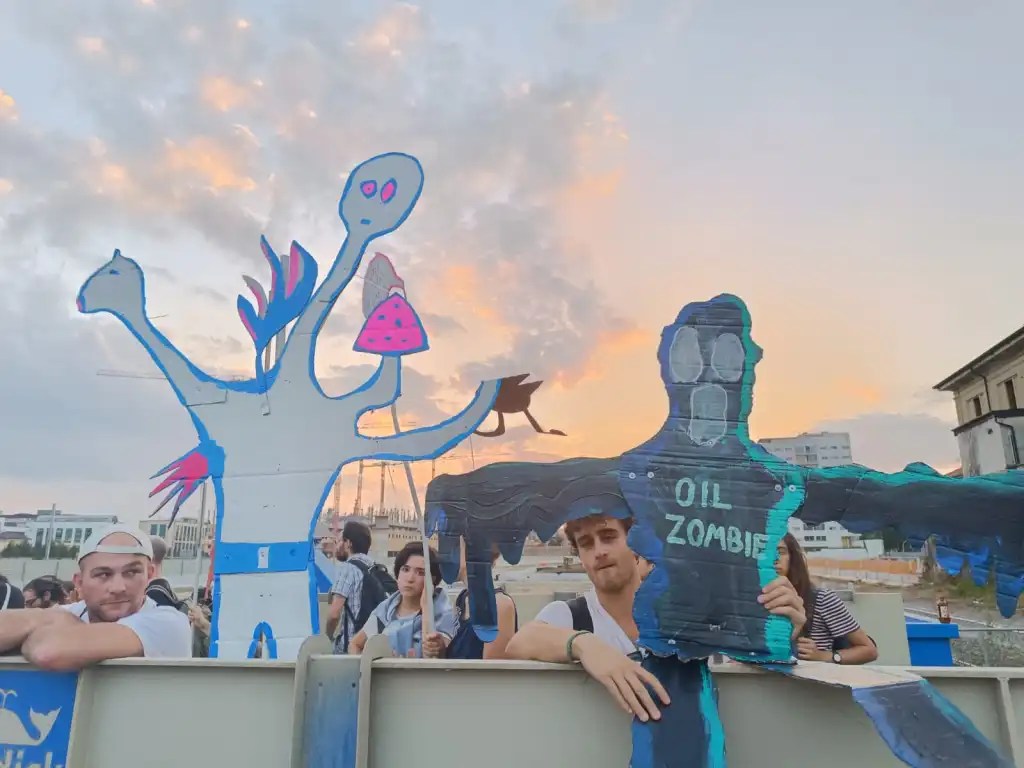
The exhibition presents works largely produced during a three-day workshop at Sale Docks led by Taring Padi, Powernotte, and the Climate Justice League. The result was a series of cardboard puppets and a 15-meter long wooden fish that were used for a water demonstration against the presence of big cruise ships in the Venice lagoon. These objects reject, in practice, any rigid definition, blurring the distinction between artworks and activist props. The exhibition itself reclaims an uncertain status, more the documentation of an action than a display of discrete objects to be contemplated. Alongside the props made for the No Cruise Ships action in the Lagoon and for a climate justice march in Milan, the exhibition features two films by Oliver Ressler (one documenting the 2019 Venice Climate Camp, the other reflecting on the occupation of the Hambach forest), and a series of banners, paintings, and prints by Taring Padi. “Gathering Into The Maelstrom” is also the title of a four-day program that took place at Sale Docks (April 17-20, 2024). The program featured assemblies, screenings, and book launches mainly focused on art and ecology. It also included talks with Palestinian artists and participation in an action in solidarity with Palestinian people during the Israeli attack on Gaza.

Artists

Taring Padi – The Institute of People Oriented Culture Taring Padi was founded in 1998 by a group of progressive art students and activists in response to the Indonesian socio-political upheavals during the country’s reformation era. As such, Taring Padi’s artistic practice is always part of and contextualised within their socio-political and cultural solidarity and action. Street protests, woodcutting workshops, art carnivals, and exhibitions in unorthodox spaces are typical of Taring Padi’s practice of producing collective and individual works. Diverse ad hoc political alliances, farming and fishing communities, as well as their own localities are places where Taring Padi work and learn together. Banners, woodcut posters, and wayang kardus (life-sized cardboard puppets), as well as the ever popular Dendang Kampungan music group are Taring Padi’s artistic formulas to agitate, educate, and organise themselves, their community, and diverse solidarity actions they are involved in. In 2002 Taring Padi became a collective in order to further inclusivity and to facilitate personal dynamic of its members, whilst maintaining its progressive and militant character in realising the potential of art as a tool for social change.

Climate Justice League – A generative co-creation of eco-warriors icons front for climate justice. The Climate Justice League will be present in the form of big cardboard puppets, ready to enter the street and march around the planet. The Climate Justice League has been launched by the Institute of Radical Imagination during the 2023 edition of the World Congress for Climate Justice,with the complicit participation of AndrecoAndrea Natella, Noura Tafeche, Serpica Naro and Dirty Art Department (Jerszy Seymour, Theo Dietz e Rosa Meulenbeld), Institute of Radical Imagination (Marco Baravalle, Emanuele Braga, Maddalena Fragnito, Gabriella Riccio, Federica Timeto) and Le Alleanze dei Corpi. 

Powernotte – Was conceived in 2020 in Venice, Italy by two artists : Davide Salmaso, Rocco Cacciari and a product manager : Giuseppe Bateato. The concept was an artisanal fusion of home design and contemporary art using the mediums of sculpture and painting. The work is an investigation of the animal world within their ecosystems. And there is special attention paid to the totemic value – even amongst the smallest. Each piece is artisanally crafted, hand-made and one of a kind. This slow production, with an attention to artistry is a pushback on the mainstream production model that harms our planet. Our products cannot be identically replicated or mass produced. They are each perfectly unique.

Screened films by Oliver Ressler

  • Ancestral Future Rising, 4K video, 20 min., 2023
  • The Desert Lives, 4K video, 55 min., 2022
  • Not Sinking, Swarming, 4K video, 37 min., 2021

Oliver Ressler is an artist and filmmaker who produces installations, projects in public space, and films on issues such as economics, democracy, migration, the climate crisis, forms of resistance and social alternatives. Ressler has had solo exhibitions at Berkeley Art Museum, USA; Museum of Contemporary Art, Belgrade; Centro Cultural Conde Duque, Madrid; Alexandria Contemporary Arts Forum, Egypt; The Cube Project Space, Taipei; Kunsthaus Graz, Graz and comprehensive solo exhibitions at Wyspa Institute of Art, Gdansk; Lentos Kunstmuseum, Linz; Centro Andaluz de Arte Contemporaneo – CAAC, Seville; SALT Galata, Istanbul; MNAC – National Museum of Contemporary Art, Bucharest; and Cultural Centre of Belgrade. Ressler has participated in more than 400 group exhibitions, including Museo Reina Sofía, Madrid; Van Abbe Museum, Eindhoven; MASSMoCA, North Adams, USA; Centre Pompidou, Paris; the biennials in Prague (2005), Seville (2006), Moscow (2007), Taipei (2008), Lyon (2009), Gyumri (2012), Venice (2013), Athens (2013, 2015), Quebec (2014), Helsinki (2014), Jeju (2017), Kyiv (2017), Gothenburg (2019) and Stavanger (2019), and at Documenta 14, Kassel, 2017 (exhibition organized by EMST). Ressler has completed forty-two films that have been screened in thousands of events of social movements, art institutions and film festivals. A retrospective of his films took place at Centre d’Art Contemporain Genève in 2013. In 2002, Ressler won the first prize at the International Media Art Award of the ZKM in Karlsruhe and he is the first prize winner of the Prix Thun for Art and Ethics Award in 2016. For the Taipei Biennale 2008, Ressler curated an exhibition on the counter-globalization movement, A World Where Many Worlds Fit. A travelling show on the financial crisis, It’s the Political Economy, Stupid, co-curated with Gregory Sholette, has been presented at nine venues (2011-2016).2019–2023 Ressler has directed Barricading the Ice Sheets, a research project on the climate justice movement, funded by the Austrian Science Fund. Configurations of the project were solo exhibitions at Camera AustriaGraz (2021); Museum of Contemporary ArtZagreb (2022); Neuer Berliner Kunstverein (n.b.k.), Berlin (2022); Tallinn Art Hall, Tallinn (2022); LABoral Centro de Arte y Creación Industrial, Gijón (2023); The Showroom, London (2023).

FRANÇOISE VERGÈS | lecture

Wednesday April 17th 15:00-16:30

at IUAV University of Venice,

address Tolentini – Santa Croce, 191, 30125 Venice.

free entry

Françoise Vergès is a political scientist, activist, historian, film producer and public educator. She is the author of A Decolonial FeminismA Feminist History of Violence and the forthcoming A Programme of Absolute Disorder. She is also a senior research fellow at the Sarah Parker Remond Centre for the Study of Racism and Racialisation, UCL.

In the framework of seminars Saperi che liberano curated by Laura Fregolent, Annalisa Sacchi and the Student’s Senate organized by Dipartimento di Culture del progetto info annalisa.sacchi@iuav.itlaura.fregolent@iuav.it

RAISING CARE ACTS OF QUESTIONING | open workshop

Friday April 19th h 14:00-17:00

at Sale Docks (Magazzini del Sale)

Dorsoduro 265, 30123, Venice

free entry

In the framework of Raising Care Platform inciated by Insittute of Radical Imagiantion – Raising Care Acts of Qestioning bring together a group of artists, curators, activists and citizens committed with autonomous care and support networks, is gathering at Sale Docks around questions on the politicization of care, autonomous healthcare strategies and the philosophy of “buen vivir”.

with Sara Buraya Boned, Elena Bleza Cabéz, Pablo García Bachiller, Jesus Carrillo, Theo Prodromidis (Institute of Radical Imagination) with Luciana Cappellari, Basso Carlo, Angela Di Biase, I-Chen Zuffellato (Ambulatorio Sociale di Caracol Olol Jackson, Vicenza), Elisa Adami (Laboratorio Salute Popolare, Bologna)

Photos by Rebecca Legnaro

ART FOR RADICAL ECOLOGIES MANIFESTO | book launch & panel

Friday April 19th h 17:00-19:00

at Sale Docks (Magazzini del Sale)

Dorsoduro 265, 30123, Venice

free entry

Panel with contributors: Françoise Vergès, Manuel Borja Villel, Ashley Dawson, Oliver Ressler, Raluca Voinea, Ovidiu Tichindeleanu, Francesco Martone, Andreco, Maddalena Fragnito, Federica Timeto,, Emanuele Braga, Marco Baravalle.

The book Art for Radical Ecologies (manifesto) (forthcoming bruno, Venice 2024)  is the second volume of the IRI Series whose aim is to produce knowledge in common and around commoning situated at the intersection between art, pedagogy and activism for a transition towards post capitalism.

The Art For Radical Ecologies Manifesto was co-written in a series of assemblies between 2021-2022. Art is a powerful tool for imagining different types of ecological relationships beyond the anthropocentric paradigm. At the same time though, our manifesto states the importance of positioning ourselves as art workers within the struggle for climate justice, starting by refusing the use of art as greenwashing and the sponsorship of oil and fossil fuels companies. Our manifesto tries to look beyond the current neoliberal regime of the arts, with its ties to class, gender, race and species forms of oppression. The book features the voice of artists, museum directors, scholars and activists who address the link between art and ecology from different perspectives: class, decoloniality, transfeminism and antispecism.

Contributors: Léna Balaud , Marco Baravalle, Mike Bonanno The Yes Men, Manolo Borja-Villel, Emanuele Braga, Andrea Conte Andreco, Ashley Dawson, Isa Fremeaux & Jay Jordan: The Laboratory of Insurrectionary Imagination, Oliver Ressler, Francoise Vergès in conversation with Maddalena Fragnito and Marco Baravalle, Tiziana Terranova, Federica Timeto, Ovidiu Țichindeleanu & Raluca Voinea, Rosa Jijon & Francesco Martone in converstaion with Boloh Miranda, Anamaria Garzón, Sofía Acosta Varea.

Edited by: Marco Baravalle, Emanuele Braga, Gabriella Riccio, Federica Timeto (Institute of Radical Imagination)

with the support of FfAI Foundation for Arts Initiatives & L’internationale online

The book is published by bruno

To purchase the publication please contact bruno, Venice

Photos by Rebecca Legnaro

TARING PADI, CLIMATE JUSTICE LEAGUE, POWERNOTTE | open workshop

April 14, 15, 16, from 11:00 to 18:00

at Sale Docks (Magazzini del Sale),

Dorsoduro 265, 30123, Venice.

Registration is free, but needed. 

For info and registration, please write to saledocks@gmail.com

The workshop aims at creating props, puppets, banners and images to be used during a No Grandi Navi (No big Ships) demonstration on Saturday, April 20th. The Committee against big cruise ships of Venice (Comitato NO Grandi Navi) fights for the defence of the Lagoon of Venice from extractivist projects and the presence of unsustainable mega cruises. On Saturday the 20th, a demonstration on the water will leave Venice, pointing towards an island of the Lagoon, with the goal of temporarily occupying it, as a symbolic act of liberation from cruise ships and all the linked projects tampering with the fragile local ecosystem. All the props and images produced during the workshop will empower the demonstration and will lately be part of an exhibition at Sale Docks.

Taring Padi – The Institute of People Oriented Culture Taring Padi was founded in 1998 by a group of progressive art students and activists in response to the Indonesian socio-political upheavals during the country’s reformation era. As such, Taring Padi’s artistic practice is always part of and contextualised within their socio-political and cultural solidarity and action. Street protests, woodcutting workshops, art carnivals, and exhibitions in unorthodox spaces are typical of Taring Padi’s practice of producing collective and individual works. Diverse ad hoc political alliances, farming and fishing communities, as well as their own localities are places where Taring Padi work and learn together. Banners, woodcut posters, and wayang kardus (life-sized cardboard puppets), as well as the ever popular Dendang Kampungan music group are Taring Padi’s artistic formulas to agitate, educate, and organise themselves, their community, and diverse solidarity actions they are involved in. In 2002 Taring Padi became a collective in order to further inclusivity and to facilitate personal dynamic of its members, whilst maintaining its progressive and militant character in realising the potential of art as a tool for social change.

Climate Justice League – A generative co-creation of eco-warriors icons front for climate justice. The Climate Justice League will be present in the form of big cardboard puppets, ready to enter the street and march around the planet. The Climate Justice League has been launched by the Institute of Radical Imagination during the 2023 edition of the World Congress for Climate Justice,with the complicit participation of AndrecoAndrea Natella, Noura Tafeche, Serpica Naro and Dirty Art Department (Jerszy Seymour, Theo Dietz e Rosa Meulenbeld), Institute of Radical Imagination (Marco Baravalle, Emanuele Braga, Maddalena Fragnito, Gabriella Riccio, Federica Timeto) and Le Alleanze dei Corpi. 

Powernotte – Was conceived in 2020 in Venice, Italy by two artists : Davide Salmaso, Rocco Cacciari and a product manager : Giuseppe Bateato. The concept was an artisanal fusion of home design and contemporary art using the mediums of sculpture and painting. The work is an investigation of the animal world within their ecosystems. And there is special attention paid to the totemic value – even amongst the smallest. Each piece is artisanally crafted, hand-made and one of a kind. This slow production, with an attention to artistry is a pushback on the mainstream production model that harms our planet. Our products cannot be identically replicated or mass produced. They are each perfectly unique.

TARING PADI | in conversation with Charles Esche

Wednesday April 17th h 18:30

at Sale Docks (Magazzini del Sale)

Dorsoduro 265, 30123, Venice

free entry

Taring Padi, founded in 1988, is a collective based in Yogyakarta Indonesia “that uses art as a tool for political expression and education for all.” Against an individualistic and market oriented conception of art, “Most Taring Padi works are created collectively and can be divided into four categories: billboards or banners, posters, puppets and popular booklets titled “Terompet Rakyat” (The People’s Trumpet)”. 

Taring Padi, who was part of the documenta fifteen lumbung, will present its work and discuss their practices at Sale Docks, in conversation with Charles Esche, director of the Van Abbemuseum in Eindhoven. 

FILM, CLIMATE JUSTICE AND DECOLONIAL IMAGINATION | conversation and screenings

Thursday April 18th hours 18:15-21:15

at Sale Docks (Magazzini del Sale)

Dorsoduro 265, 30123, Venice

free entry

with Filipa Cesar, Oliver Ressler, Massimiliano Mollona in the framework og Cinema as Assembly platform iniciated by Institute of Radical Imagination

In On the Emergence of an Ecological Class (2022) the late Bruno Latour and Danish sociologist Nikolaj Schultz, sketch an ecological manifesto, which envisions the coming together of different class constituencies against the toxic effect of planetary capitalism. A similar argument is made by Matthew Huber for whom the emergence of a transnational alliance of energy workers, is a fundamental step towards ecological justice. 

But how would such intersectional class alliance look like in the real world? And can suchemphasis on ‘class’ and ‘justice’ avoid being too narrow or Eurocentric, and capture not just the structural relation between pollution and colonialism (Liboiron, 2023) but also differentunderstandings of the environment, not just as a precious resource, but as a living being? 

Departing from Fanon’s claim that all decolonial struggles are as much material as they are struggles for self-representation, this workshop interrogates how cinema addresses ecological justice, in conversation with filmmakers Oliver Ressler and Filipa César.

The two filmmakers’ long-established engagement with environmentalism and the issue of political representation, follow slightly different strategies. Ressler, directly engages with specific environmental issues, collaborating with diverse climate justice movements and communities, and opening a space of poetic prefiguration of grassroots political processes; César casts a broader view of ‘the environment’, intended as a polyphonic space loaded with political, ancestral, material, and poetic resonances, developing long-term collaborations with the community of Malafo, in Guinea Bissau, whereby filming is a process of consolidating relatedness – a form of cine-kinship. 

These two approaches interrogate in different ways the power of film as tool of counter-information and of production of new imaginaries of struggle.  

Film excerpts from Oliver Ressler’ following films will be screened: 

  • Ancestral Future Rising, 20 min., 2023
  • The Desert Lives, 55 min., 2022
  • Not Sinking, Swarming, 37 min., 2021

Film excerpts from Filipa César’s following films will be screened: 

  • Resonance Spiral,92 min., 2024. 
  • Mangrove School,35 min., 2022
  • Spell Reel,96 min., 2017

Filipa César iBerlin-based artist and filmmaker. She is interested in the fictional aspects of documentary, the porous borders between cinema and its reception, and the politics and poetics inherent to moving images. Her praxis takes media as a means to expand and expose counter narratives of resistance to historicism. Since 2011, César has been looking into the origins of cinema in Guinea-Bissau as part of the African Liberation Movement and its imaginaries and cognitive potencies, developing that research into the collective project Luta ca caba inda. She was a participant of the research projects Living Archive (2011-13) and Visionary Archive (2013-15) both organised by Arsenal—Berlin. Selected film festivals include Kurzfilmtage Oberhausen; Curtas Vila do Conde; Forum Expanded-Berlinale; IFFR, Rotterdam, and Cinéma du Réel. Selected exhibitions and screenings include: SFMOMA; São Paulo Biennial; Manifesta 8, Cartagena; Haus der Kulturen der Welt, Berlin; Jeu de Paume, Paris; Kunstwerke, Berlin; NBK, Berlin; Hordaland Art Center, Bergen; Futura, Prague; Khiasma, Paris; Tensta konsthall, Spånga; Mumok, Vienna; MoMA, New York; Harvard Film Museum, Boston.

Oliver Ressler is an artist and filmmaker who produces installations, projects in public space, and films on issues such as economics, democracy, migration, the climate crisis, forms of resistance and social alternatives. Ressler has had solo exhibitions at Berkeley Art Museum, USA; Museum of Contemporary Art, Belgrade; Centro Cultural Conde Duque, Madrid; Alexandria Contemporary Arts Forum, Egypt; The Cube Project Space, Taipei; Kunsthaus Graz, Graz and comprehensive solo exhibitions at Wyspa Institute of Art, Gdansk; Lentos Kunstmuseum, Linz; Centro Andaluz de Arte Contemporaneo – CAAC, Seville; SALT Galata, Istanbul; MNAC – National Museum of Contemporary Art, Bucharest; and Cultural Centre of Belgrade. Ressler has participated in more than 400 group exhibitions, including Museo Reina Sofía, Madrid; Van Abbe Museum, Eindhoven; MASSMoCA, North Adams, USA; Centre Pompidou, Paris; the biennials in Prague (2005), Seville (2006), Moscow (2007), Taipei (2008), Lyon (2009), Gyumri (2012), Venice (2013), Athens (2013, 2015), Quebec (2014), Helsinki (2014), Jeju (2017), Kyiv (2017), Gothenburg (2019) and Stavanger (2019), and at Documenta 14, Kassel, 2017 (exhibition organized by EMST). Ressler has completed forty-two films that have been screened in thousands of events of social movements, art institutions and film festivals. A retrospective of his films took place at Centre d’Art Contemporain Genève in 2013. In 2002, Ressler won the first prize at the International Media Art Award of the ZKM in Karlsruhe and he is the first prize winner of the Prix Thun for Art and Ethics Award in 2016. For the Taipei Biennale 2008, Ressler curated an exhibition on the counter-globalization movement, A World Where Many Worlds Fit. A travelling show on the financial crisis, It’s the Political Economy, Stupid, co-curated with Gregory Sholette, has been presented at nine venues (2011-2016).2019–2023 Ressler has directed Barricading the Ice Sheets, a research project on the climate justice movement, funded by the Austrian Science Fund. Configurations of the project were solo exhibitions at Camera AustriaGraz (2021); Museum of Contemporary ArtZagreb (2022); Neuer Berliner Kunstverein (n.b.k.), Berlin (2022); Tallinn Art Hall, Tallinn (2022); LABoral Centro de Arte y Creación Industrial, Gijón (2023); The Showroom, London (2023).

CLIMATE ASSEMBLY | Museum of the Commons

Friday April 19th h 10:00-12:00

at Sale Docks (Magazzini del Sale)

Dorsoduro 265, 30123, Venice

free entry

Museum of the Commons Climate Assembly on April 19th on the role of L’Internationale art and cultural  institutions in the present environmental and geopolitical crisis with participating institutions MSU (Zagreb), Museo Reina Sofia (Madrid), MACBA (Barcelona), M_HKA (Antwerp), MSN (Warsaw), Salt (Istanbul),  Van Abbemuseum (Eindhoven), with Institute of Radical Imagination (Naples), tranzit.ro (Bucharest, Cluj and Iaşi) HDK Valand (Gothenburg), NCAD and IMMA (Dublin).

Museum of the Commons. This is the fourth cooperative project led by L’Internationale, focusing on the themes of climate, translocal cooperation, and artistic strategies of healing and repair. Museum of the Commons weaves together three transversal thematic threads corresponding to key challenges contemporary societies are facing: Climate tackles issues of the current planetary climate crisis, the sustainability of institutional, artistic and cultural practices and processes, and the urgency of transforming our politics, societies, cultures and ways of life. Situated Organisations queries the role of museums and art organisations as actors in complex social networks and ecosystems, to seek new ways of democratizing institutions and to render them more open, inclusive and useful. The final thread, Past in the Present, focuses on the crucial roles our local and shared histories hold in constituting contemporary identities, politics, societies and cultures, investigating the persistence and long-lasting impact of historical and current environmental and colonial violence. In doing so, the confederation seeks to mobilise art and culture as strategic tools in processes of healing, reconstruction and repair of damage that has been inflicted.

L’Internationale

What: L’Internationale is a European confederation of museums, arts organisations and universities, founded in 2009. It takes its name from the 19th century worker’s anthem written by Eugène Pottier

Why: L’Internationale was founded to offer an alternative model to globalising art institutions that replicate the structures of multinational powers and their centralised distribution of knowledge. Believing in the power of art to be a platform for the discussion of a renewed social contract, we advocate for a new internationalist model that challenges exclusivity and emphasizes common heritage through interconnected archives and constituent-led approaches, fostering individual and collective emancipation.

Who: In its current configuration L’Internationale brings together eight major European art institutions: HKW (Berlin, Germany); MSU (Zagreb, Croatia); Museo Reina Sofía(Madrid, Spain); MACBA (Barcelona, Spain); M HKA, (Antwerp, Belgium); MSN(Warsaw, Poland), Salt (Istanbul, Turkiye), Van Abbemuseum (Eindhoven, the Netherlands), with Institute of Radical Imagination (Naples,Italy), tranzit.ro (Bucharest, Cluj and Iasi, Romania),and VCRC (Kyiv, Ukraine). L’Internationale has three academic partners: HDK-Valand (Gothenburg, Sweden), NCAD (Dublin, Ireland) and ZRC SAZU(Ljubljana, Slovenia) and three associate organisations IMMA (Dublin, Ireland), MG+MSUM (Ljubljana, Slovenia) and WIELS (Forest, Belgium).

How: L’Internationale’s principle funder is the Creative Europe Programme of the European Union. The current EU funded programme, ‘Museum of the Commons’ runs from February 2023 – December 2026 and includes a €2m grant that is match funded by the partners of the programme. The confederation works across programming (exhibitions, seminars, schools, residencies, public programmes) research and publishing (through L’Internationale Online), and communication.

Photos by Rebecca Legnaro

POETICAL ECONOMY AND THE QUESTION OF FUNDING | Yazan Khalili talk

Friday April 19th h 19:15-21:00

at Sale Docks (Magazzini del Sale)

Dorsoduro 265, 30123, Venice

free entry

This talk will go through different examples and practices from Palestine that have been actively trying to produce affirmative critique of the structures of funding and the financialization of the cultural economy. What structures can be built, what infrastructures can be used, how collective work can be imagined, and how to work between theory and practice. 

Yazan Khalili is a visual artist, architect, and cultural activist. Khalili’s photography is detailed, reflective and full of intent. Using photography and the written word, Khalili unpacks historically constructed landscapes. Borrowing from cinematic language, images become frames where the spectator embodies the progression of time and narratives. He weaves together parallel stories over the years, forming both questions and paradoxes concerning scenery and the act of gazing, all of which are refracted through the prism of intimate politics and alienating poetics. In particular, he focuses on the effect of geographical distance on our rendering of territory, and its ability to heighten or arrest our political and sentimental attachments.

Born 1981. Works in and out of Palestine, currently based in Amsterdam, Netherlands, where he is a PhD candidate at Amsterdam School for Cultural Analysis (ASCA), University of Amsterdam. He is an architect, visual artist, and cultural producer. His works have been exhibited in several major exhibitions, including among others: Documenta fifteen 2022, KW, Berlin 2020, MoCA Torento 2020, New Photography, MoMA 2018, Jerusalem Lives, Palestinian Museum, 2017, Post-Peace, Kunstverein Stuttgart 2017, Shanghai Biennial 2016, Sharjah Biennial 2013. In 2020 he co-founded Radio Alhara, and in 2019 he co-founded The Question of Funding collective.

Yazan Khalili received a degree in architecture from Birzeit University in 2003 and in 2010 received his MA degree from the Centre for Research Architecture at Goldsmith’s College, University of London, and in 2015 his MFA degree at Sandberg Institute, Rietveld Academy, Amsterdam. He was one of the founding members of Zan Design Studio (2005-2010). He was the production coordinator for Sharjah Biennials 9 & 10, and the technical director of the inaugural exhibition of the Palestinian Museum “Jerusalem Lives” (2017). He co-curated Young Artist of the Award (YAYA) 2012, The City | The Image symposium with Goethe Institute, Ramallah 2012, The Long Journey exhibition, the UNRWA Audio-Visual archive for Palestine refugees, in 2013, and Debt exhibition at KSCC in 2018. In 2015, he co-organized Walter Benjamin in Palestine workshop and symposium, and Marx: The Ultimate Contemporary in 2018.

He is the winner of Extract V young artist prize 2015.
He has been the artistic director of Khalil Sakakini Cultural Centre between 2015 until end of 2019, he was the Co-Chair of Photo discipline at MFA program at Bard College, NY, till 2022, and guest artist in residence at Rijksakademie, Amsterdam till 2022.

Photos by Rebecca Legnaro

PROTECT THE VENICE LAGOON. ACTION IN VENICE AGAINST CRUISE SHIPS | From the city to the lagoon… SIT-IN AND WATER PARADE

Saturday May 25th

Meeting point: ZATTERE from 12:30: music, food, interventions.

2 PM DEPARTURE towards Punta Fusina
Meeting point for the mainland: 3:30 PM PUNTA FUSINA (ACTV stop)
Let’s defend our Lagoon!
Comitato No Grandi Navi, Venezia

nograndinavi #venice #marghera #portomarghera #Lagoon

The 25th of May is the date we have been waiting for, is finally approaching! We set off from Zattere, a symbolic place in the fight against large cruise ships, heading towards Porto Marghera, where the cruise ships thought they would be undisturbed. Despite a first important victory in 2021 when, after 10 years protests, cruise ships were finally banned from Venice, the struggle is not over. Indeed, the unwelcome presence of cruise ships, still threatens our Lagoon. The idea of the companies, the port, the municipality, the region, and the
government is to make the Marghera docks (in the Venetian mainland) permanent. Not only that, they want to bring the ships back into the city by moving millions of tonnes of toxic sludge, through
massive dredging, further tampering with a part of the Lagoon already historically strained by a century of unsustainable industrial policies. Moreover, this is an illegal plan, against what was
established by the Draghi Government, which indicated the construction of an offshore port as the definitive solution. As our history shows, the city and the Lagoon are made of the same substance. You cannot defend the former and leave the latter at the mercy of speculators and their greed for profit. The fight to defend
the social biodiversity of the city is no different from that to defend the biodiversity of the water city. Thanks to the contribution of Taring Padi and Powernotte who worked with dozen of activists at Sale Docks last April, the parade will be led by a large aquatic creature, a spirit animal and a protector of the Lagoon. The artists also produced a series of large cardboard puppets and masks that will ply the
waters together with activists.

Using the props created during the workshop with Taring Padi, Powernotte and the Climate Justice League, No Grandi Navi (No big Ships) demonstration on Saturday, May 25th. The Committee against big cruise ships of Venice (Comitato NO Grandi Navi) fights for the defence of the Lagoon of Venice from extractivist projects and the presence of unsustainable mega cruises. On Saturday May 25th a demonstration on the water will leave Venice, pointing towards an island of the Lagoon, with the goal of temporarily occupying it, as a symbolic act of liberation from cruise ships and all the linked projects tampering with the fragile local ecosystem. All the props and images produced during the workshop will empower the demonstration and will lately be part of an exhibition at Sale Docks.

The committee No Big Cruiseship (Comitato No Grandi Navi) The battle for the expulsion of large ships from the San Marco Basin and the lagoon must be participatory and involve as many movements and citizens as possible, from Venice and Mestre. For this reason, the coordination of the associations that has restarted the battle in recent years have decided to change their skin, to give a precise signal of novelty and discontinuity with the past.

The movement changes its name: it is now called “No Grandi Navi Committee – Lagoon Bene Comune”, where the reference to the lagoon is a precise choice of content, because Venice does not exist without a healed and balanced lagoon that defends it. For this reason, it is not enough to be satisfied with not seeing the large ships in the San Marco Basin or with seeing half of them: cruise tourism must be expelled from the lagoon to allow the start of real hydrodynamic and morphological recovery interventions;
The movement was born on a common platform of analysis and requests, summarized in the “What We Ask” page. For further information, we recommend reading our “White Paper”. Each individual member of the Committee will maintain their own autonomy of initiatives, as long as they do not conflict with the freely accepted common platform.

GATHERING INTO THE MAELSTROM | Platform, Action, Exhibition

Curated by Institute of Radical Imagination & Sale Docks

in the framework of L’internationale EU project Museum of the Commons

location Sale Docks, (Magazzini del Sale), Dorsoduro 265, 30123, Venice. All events are free entrance.

PROGRAM

Gathering into the Maelstrom in Venice at Sale Docks is a four-days program curated by Institute of Radical Imagination (IRI) and Sale Docks in the framework of Museum of the Commons, a cooperation project by L’Internationale a European confederation of museums, arts organizations and universities.

Our world is warming up causing immense turbulence: the historical moment we are living in is a frightening vortex. War is at the center of the vortex, a black hole from which we can no longer escape. Gaza represents a point of no return in history, claiming for the end of colonial processes that have been going on for centuries. Capitalist extractivism has brought the planet to the brink of collapse, causing energy crisis, massive migratory processes, and a fascist and xenophobic crisis in those communities on the belief they have some form of privilege.

It is within this maelstrom that Institute of Radical Imagination and Sale Docks launched back in 2021 the Art For Radical Ecologies Platform, an international community of artists, academics, and art workers who came together and wrote a manifesto by engaging in discussions with eco-activists from around the world and participating in struggles.

Since the moment of its foundation the Institute of Radical Imagination has tried to offer itself as a platform for those forms of resistance, and to think about their possible intersections with art. The same goes for Sale Docks, a space that was occupied in Venice in 2007 and that has, since then, become a reference for international art workers’ struggles and local activist groups, having developed an institutional model alternative to the typical neoliberal art institution and its links to mass tourism and toxic philanthropy. 

The Gathering into the Maelstrom –  from 17th to 20th of April in Venice at Sale Docks Dorsoduro 265 – is an invitation to learn to inhabit this vortex, rooting artistic production in ecological struggles, and transforming the field of contemporary art into a political territory. To generate a Museum of the Commons we can not avoid questioning the toxicity that permeates institutions and, at the same time, building non-capitalistic, non-colonial, non-patriarchal, and non-anthropocentric alliances.
Opening on Wednesday 17th, the first three days of the program present talks by representatives of decolonial thought like François Vergès and Yazan Khalili, screenings of  films by Oliver Ressler, the launching of Art for Radical Ecologies Manifesto book, Museum of the Commons Climate Assembly, and an exhibition of props realized in a workshop with Taring Padi, IRI and Powernotte. The fourth day features an action on the water in collaboration with Comitato No Grandi Navi (the local Committee Against Big Cruise Ships). The goal of the action is to temporarily occupy an island in an area where Cruise Ships transit and dock, posing a serious threat to the fragile ecosystem of the Lagoon and to a city like Venice already overwhelmed by mass tourism.

Gathering Into The Maelstrom is part of EU project Museum of The Commons internationaleonline.org

Co-Funded by the European Union. Views and opinions expressed are however those of the author(s) only and do not necessarily reflect those of the European Union or the European Education and Culture Executive Agency (EACEA). Neither the European Union nor EACEA can be held responsible for them.

RED GREEN, BLACK AND WHITE | Performance

English | Croatian | Italian

RED GREEN, BLACK AND WHITE

a performative inquiry by Institut of Radical Imagination and MSU Zagreb in the framework of L’internationale EU project Museum of the Commons

MZU Zagreb, Sunday January 21st 2024 at 4pm

idea, dramaturgy, direction : Emanuele Braga, Gabriella Riccio  (Institute of Radical Imagination) & Anna Rispoli

based on an concept by Anna Rispoli

interviews, text : Emanuele Braga, Gabriella Riccio, Marco Baravalle (Institute of Radical Imagination) & Anna Rispoli + 13 inhabitants of Zagreb 

with the participation of : Hrvoje Laurenta, Farzaneh Sourighiasvand, Marko Pogačar, Leonarda Šmigmator, Matko Radić, Luka Tomac, Hana Matović, Azra Svedružić, Mirjana Vidaković, Hana Sirovica, Jelena Androić, Ana Škegro, Petra Matić, Emanuele Braga, Gabriella Riccio, Anna Rispoli and Inicijativa za slobodnu Palestinu / Free Palestine Initiative Croatia

Production Institute of Radical Imagination

Co-production MSU Zagreb

Duration: ca. 60’

Language: Croatian

Date: Sunday 21tst Jan at 4pm


Koncept, dramaturgija, režija: Emanuele Braga, Gabriella Riccio (Institut za radikalnu imaginaciju) i Anna Rispoli

Bazirano na ideji Anne Rispoli

Intervjui i tekst: Emanuele Braga, Gabriella Riccio, Marco Baravalle (Institut za radikalnu imaginaciju) i Anna Rispoli uz 13 građana Zagreba

Sudjeluju: Hrvoje Laurenta, Farzaneh Sourighiasvand, Marko Pogačar, Leonarda Šmigmator, Matko Radić, Luka Tomac, Hana Matović, Azra Svedružić, Mirjana Vidaković, Hana Sirovica, Jelena Androić, Ana Škegro, Petra Matić, Emanuele Braga, Gabriella Riccio, Anna Rispoli i Inicijativa za slobodnu Palestinu

Produkcija: Institut za radikalnu imaginaciju (Institute of Radical Imagination)

Koprodukcija: MSU Zagreb

Trajanje izvedbe: 60’

Tekst: hrvatski

based in Art for Radical Ecologies Manifesto

RED GREEN, BLACK & WHITE. Fifth of a series of performed militant inquiries Red Green, Black and White is based on the interviews of 13 citizens and activists for social and climate justice. Zooming dizzily between the urban dimension of Zagreb and the global geo-political one, the work finds the words to touch on the hot spots of ethical, ecological and political responsibility today. Because it is no longer possible to remain silent without becoming complicit.

temelji se na Manifest Umjetnosti za radikalne ekologije

CVRENO ZELENO, CRNO I BIJELO. Peto u nizu provedenih aktivističkih istraživanja Instituta za radikalnu imaginaciju, „Crveno, zeleno, crno i bijelo“ temelji se na intervjuima trinaest građana i aktivista za društvenu i klimatsku pravdu. Intenzivno se fokusirajući kako na urbani Zagreb, tako i na širi kontekst globalne geopolitike, rad pronalazi riječi kojima dotiče žarišta etičke, ekološke i političke odgovornosti danas. Jer svaka daljnja šutnja postaje suučesništvo. Ovaj program dio je projekta Museum of the Commons, u sklopu Internacionale, saveza 14 europskih muzeja i drugih kulturnih institucija za suvremenu umjetnost, a održat će se u nedjelju, 21. siječnja s početkom u 16 sati u predvorju MSU-a.

basato su Art for Radical Ecologies Manifesto

ROSSO VERDE, BIANCO & NERO. Quinto di una serie di inchieste militanti Red Green, Black and White si basa sulle interviste di 13 cittadini e attivisti per la giustizia sociale e climatica. Zoomando vertiginosamente tra la dimensione urbana di Zagabria e quella geopolitica globale, il lavoro trova le parole per toccare i punti caldi della responsabilità etica, ecologica e politica oggi. Perché non è più possibile tacere senza diventare complici.

Photos courtesy of Gabriella Riccio, Emanuele Braga, Marija Tereza Murina 

BIENNALOCENE

Can art be political prefiguration?

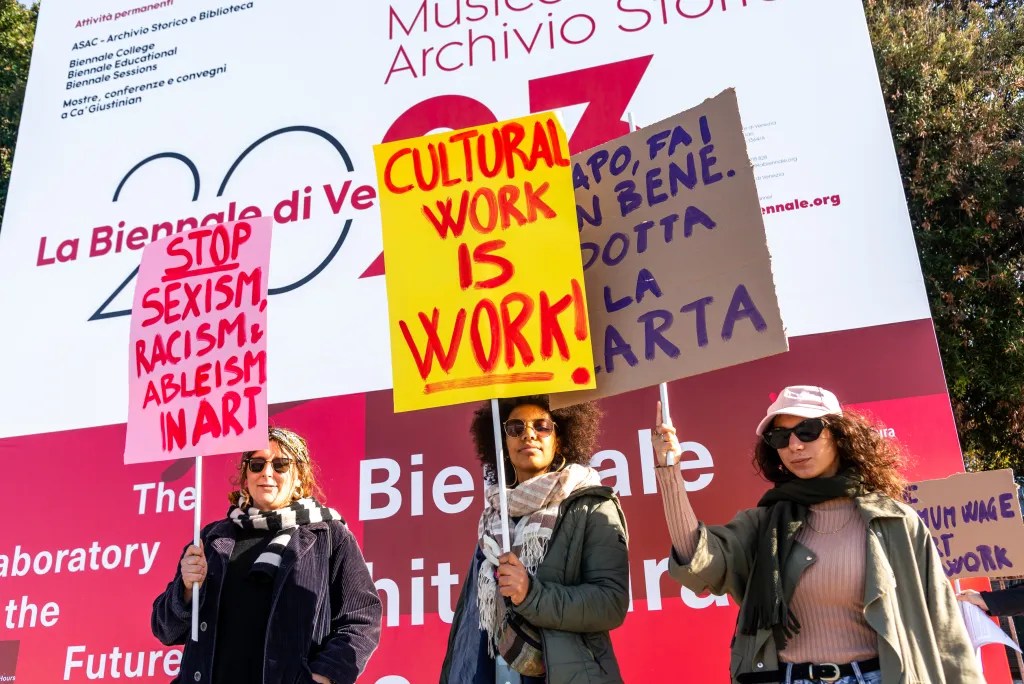
Biennalocene is an assembly of art workers from Venice. It was born in May 2023 from a performative investigation by Sale Docks and Institute of Radical Imagination. . The assembly stands as a place of self-organization and mobilization against the precarious and exploitative conditions that characterize the arts sector in our city. Over the course of several assemblies from June to October 2023, hundreds of workers collectively wrote the METROPOLITAN CHARTER OF CULTURAL WORK. Its uniqueness (in a sector where precarization is favored by fragmentation and individualization) is that it was born out of a cross-cutting confrontation (facilitated by Sale Docks, Institute of Radical Imagination, ADL Cobas, and Mi Riconosci?), with the intention of affirming the rights of workers who are diverse in terms of tasks, contractualization, and professional aspirations: cultural mediators, cleaners, artists, performers, curators, museum guards, freelancers and waged workers. Our campaign aims to get as many of the city’s cultural institutions (museums, foundations, cooperatives, and businesses) to adopt the Charter, taking a decisive step forward on the terrain of labor rights in the arts and culture sector. Biennalocene is the era when workers’ rights transform our city!

Biennalocene è un’assemblea di lavoratorə dell’arte e della cultura di Venezia. È nata nel maggio 2023 da una performance-inchiesta di Sale Docks e dell’Institute of Radical Imagination. L’assemblea si pone come luogo di auto-organizzazione e di mobilitazione contro le condizioni di precarietà e sfruttamento che caratterizzano il settore artistico nella nostra città. Nel corso di diverse assemblee, da giugno ad ottobre 2023, centinaia di lavroatorə hanno scritto collettivamente la CARTA METROPOLITANA DEL LAVORO CULTURALE. La sua particolarità (in un settore in cui la precarizzazione è favoritadalla frammentazione e dall’individualizzazione) è quella di essere nata da un confronto trasversale (facilitato da Sale Docks, Institute of Radical ImaginationADL Cobas e Mi Riconosci?), con l’intento di affermare i diritti di lavoratorə diversə per mansioni, contrattualizzazione e aspirazioni professionali: mediatorə culturali, addettə alle pulizie, artistə, performer, curatorə, guardasala, lavoratorə dipendenti o autonomə. La nostra campagna punta a far sì che il maggior numero si istituzioni culturali cittadine: musei, fondazioni, cooperative e imprese adottino la Carta, facendo un passo avanti decisivo sul terreno dei diritti del lavoro nel settore artistico e culturale. Biennalocene è l’era in cui i diritti dei lavoratorə trasformano la nostra città!

METROPOLITAN CHARTER OF CULTURAL WORK // CARTA METROPOLITANA DEL LAVORO CULTURALE

Adopt the Chart / Adotta la Carta 👉 BIENNALOCENE.COM

ART FOR RADICAL ECOLOGIES MANIFESTO

1/ Art is part of the world. Art for Radical Ecologies is part of the struggles to change it.

2/ Art is a promise of other worlds, but it is in the actual world that promises must be kept participating in the struggles for its transformation.

3/ New materialism and historical materialism together act against exploitation and domination. Speculation opens up to potential becoming counter-hegemonic social practice, otherwise it is neutralization and capture.

4/ In our current environmental breakdown, the necessary condition for autonomy of art is its autonomy from the neoliberal-extractivist apparatus. Art workers and art institutions must reflect about their positionality and act accordingly.

5/ Art for Radical Ecologies is abolitionist, against police repression, fascism, racism, colonialism and genocide. It is grounded in the voices of the oppressed and is our breath of liberation.

6/ The revolutionary subject is not only human. Transversal and interspecies alliances can powerfully act against ventriloquisms, dualisms, and othering hierarchies. 

7/ Art for Radical Ecologies makes visible the human and other-than-human vulnerabilities and precariuosness and takes care of them.

8/ Dismantling the foundations of colonial privilege in this era of environmental and democratic collapse is paramount. Art for Radical Ecologies opens up space against the contention and detention of migrating humans and  other-than-humans. 

9/ Struggles are interconnected, because so are oppressions. Ideological and material extractivism abusing lives as resources, means or products must end now. In shared life, liberation is total. 

10/ End Fossil is the priority. Any complicity with biocapitalism, extractive industry and financial greenwashing in and outside art institutions must end.

11/ Art for Radical Ecologies is either anti-capitalist or it is not. Capitalism is the driver of environmental breakdown. There is no such thing as sustainable capitalism. Technosolutionism and transition reformism are bullshit.

12/ Art for Radical Ecologies stands with technologies that free human and other-than human life and do not perpetuate the exploitation of productive and reproductive labor.

13/ Art for Radical Ecologies is generative yet anti-productivist. It embraces degrowth and multiplies questions, terminologies, connections and scenarios.

14/ Art institutions funded by toxic philanthropy must be abolished. Anti-museums and alter-institutions are the forms that we adopt for common instituent imagination.

15/ As art workers we inhabit spaces of race, class, gender privilege as well as subordination. We  stand with those whose freedoms are menaced. We reclaim freedom of speech and stand against censorship.

16/ Dystopia is privilege. Enough with the apocalyptic talk, it’s not the end of the world, but of global capitalism and its toxic imaginaries. Art repairs temporalities and liberates futurity, opening horizons beyond capitalist realism and catastrophism.

Published on November 3rd, 2023 by Institute of Radical Imagination

Signatures by Individuals and Organisaitons

  1. Institute of Radical Imagination
  2. Emanuele Braga, artist, Milano, Italy
  3. Gabriella Riccio, artist, Napoli, Italy
  4. Marco Baravalle, researcher and curator, Venice, Italy
  5. Maddalena Fragnito, artist and researcher, Milano, Italy
  6. Federica Timeto, professor Ca’ Foscari Uniersity, Venice, Italy
  7. Andreco, Artist, Rome, Italy
  8. Climate Art Project, Cultural Association, Rome, Italy
  9. Ashley Dawson, researcher and activist, New York / USA
  10. Oliver Ressler, artist and filmmaker, Vienna, Austria
  11. Sale Docks, Venice, Italy
  12. Mao Mollona, London, UK
  13. Elena Blesa Cabéz, mediator and researcher, Barcelona, Spain
  14. Sara Buraya Boned, cultural worker, Madrid, Spain
  15. Francesco Martone, Artsforthecommons/int’l Tribunal on the Rights of Nature, Italy/Ecuador
  16. Rosa Jijon, Artist at Artsforthecommons/Global Alliance on the Rights of Nature, Italy/Ecuador
  17. Debra Solomon, infrastructure activist / artist / planner, The Netherlands
  18. The Urbaniahoeve Foundation, social design lab for urban and regenerative agricultures, The Netherlands
  19. Anna Viola Hallberg, artist/curator, Stockholm/Sweden
  20. Nick Aikens, editor, curator, researcher, Brussels, Belgium / Gothenburg, Sweden
  21. André Alves, Artist Educator Writer, Porto/Portugal
  22. Denise Araouzou, Curator, Researcher, Cyprus / Italy
  23. Amalia Caputo, artist, Venezuela/USA
  24. Jules Coumans, Artist, Amsterdam Netherlands
  25. Theo Dietz, artist, Amsterdam, Netherlands
  26. Rita Barreira, Researcher/ Cultural Worker, Lisbon/ Portugal
  27. amalia caputo, artist, Venezuela/USA
  28. Robert Rickli, Artist, Prague , Czech Republic
  29. Sitesize, Artistic and cultural association, Barcelona / Catalonia
  30. Mario Framis Pujol, Farmer researcher, Barcelona, Spain
  31. Leonardo, Student and writer, Milano/ Italy
  32. Martina Riescher, Multidisciplinary Artist, Munich/Germany, L’Aquila/Italy
  33. Koohan Paik-Mander, Retired, Honokaa, USA
  34. Nathalie Trutmann, Artist, Suresnes
  35. Valeria, artist sanguini, Italy
  36. Leila Topic, art historian, Zagreb/ Croatia
  37. Stevan Vukovic, Curator, Belgrade, Serbia
  38. Sonia Rolak, artist, Venice, Italy
  39. Max Provenzano, Artist, Lisbon
  40. Giulia Furlanetto Martina, Student, Venezia
  41. Giulia Gregnanin, Director, Helmsdale
  42. Ignacio Pérez Pérez, Artist, Kankaanpää, Finland
  43. Andrea Di Turi, Milan, Italy
  44. Greta Ttrisciani, cultural manager, Montegranaro-Italy

ASSEMBLEA BIENNALOCENE Atto V – PRESIDIO

PRESIDIO BIENNALOCENE

Appello a tutte le lavoratrici e i lavoratori dell’arte di Venezia.

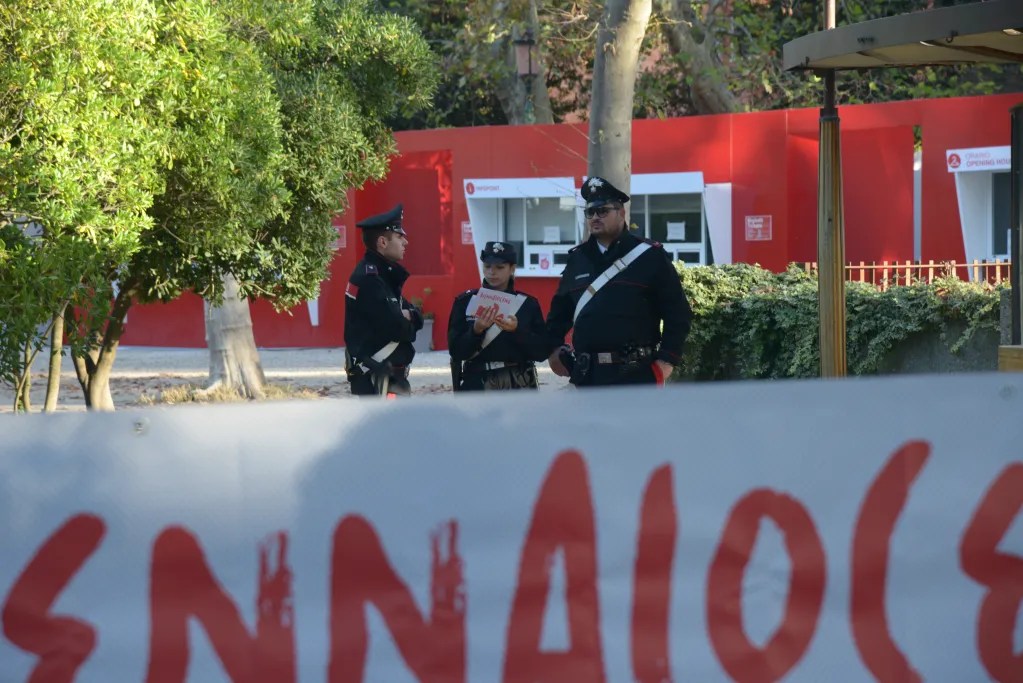
Sabato 28 ottobre, contestualmente all’apertura dei cancelli dei Giardini della XVIII Biennale Architettura di Venezia, durante un sit in verrà presentata pubblicamente la Carta Metropolitana del lavoro culturale: la prima tappa di un percorso chiamato Biennalocene, assemblea che unisce lavoratrici e lavoratori dell’arte e della cultura e studenti, nata a giugno su impulso di Sale Docks, Institute of Radical Imagination, Mi Riconosci e ADL Cobas.
Presenteremo la Carta davanti ai cancelli di Biennale perché l’ecosistema di padiglioni ed eventi collaterali che essa genera, presenta molti dei problemi che abbiamo riscontrato: l’adozione di contratti che prevedono paghe da 5-6 euro lordi orari (come il Multiservizi), ritmi di lavoro incessanti e vessazioni di vario genere. Sabato 28 ottobre inviteremo la Biennale ad incontrarci per discutere dell’adozione della Carta e le chiederemo, da subito, di farsi carico di questi abusi, di prendere provvedimenti affinché le condizioni lavorative dei suoi dipendenti vengano estese a tutte le lavoratrici e lavoratori di partecipazioni nazionali, padiglioni esterni ed eventi collaterali marchiati Biennale.
Ecco alcune delle richieste contenute nella Carta che verrà resa pubblica il 28.

  • Salario minimo a 10 € l’ora
  • Contratto Federculture
  • Stage retribuiti
  • No alle false partite IVA
  • …e molto altro ancora!

Ti aspettiamo, sabato 28 ottobre, alle 9, ai Giardini!

BIENNALOCENE DEMOSTRATION

Call to all art workers of Venice.

On Saturday 28 October, at the same time as the opening of the gates of the Gardens of the XVIII Venice Architecture Biennale, the Metropolitan Charter of cultural work will be publicly presented during a sit-in: the first stage of a journey called Biennalocene, an assembly that unites workers from the art and culture and students, born in June on the initiative of Sale Docks, Institute of Radical Imagination, Mi Rittici and ADL Cobas.
We will present the Charter in front of the gates of the Biennale because the ecosystem of pavilions and collateral events that it generates presents many of the problems that we have encountered: the adoption of contracts that provide wages of 5-6 euros gross per hour (such as Multiservices), incessant work rhythms and harassment of various kinds. On Saturday 28 October we will invite the Biennale to meet to discuss the adoption of the Charter and we will ask it, immediately, to take charge of these abuses, to take measures to ensure that the working conditions of its employees are extended to all workers of national participations , external pavilions and collateral events branded Biennale.
Here are some of the requests contained in the Charter which will be made public on the 28th.

  • Minimum wage of €10 per hour
  • Federculture contract
  • Paid internships
  • No to false VAT numbers
  • …and much more!

We’ll be waiting for you on Saturday 28 October, at 9am, at the Giardini!

NO JUSTICE NO PEACE

No Justice No Peace is a syllabus initiated by Madu and @sandra_malecane available on HackMD for everyone to contribute to. An attempt towards awareness.

ENG
This document compiles writings, reports, images, and narratives from people living in Palestine and Israel, as well as those who have dedicated years to comprehending the context.

Let’s pause and lend an ear to these voices, against the sensationalism of mainstream media and the rapid pace of social networks.

Inside, you will discover articles, podcasts, contact information for individuals and grassroots organisations, book recommendations, films, and more.

ITA
Questo documento raccoglie scritti, resoconti, riflessioni e parole di chi vive in Palestina e in Israele, e di chi studia il contesto da anni.

Prestiamo ascolto a queste voci, contro il sensazionalismo dei media mainstream e il ritmo incalzante dei social network.

All’interno troverete articoli, podcast, voci di persone e organizzazioni locali, libri, film e altro ancora.

ASSEMBLEA DI BIENNALOCENE Atto IV

Sale Docks, Mi Riconosci?, Institute of Radical Imagination e ADL Cobas

Quartaassemblea pubblica di #BIENNALOCENE

🗓09/10/23
🕦19:30
📍Sale Docks, Dorsoduro 265, Venezia

Obiettivo: verso una presentazione pubblica della Carta metropolitana del lavoro culturale.

Sale Docks @saledocks con @miriconosci.beniculturali@adl_cobas e @instituteofradicalimagination_

Tutt* sono benvenut*

Sale Docks, Mi Riconosci?, Institute of Radical Imagination & ADL Cobas

Fourth public assembly of #BIENNALOCENE

🗓09/10/23
🕦19:30
📍Sale Docks, Dorsoduro 265, Venice

Goal: towards a public presentation of the Metropolitan Charter of Cultural Work.

Sale Docks @saledocks con @miriconosci.beniculturali@adl_cobas e @instituteofradicalimagination_

All are welcome

ART FOR RADICAL ECOLOGIES (MANIFESTO) ASSEMBLY #3 | WCCJ 2023

ENGLISH

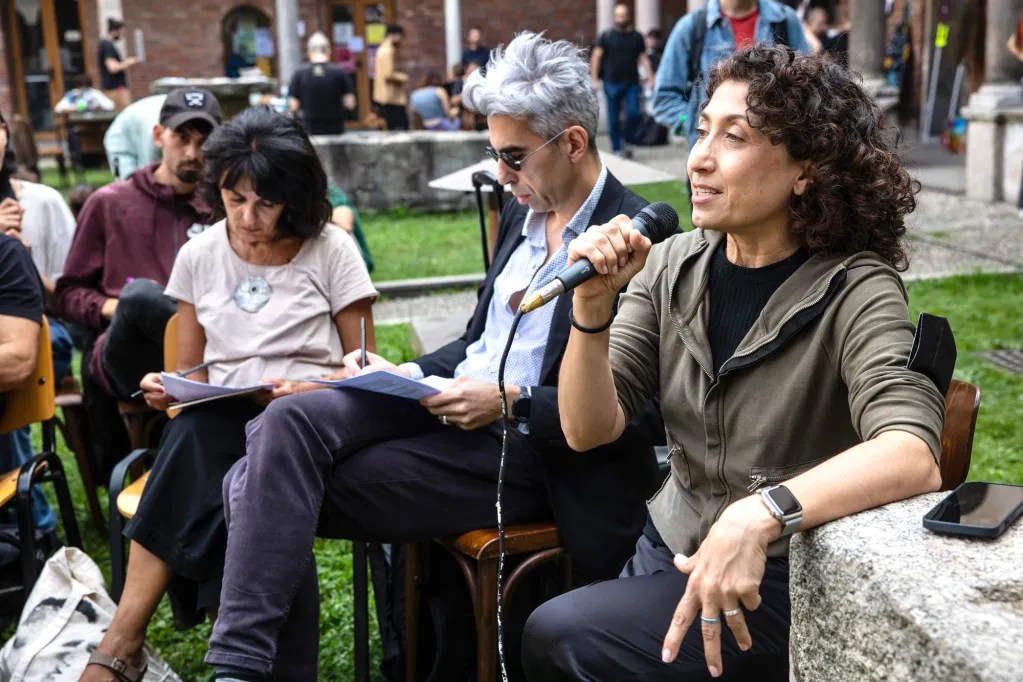
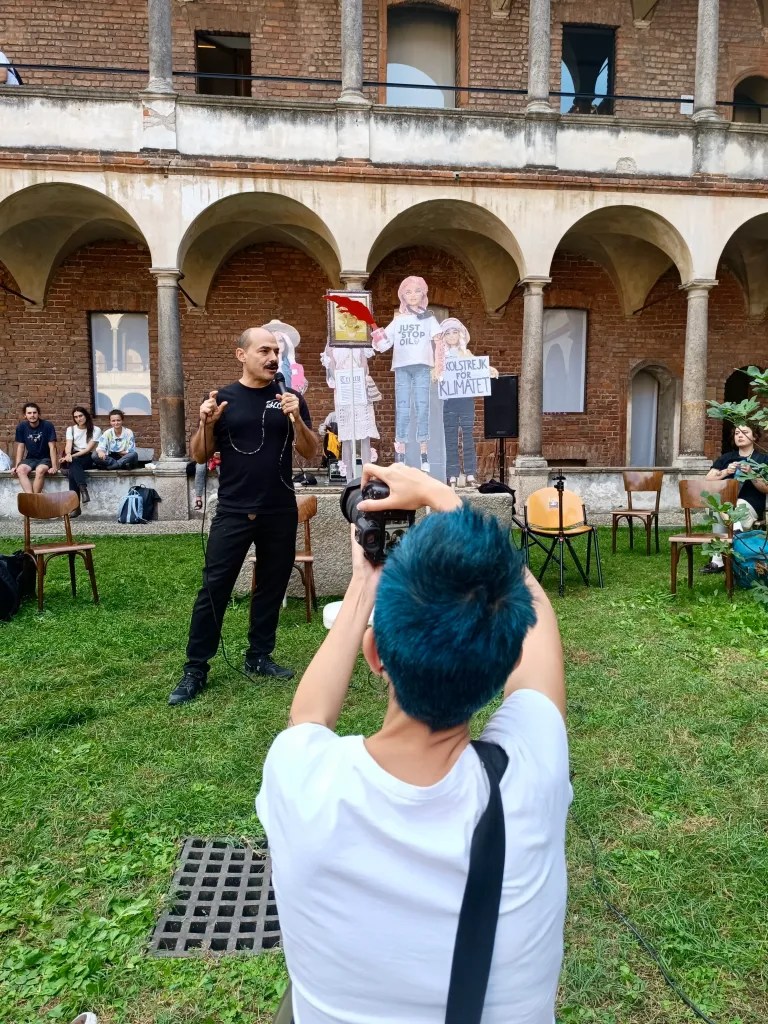
Institute of Radical Imagination participates in the framework of the World Congress for Climate Justice, Milan 12-15 October 2023. Conceived as a First International aimed at opening up a space of discussion between explicitly anti-capitalist climate movements, activists and intellectuals from all over the planet, with the ambition of defining a common agenda and ideological perspective in the shared transnational space of the ecosocial struggles of the present.

With 200+ delegates and 60+ movement.

📍State University of Milan, via Festa del Perdono 7, Cloister Legnaia (Aula EcoLab)
🗓 12 October 2023
🕦 H 14:30 – 16:00

Participants a.o.

Institute of Radical Imagination (Marco Baravalle, Emanuele Braga, Sara Buraya, Maddalena Fragnito, Gabriella Riccio, Federica Timeto), The Yes Men (Mike Bonanno) and Barbie Liberation Organization, Andreco Climate Art Project, Ashley Dawson, Terike Haapoja, Andrea Natella, Noura Tafeche, Serpica Naro, Dirty Art Department (Jerszy Seymour, Theo Dietz e Rosa Meulenbeld), Effimera (Giorgio Griziotti), Tiziana Terranova, and the contribution in remote by Arts for the Commons A4C (Rosa Jijón and Francesco Martone) and Laboratory of Insurrectionary Imagination (Isabelle Fremeaux & Jay Jordan)

The Milano World Congress for Climate Justice is the opportunity to bring together art and performing arts workers to continue a discussion that will lead to the collective writing of a manifesto on the role of art in the struggle for climate justice and in the creation of new ecologies (which take into account the intersection of environmental and social facts). If the pandemic had already dramatically underlined the consequences of extractivist anthropization, the war in Ukraine (in addition to its immediate death toll) is a manifestation of what Andreas Malm has called ‘fossil fascism’, a mix of authoritarianism and fossil fuels that weakens the already insufficient measures to combat global warming. The scarcity of Russian gas has brought coal back into vogue and, in Italy, the construction of new re-gasifiers is on the agenda. The decision to organize the workshop at the World Congress for Climate Justice 2023 reflects our belief in the importance of freeing art from the capture of institutional circuits. We want to experience, as participants in social movements, aesthetic-political concatenations that interpret creativity as a radical character of the social and not as a commodity. The participants also share the conviction that the fight for climate justice is, necessarily, a fight against and beyond extractive capitalism, even in its green version (actually an attempt to turn the crisis into new accumulation). The workshop will involve discussion and co-creation starting from the practices of the invited guests around certain central themes: the use of art as a method of inquiry and visualization in the climate crisis; the production of activist art forms that look at the performativity of direct action; art as a ground for radical imagination in designing new ecologies that reshape the relationship between human and non-human; art as an archive of movement practices, and so on.

FOLLOW

ITALIANO

Institute of Radical Imagination partecipa al Congresso Mondiale per la Giustizia Climatica, Milano 12-15 Ottobre 2023. Concepito come una Prima Internazionale volta ad aprire uno spazio di discussione tra movimenti climatici, attivisti e intellettuali esplicitamente anticapitalisti di tutto il pianeta, con l’ambizione di definire un’agenda comune e una prospettiva ideologica nello spazio transnazionale condiviso delle lotte ecosociali del presente.

Con oltre 200 delegati e oltre 60 movimenti.

📍 Università Statale di Milano, via Festa del Perdono 7, Chiostro Legnaia (Aula EcoLab)
🗓 12 Ottobre 2023
🕦 H 14:30 – 1&:00

Partecipano tra *l* altr*

Institute of Radical Imagination (Marco Baravalle, Emanuele Braga, Sara Buraya, Maddalena Fragnito, Gabriella Riccio, Federica Timeto), The Yes Men (Mike Bonanno) and Barbie Liberation Organization, Andreco Climate Art Project, Ashley Dawson, Terike Haapoja, Andrea Natella, Noura Tafeche, Serpica Naro, Dirty Art Department (Jerszy Seymour, Theo Dietz e Rosa Meulenbeld), Effimera (Giorgio Griziotti), Tiziana Terranova, and the contribution in remote by Arts for the Commons A4C (Rosa Jijón and Francesco Martone) and Laboratory of Insurrectionary Imagination (Isabelle Fremeaux & Jay Jordan)

Il World Congress for Climate Justice di Milano è l’occasione per riunire i lavoratori dell’arte e dello spettacolo per continuare una discussione che porterà alla stesura collettiva di un manifesto sul ruolo dell’arte nella lotta per la giustizia climatica e nella creazione di nuove ecologie (che tengono conto dell’intersezione tra fatti ambientali e sociali). Se la pandemia aveva già sottolineato drammaticamente le conseguenze dell’antropizzazione estrattivista, la guerra in Ucraina (oltre al suo immediato bilancio di vittime) è una manifestazione di quello che Andreas Malm ha chiamato “fascismo fossile”, un mix di autoritarismo e combustibili fossili che indebolisce il sistema misure già insufficienti per combattere il riscaldamento globale. La scarsità del gas russo ha riportato in auge il carbone e, in Italia, è all’ordine del giorno la costruzione di nuovi rigassificatori. La decisione di organizzare il workshop al Congresso Mondiale per la Giustizia Climatica 2023 riflette la nostra convinzione nell’importanza di liberare l’arte dalla cattura dei circuiti istituzionali. Vogliamo sperimentare, come partecipanti ai movimenti sociali, concatenazioni estetico-politiche che interpretino la creatività come carattere radicale del sociale e non come merce. I partecipanti condividono anche la convinzione che la lotta per la giustizia climatica sia, necessariamente, una lotta contro e oltre il capitalismo estrattivo, anche nella sua versione verde (in realtà un tentativo di trasformare la crisi in nuova accumulazione). Il workshop prevederà discussioni e co-creazione a partire dalle pratiche degli ospiti invitati attorno ad alcuni temi centrali: l’uso dell’arte come metodo di indagine e visualizzazione nella crisi climatica; la produzione di forme d’arte attiviste che guardano alla performatività dell’azione diretta; l’arte come terreno per l’immaginazione radicale nella progettazione di nuove ecologie che rimodellano la relazione tra umano e non umano; l’arte come archivio di pratiche di movimento, e così via.

SEGUE

MIKE BONANNO THE YES MEN TALK | WCCJ 2023

ENGLISH

In the framework of the World Congress for Climate Justice, Milan 2023

📍 State University of Milan, via Festa del Perdono 7, Cloister Legnaia (Aula EcoLab)
🗓 12 October 2023
🕦 H 16:00 – 16:30

MIKE BONANNO (THE YES MEN) | Talk

“After 10,000 years of a stable climate, the earth has entered a period of great instability,” says Vamos. “Because of this, students today will likely face environmental and social problems at a scale and complexity that civilization has yet to witness. It is for this reason that my focus as an educator and a communicator has been to help prepare them to proactively work towards solving these emergent problems, both through applied multi-disciplinary projects that treat the symptoms, and by civic engagement intended to address the root causes.”

About IGOR VAMOS

Igor Vamos is a member of The Yes Men using the alias Michael “Mike” Bonanno, and an associate professor of media arts at Rensselaer Polytechnic Institut. Vamos is also well-known for his collaborative public art projects such as the Barbie Liberation Organization and the Center For Land Use Interpretation, a non-profit organization dedicated to the increase and dissemination of knowledge about the nature of human interaction with the Earth.

THE YES MEN

“Invite us to corrupt your students!”. The Yes Men is performance-activist duo that impersonates captains of industry and surprise unsuspecting business audiences with satirical, poignant actions that comment upon pressing social and environmental issues.

BARBIE LIBERATION ORGANISATION

“We are the Barbie Liberation Organization (B.L.O.), an underground network of creative activists. We challenge malign societal norms and spark conversations that resonate beyond the ordinary. Creativity is our weapon of choice. Through acts of cultural insurgency, we aim to liberate minds and provoke thought. Our covert operations are carefully crafted to disrupt the status quo and inspire others to question the constructs that confine them.”

CENTER FOR LAND USE INTERPRETATION

Dedicated to the increase and diffusion of knowledge about how the nation’s lands are apportioned, utilized, and perceived. The CLUI exists to stimulate discussion, thought, and general interest in the contemporary landscape. Neither an environmental group nor an industry affiliated organization, the work of the Center integrates the many approaches to land use—the many perspectives of the landscape—into a single vision that illustrates the common ground in “land use” debates. At the very least, the Center attempts to emphasize the multiplicity of points of view regarding the utilization of terrestrial and geographic resources.

ITALIANO

Nell’ambito del World Congress for Climate Justice, Milano 2023

📍 Università Statale di Milano, via Festa del Perdono 7, Chiostro Legnaia (Aula EcoLab)
🗓 12 Ottobre 2023
🕦 H 16:00 – 16:30

MIKE BONANNO (THE YES MEN) | Talk

“Dopo 10.000 anni di clima stabile, la terra è entrata in un periodo di grande instabilità”, afferma Vamos. È per questo motivo che il mio obiettivo come educatore e comunicatore è stato quello di aiutarli a prepararsi a lavorare in modo proattivo per risolvere questi problemi emergenti, sia attraverso progetti multidisciplinari applicati che trattano i sintomi, sia attraverso l’impegno civico inteso ad affrontare le cause profonde.”

About IGOR VAMOS

Igor Vamos è membro di The Yes Men utilizzando lo pseudonimo di Michael “Mike” Bonanno e professore associato di arti multimediali al Rensselaer Polytechnic Institut. Vamos è anche noto per i suoi progetti collaborativi di arte pubblica come la Barbie Liberation Organization e il Center For Land Use Interpretation, un’organizzazione no-profit dedicata all’aumento e alla diffusione della conoscenza sulla natura dell’interazione umana con la Terra.

THE YES MEN

“Invitateci a corrompere i vostri studenti!”. The Yes Men è un duo di attivisti e performance che impersona capitani d’industria e sorprende il pubblico ignaro degli affari con azioni satiriche e toccanti che commentano urgenti questioni sociali e ambientali.

BARBIE LIBERATION ORGANISATION

“Siamo la Barbie Liberation Organization (B.L.O.), una rete sotterranea di attivisti creativi. Sfidiamo le norme sociali maligne e scateniamo conversazioni che risuonano oltre l’ordinario. La creatività è la nostra arma preferita. Attraverso atti di insurrezione culturale, miriamo a liberare le menti e provocare riflessioni. Le nostre operazioni segrete sono attentamente progettate per sconvolgere lo status quo e ispirare gli altri a mettere in discussione i costrutti che li confinano.”

CENTER FOR LAND USE INTERPRETATION

Dedicato all’aumento e alla diffusione della conoscenza su come le terre della nazione vengono ripartite, utilizzate e percepite. Il CLUI esiste per stimolare la discussione, il pensiero e l’interesse generale nel panorama contemporaneo. Né un gruppo ambientalista né un’organizzazione affiliata all’industria, il lavoro del Centro integra i numerosi approcci all’uso del territorio – le molteplici prospettive del paesaggio – in un’unica visione che illustra il terreno comune nei dibattiti sull’”uso del territorio”. Per lo meno, il Centro tenta di sottolineare la molteplicità dei punti di vista riguardo all’utilizzo delle risorse terrestri e geografiche.

THE CLIMATE JUSTICE LEAGUE Workshop | WCCJ 2023

ENGLISH

In the framework of the World Congress for Climate Justice, Milan 2023

📍 State University of Milan, via Festa del Perdono 7, Cloister Legnaia (Aula EcoLab)
🗓 12 October 2023
🕦 H 16:30 – 18:30

THE CLIMATE JUSTICE LEGUE Workshop

curated by Emanuele Braga

with the complicit participation of Andreco,  Andrea NatellaNoura TafecheSerpica Naro and Dirty Art Department (Jerszy Seymour, Theo Dietz e Rosa Meulenbeld), Institute of Radical Imagination (Marco Baravalle, Emanuele Braga, Maddalena Fragnito, Gabriella Riccio, Federica Timeto)

The CLIMATE JUSTICE LEAGUE saw its genesis at LE ALLEANZE DEI CORPI Festival, Milan KINLab September 2023

A generative co-creation of eco-warriors icons front for climate justice. The Climate Justice League will be present in the form of big cardboard puppets, ready to enter the street and march around the planet.

Subvertising and radical imagination: we need super heroes for climate justice! In the history of art and activism we have always practiced the situationist art of inventing fictional characters alongside real everyday struggles and which embodied the spirit of the time. Luther Blisset, San Precario, Serpica Naro, Gaetano, to name a few famous ones close to us, born in Milan and Italy. In this era of great upheavals, of floods, tornadoes and heat waves, in this Milan where the parks are closed due to cyclones, the entire Po Valley has been flooded and in the Alps there are no longer glaciers and water reserves… who can come to our rescue? What are the faces of the new CLIMATE JUSTICE LEAGUE? And above all, who are the evil forces behind all this?
After the great success of Greta Gerwig’s Barbie, Yesman and Pussyriot have just released the new face of Barbie Eco Worrior which you can find on  https://www.barbieliberation.org/. These and other super personalities will participate in the WORLD CONGRESS FOR CLIMATE JUSTICE hich will be held in Milan next 12-15 October. On this occasion Institute of Radical Imagination will also launch the anti-speciesist, fossil free and post-anthropocentric ART FOR RADICAL ECOLOGIES MANIFESTO.

ITALIANO

Nell’ambito del World Congress for Climate Justice, Milano 2023

📍 Università Statale di Milano, via Festa del Perdono 7, Chiostro Legnaia (Aula EcoLab)
🗓 12 Ottobre 2023
🕦 H 16:30 – 18:30

LA CLIMATE JUSTICE LEGUE Workshop

a cura di Emanuele Braga

con la partecipazione complice di Andreco,  Andrea NatellaNoura TafecheSerpica Naro and Dirty Art Department (Jerszy Seymour, Theo Dietz e Rosa Meulenbeld), Institute of Radical Imagination (Marco Baravalle, Emanuele Braga, Maddalena Fragnito, Gabriella Riccio, Federica Timeto)

La genesi della CLIMATE JUSTICE LEAGUE è stata presentata a LE ALLEANZE DEI CORPI Festival, Milano KINLab September 2023

Una co-creazione generativa di icone di eco-guerrieri in prima linea per la giustizia climatica. La Climate Justice League sarà presente sotto forma di grandi pupazzi di cartone, pronti a scendere in strada e marciare intorno al pianeta.

Subvertising e immaginazione radicale, ovvero: abbiamo bisogno di  super eroə per la giustizia climatica! Nella storia dell’arte e attivismo  abbiamo praticato da semprei l’arte situazionista dell’invenzione di personaggi fiction al fianco delle lotte reali di tutti i giorni e che incarnassero lo spirito del tempo. Luther Blisset, San Precario, Serpica Naro, Gaetano, per citarne alcuni famosi e a noi vicini, nati a Milano e in Italia. In questa epoca di grandi stravolgimenti, di alluvioni, tornadi e ondate di calore, in questa Milano in cui i parchi sono chiusi per ciclone, tutta la pianura padana è stata alluvionata e sulle alpi non ci sono più ghiacciai e riserve idriche… chi può venire in nostro soccorso? Quali sono i volti della nuova CLIMATE JUSTICE LEAGUE? E soprattutto chi sono le forze del male che stanno dietro a tutto questo?
Dopo il grande successo di Barbie di Greta Gerwig, Yesman e Pussyriot hanno appena liberato il nuovo volto di Barbie Eco Worrior che potete trovare sul sito https://www.barbieliberation.org/.  Questə e altrə super personaggə parteciperanno al congresso mondiale per il clima WORLD CONGRESS FOR CLIMATE JUSTICE che si terrà a Milano il prossimo 12-15 Ottobre. In questa occasione Iinstitute of Radical Imagination con la piattaforma antispecista, fossil free e post-antorpocentirca l’ART FOR RADICAL ECOLOGIES MANIFESTO. 

ASSEMBLEA DI BIENNALOCENE Atto III

Sale Docks, Mi Riconosci?, Institute of Radical Imagination e ADL Cobas

Terza assemblea pubblica di #BIENNALOCENE

🗓20/09/23
🕦19:30
📍Sale Docks, Dorsoduro 265, Venezia

Obiettivo: chiudere la scrittura della Carta metropolitana del lavoro culturale.

In una città in cui la surreale discussione ruota attorno al biglietto di ingresso, in cui i posti letto per turisti superano i residenti, in cui più la crisi morde più i prezzi salgono (a livelli grotteschi), nessuno discute di migliorare le condizioni di chi lavora nell’arte e nella cultura come semplice strategia per permettere a tant_ giovan_ di diventare residenti. Eppure siamo qui, tant_, come abbiamo dimostrato nelle precedenti assemblee di Biennalocene e siamo anche decis_ a non arrenderci all’avanzare del deserto. La nostra carta parla di salario minimo metropolitano, di rispetto e applicazione dei giusti contratti, di farla finita con le false p. IVA, di sicurezza, di superare il sistema delle esternalizzazioni, di giustizia di genere e altro ancora.

Scriviamola assieme!

Sale Docks @saledocks con @miriconosci.beniculturali@adl_cobas e @instituteofradicalimagination_

Tutt* sono benvenut*

Sale Docks, Mi Riconosci?, Institute of Radical Imagination & ADL Cobas

Third public assembly of #BIENNALOCENE

🗓20/09/23
🕦19:30
📍Sale Docks, Dorsoduro 265, Venice

Goal: to complete the writing of the Metropolitan Charter of Cultural Work.

In a city where the surreal discussion revolves around the entrance ticket, where the number of beds for tourists exceeds the number of residents, where the more the crisis bites, the more the prices rise (to grotesque levels), no one is discussing improving the conditions of those who work in the field of art and culture as one simple strategy to pursue to allow many young people to become residents. Yet we are here, as we have demonstrated in our previous Biennalocene open public assemblies and we are also determined not to give up to the void that gains more and more terrain. Our charter talks about the metropolitan minimum wage, about respecting and applying correct contracts, about putting an end to false VATs, and about work ssafety, to overcome tosic outsourcing, about gender justice and more.

Let’s write it together!

Sale Docks @saledocks con @miriconosci.beniculturali@adl_cobas e @instituteofradicalimagination_

All are welcome

ART FOR RADICAL ECOLOGIES (MANIFESTO) ASSEMBLY #2 | VENICE CLIMATE CAMP 2023

ENGLISH

ART FOR RADICA ECOLOGIES platform

Institute of Radical Imagination with Marco Baravalle, Emanuele Braga, Gabriella Riccio, Federica Timeto

September 9th, at 3.30 pm

What does ‘radical ecologies’ mean? An appointment to proceed in the collective writing of a manifesto that positions the art world in the fight for climate justice.

Follow up to the Art for Radical Ecologies Assembly opended at Venice Climate Camp 2022, to move towards the Art for Radical Ecologies (manifesto)

ITALIANO

ARTE PER LE ECOLOGIE RADICALI la piattaforma

Institute of Radical Imagination con Marco Baravalle, Emanuele Braga, Gabriella Riccio, Federica Timeto

9 Settembre alle 15:30

Cosa significa “ecologie radicali”? Un appuntamento per procedere nella scrittura collettiva di un manifesto che posizioni il mondo dell’arte nella lotta per la giustizia climatica.

Il seguito all’Assemblea Art for Radical Ecologies aperta al Venice Climate Camp 2022, per andare verso Art for Radical Ecologies (manifesto)

ASSEMBLEA DI BIENNALOCENE Atto II

Sale Docks, Mi Riconosci?, Institute of Radical Imagination e ADL Cobas

invitano tutte le lavoratrici ed i lavoratori della cultura a partecipare alla seconda assemblea aperta verso la co-scrittura di un codice etico per le istituzioni culturali a Venezia

Tavoli di lavoro

  • 1 – Contratti, Partite IVA, Esternalizzazioni, Salario Minimo
  • 2 – Sicurezza, Cura, Stages e Tirocini

Tutt* sono benvenut*

Sale Docks, Mi Riconosci?, Institute of Radical Imagination & ADL Cobas

invite all cultural workers to participate in the second open assembly towards the co-writing of an ethical code of conduct for cultural institutions in Venice

Working groups

  • 1 – Contracts, VATs, Outsourcing, Minimum Wage
  • 2 – Safety, Care, Training

All are welcome

WORK, NOT UBI, MAKES US MORE LONELY AND COMPETITIVE

Marco Baravalle & Emanuele Braga

ENGLISH

Marco Baravalle and Emanuele Braga will be at Teatro do Bairro Alto, in Lisbon, for a live presentation of the Art for UBI manifesto. Before that, they answered some questions about this work and its central theme, the Unconditional Basic Income (RBI or UBI).

You dedicate all your time to studies. You behave in class, read the textbooks, do your homework. Progress and repeat the procedure at each new difficulty level until you unlock a new map. In the world of work, the days lengthen, and your concentration narrows. There is no longer time for discovery and all the time must be dedicated to complying, with professionalism and resilience, with the orders of the boss. You depend on your salary, social security does not guarantee a dignified life, and among so many duties, changing is no longer a right. You have to work at the expense of the present, and work with fear of the future that you never know what it will bring. Working to pay the rent, to feed the family, to enjoy the world. It is from the work that the reward comes, it is the work that justifies the salary, and it will be our aptitudes to do so that guarantee us a dignified life, we are told. But will it be so?

Without telling anyone’s story, this story that anyone can identify with, reflects a systemic narrative. Our life, from an early age, is organized according to work, in a bet based on the expectation that the salary will fulfill, one day, in a hypothetical future, the missive of guaranteeing each employee a dignified life. But if for many years its questioning was out of the question, the data we have today make it more difficult to believe it.

The inflation that is reflected in the profits of large corporations, the galloping cost of housing in low-wage areas, precariousness, which is spreading around the world like a virus that erodes rights and guarantees, with an almost pandemic character, or the flagrant crisis climate, not only threaten the promise of seeing a dignified life in wages, but also denote the perversity of the paths we have followed behind this idea. Faced with so many signs, it is urgent to broaden the horizons of our vision and that is the proposal of the Institute for Radical Imagination, the space where the Art For UBI manifesto by Marco Baravalle, Emanuele Braga and Gabriella Riccio was born.

“While the financial elite continues to use the art market as a safe haven for financial assets, the Covid-19 pandemic has further highlighted the fragility and precariousness of artistic workers around the world. This context fueled the discussion around the Universal Basic Income. The Art for UBI manifesto argues that this measure is a necessary condition to rethink an ecologically extractive economic model, correct race and gender asymmetries and change the current neoliberal structure of the art world”, reads in the project description.

Bringing together in book format a set of artists’ essays on Unconditional Basic Income, Baravalle, Braga and Riccio seek not only to create a publication that informs this debate, but also to initiate a broader conversation about the necessary changes in our society. As a result of this intention, Baravalle and Braga will be on the 29th of June (Thursday) at the Teatro do Bairro Alto, in Lisbon, for a live presentation of their manifesto and, before that, they responded by email to a short interview about their investigation.

Emanuele Braga is an activist, artist, co-founder of the Institute of Radical Imagination and member of MACAO, a structure where he experimented with Common Coin and Bank of the common. He contributed to the Income performances. The unconditional speech, at Wiener Festwochen in June 2021, and in One income, many worlds, at Museo Reina Sofia, in September 2021. Marco Baravalle is an activist, researcher, co-founder of the Institute of Radical Imagination and member of S.a.L.E. Docks, an independent collective dedicated to the relationship between art, activism and gentrification. He was one of the contributors to the performance One income, many worlds, at the Museo Reina Sofia, in September 2021.


Shifter (S.): I know it’s a tough question but since you’ve delved into the topic. Are you able to give us a snapshot of the horizon in relation to UBI? What did you feel are the main obstacles and, by the way, what did you feel would be the biggest gains globally?

E.B.: I think we need to flip the perspective: the truth is that work is no longer enough. The financialization of the economy and the dismantling and precarization of the labor market have made it impossible to distribute sufficient wealth through work. For this reason, I believe we should take these two possible scenarios in the European area seriously: on one hand, struggles for a welfare system that replaces and complements the lack of income from work. On the other hand, we must prepare for major processes of social expulsion and revolt.

M.B.: If, as Emanuele says, wage work is no longer the unique tool for the distribution of wealth, is also true that the main obstacles to deeply rethink our system in Europe, come from reactionary governments which, beyond their populist rhetoric, once in power, cut on the already weak welfare system and enact laws that widen the gap between rich and poor. We are witnessing this very process right now in Italy. But this is not simply a problem of the far right. The rigidity with which Macron reacted to the large French movement against his pension reform is unbelievable. On the other hand, the movements in France show that broad layers of society are strongly posing the issue of income distribution and are also doing so in connection with other issues, such as that of environmental justice.

S.: Lately, with the emergence of generative technologies we have seen a fuss about a possible devaluation of artists. However, if we understand these models we see that they are not really creative, they cannot really replace artists, they can produce objects that replace art in the value chains. This has more to do with the economic model of art than with art itself? Do you agree that there is confusion around this idea, and that it is important to think collectively about what is art and what is the art market?

E.B.: I don’t believe that AI is stealing artists’ jobs. I think the relationship between art and technological innovation should be interpreted in a different way. Creativity, the figure of the artist, has been the laboratory for transitioning from the paradigm of factory work to the post-Fordist one. It’s a production model based on being entrepreneurs of oneself, being flexible, collaborative, and multitasking. Within the paradigm of creative industries, the social organization of digital platforms has developed. The laboratory of creativity and the surplus it continually reproduces are captured by capital in the form of technological innovation. Creativity dissolves into society like an aspirin in a glass of water, as Paolo Virno said in “Grammar of the Multitude.” Now I add: from that glass of water, algorithmic control of society and the automation of our behaviors have emerged. Behind AI, there is the collective intelligence of billions of people who contribute to its capabilities, and hundreds of thousands of underpaid workers who invisibly maintain its infrastructure and functioning. Unlike the creative industries, art now more than ever has a role in giving expression to subversion, sabotage, and the space to de-automate the technological circuits of domination.

S.: Do you think it is important to free artists from this almost existential need to produce for the market?

E.B.: I don’t want to perpetuate the idea of art as a space of privilege, created by individuals who can afford it economically and culturally. Our friend and comrade Gregory Sholette, in “Dark Matter,” contrasts the enormous invisible production of symbols, art, and culture that takes place in activism and social cooperation with the few artists recognized as famous by the art system and the market. The immense production of art, signs, and culture within society is to famous artists what dark matter in the universe is to the few visible stars. I believe that as art institutions, we need to build discursive devices that exist within the social and the struggles. While the art market tends to commodify activism and militant research, aestheticizing the struggles, I believe in the exact opposite: we should understand how expressive dispositifs can become war-machines (in the sense Gilles Deleuze uses this term) to organize processes of liberation within society.

M.B.: I would like to add that I think it is very important to create new possibilities of subjectivation for artists outside the market. This is one of the goals of radical art, to find ways for art and for being an artist (or art worker) within, but also against and beyond the predefined track (art school-biennials-museum-gallery). This doesn’t mean, as in the common sense of avant-garde, to merge art and life, but to win new autonomy for the art fact, more autonomy from the pervasive presence of capital.

S.: Do you think this change is essential and necessary to unlock transfeminist and decolonial struggles? Can it be a way to mitigate structural inequalities?

E.B.: The feminist perspective was the first to focus on this point, going beyond the interpretation that the working class made of Marx. Feminists have asserted that the central aspect of capital extraction lies in the invisibilization of reproductive labor. Capital has always profited from the cycles of life reproduction more than from exploiting wage labor. In the investigations we are conducting in various European territories, it becomes evident that citizenship and race are the other main dispositifs of exploitation. Denying equal rights and forcing individuals along racial lines to perform the most degrading jobs and social positions is an incredible lever for exploitation and the accumulation of privilege. Recognizing a Universal Basic Income and universal social services such as education, healthcare, and housing for everyone is undoubtedly a measure that breaks the chains of blackmail and exploitation. It is a way to ensure that all individuals have access to a basic level of economic security and fundamental services, regardless of their background or circumstances.

M.B: We see how often gender, race and class exploitations are intersected. We need to find ways to create a positive intersectionality too. That is why, beyond its social impact, we focused on the possible impact of UBI on gender, race, and ecological inequalities. If I may, one limit that is often visible within the art world at this very moment is a widespread attention towards decolonial and queer perspectives, but in the framework of a general acceptance of the neoliberal system. On the contrary, I agree with the Combahee River Collective (a collective of Afro-American feminists from the 70s) when they wrote: “We are socialists because we believe that work must be organized for the collective benefit of those who do the work and create the products, and not for the profit of the bosses. Material resources must be equally distributed among those who create these resources. We are not convinced, however, that a socialist revolution that is not also a feminist and anti-racist revolution will guarantee our liberation”.

S.: Some critics of UBI say that promoting such an agenda – where the money goes to the individual – may promote a more individualized society and lead to a disconnect from collective causes or even a weakening of social democracy. What would be your counter-argument to this criticism?

E.B.: I have no idea; I’m not trying to sell anything, but to understand. In the investigations we have conducted by listening to people, I have come to understand that people are prone to depression, burnout, bullying, feeling lonely and isolated, to the point of quitting their jobs because it is work that induces individualism, loneliness, and selective competition. Work, not UBI, leads us to be lonely and competitive. Secondly, people who have access to social services and income support usually begin to cooperate. They do things they couldn’t afford to do before. I believe it is similar to managing leisure time, time for nurturing relationships, for play, for doing something meaningful, for organizing based on one’s beliefs. I don’t think anyone has ever feared that granting more leisure time would result in a society of competitive individualists. It seems absurd and propaganda full of bias and preconceptions.

M.B.: I think such a statement is simply a lie. The neoliberal system is based on the ideology of individualization. Cooperation is disincentivized, our networked economy is the fruit of social intelligence, but its fruits are sifted and harvested for profit. Instead, we think that income guarantee measures and a solid welfare system are important tools to free up all that time now invested in individual competition and give more breathing space to collective dynamics and cooperative processes.

S.: Your project has several formats, among them a book where you put together several perspectives on the UBI. You identify yourselves as artists but you are a little different from the orthodoxy of producing pieces for the market or the galleries. Do you think it is important to go down this path, and create these pretexts for artists to think more about the world and less only about their next exhibition or their next work?

 E.B.: The history of art is filled with artists who have said things that couldn’t be said, who have shown what cultural and political regimes tried to make invisible. The history of art is also populated by political dissidents and activists who pretended to be artists or used art as a means to express their thoughts without being directly imprisoned. The history of art I want to belong to is populated by these kinds of figures. I challenge you to search carefully and study the history of art beneath the surface of appearances because I don’t believe you will find many artists who have made their mark without belonging to one of these two categories.

M.B. In my case I don’t even identify as an artist. I usually introduce myself as an activist, researcher and curator. To me, Art For UBI is mainly a tool for experimenting a method of performative militant investigation. Something where aesthetics and politics intersect. Maybe Emanuele is right, our genealogy is to be found mainly in that “other” history of art (one of the many that exist), and indeed what characterizes our curriculum is a long commitment to grassroots activism.

S.: And how important is it to do it collectively? Do you think that the traditional path of art is giving rise to artists who are also more isolated? Is it necessary to recover the social fabric?

E.B.: I have been working as an artist for 25 years, and I have always signed my main works with collective signatures. In truth, even when I sign a work with just my name and surname, I know deep down that I am cheating. I strongly feel that the works, actions, speeches, and texts we produce are the result of complex situated relationships. I would be nothing without the network of relationships in which I choose to operate. Authorship lies more in the series of interdependencies we choose or happen to have. I am nothing on my own. And my name is always an anagram, the meaning of which is continuously evolving and implies collective intelligence, non-human resources, desires, and conditions of oppression. That is why I advise everyone, when they sign a work as a single author, to spend a lot of time explicitly elucidating the genealogy and interdependencies from which it derives.


M.B. Emanuele’s answer perfectly works for me too. Let me add one thing. Besides recovering the social fabric, I think what is commonly called radical art must also re-discover its way to conflict and social struggles. Too often in the past decades socially engaged art has presented itself with an NGO attitude, worried about repairing supposed micro-fractures while completely ignoring the structural causes of such damages.

PORTUGUES

Marco Baravalle e Emanuele Braga estarão no Teatro do Bairro Alto, em Lisboa, para uma apresentação ao vivo do manifesto Art for UBI. Antes disso, responderam a algumas questões sobre este trabalho e o seu tema central, o Rendimento Básico Incondicional (RBI ou UBI, na sigla em inglês).

Dedicas todo o teu tempo aos estudos. Comportas-te nas aulas, lês os manuais, fazes os trabalhos de casa. Progrides e repetes o procedimento a cada novo nível de dificuldade até que desbloqueias um novo mapa. No mundo do trabalho os dias alongam-se, e a tua concentração afunila-se. Já não há tempo para a descoberta e todo o tempo se deve dedicar ao cumprimento, com profissionalismo e resiliência, das ordens do patrão. Dependes do salário, a providência social não garante uma vida digna, e entre tantos deveres mudar deixa de ser um direito. Há que trabalhar para as custas do presente, e trabalhar com medo do futuro que nunca se sabe o que trás. Trabalhar para pagar a renda, para alimentar a família, para fruir do mundo. É do trabalho que surge a recompensa, é o trabalho que justifica o salário, e serão as nossas aptidões para o fazer a garantir-nos uma vida digna, dizem-nos. Mas será mesmo assim? 

Sem contar a história de ninguém, esta história com que qualquer um se pode identificar, reflete uma narrativa de carácter sistémico. A nossa vida, desde cedo que se organiza em função do trabalho, numa aposta baseada na expectativa de que o salário cumprirá, um dia, num futuro hipotético, a missiva de garantir a cada assalariado uma vida digna. Mas se durante muitos anos o seu questionamento esteve for de questão, os dados de que hoje dispomos tornam mais difícil acreditar nela. 

A inflação que se reflete nos lucros das grandes corporações, o galopante custo da habitação em zonas de baixos salários, a precariedade, que se vai disseminando pelo mundo como um vírus que corrói direitos e garantias, com um carácter quase pandémico, ou a flagrante crise climática, não só ameaçam a promessa de ver no salário uma vida digna, como denotam a perversidade dos caminhos que temos percorrido atrás desta ideia. Perante tantos sinais, urge alargar os horizontes da nossa visão e essa é a proposta do Instituto para a Imaginação Radical, espaço onde nasceu o manifesto Art For UBI de Marco Baravalle, Emanuele Braga e Gabriella Riccio. 

“Enquanto a elite financeira continua a usar o mercado de arte como um porto seguro para ativos financeiros, a pandemia da Covid-19 evidenciou ainda mais a fragilidade e precariedade de trabalhadores do meio artístico em todo o mundo. Este contexto alimentou a discussão em torno do Universal Basic Income (Rendimento Básico Universal). O manifesto Art for UBI defende que esta medida é condição necessária para repensar um modelo económico ecologicamente extrativista, corrigir assimetrias de raça e género e mudar a atual estrutura neoliberal do mundo da arte”, lê-se na descrição do projeto

Reunindo em formato livro um conjunto de ensaios de artistas sobre o Rendimento Básico Incondicional, Baravalle, Braga e Riccio, procuram não só criar uma publicação que informe este debate, como iniciar uma conversa alargada sobre as mudanças necessárias na nossa sociedade. Fruto dessa intenção, Baravalle e Braga estarão dia 29 de Junho (Quinta feira) no Teatro do Bairro Alto, em Lisboa, para uma apresentação ao vivo do seu manifesto e, antes disso, responderam por e-mail a uma pequena entrevista sobre a sua investigação. 

Emanuele Braga é ativista, artista, cofundador do Institute of Radical Imagination e membro de MACAO, estrutura onde fez experiências com Common Coin e Bank of the common. Contribuiu para as performances Income. The unconditional speech, no Wiener Festwochen em junho 2021, e em One income, many worlds, no Museo Reina Sofia, em setembro 2021. Marco Baravalle é ativista, investigador, cofundador do Institute of Radical Imagination e membro de S.a.L.E. Docks, coletivo independente que se dedica à relação entre arte, ativismo e gentrificação. Foi um dos contribuidores para a performance One income, many worlds, no Museo Reina Sofia, em setembro 2021.


Shifter (S.): Sei que pode ser uma pergunta difícil, mas dado que mergulharam no tema: são capazes de nos dar um retrato do horizonte do RBI? Quais são os principais obstáculos e quais seriam os principais ganhos globalmente?

Emanuele Braga (E.B.): Acho que temos de alterar essa perspectiva: a verdade é que o trabalho já não chega. A financeirização da economia e o desmantelamento e a precarização do trabalho tornaram impossível distribuir suficiente riqueza através do trabalho. Por essa razão, acredito que na área europeia devemos levar estes dois possíveis cenários a sério: por um lado, lutas pelo estado social que substitua e complemente a falta de salário pelo trabalho. Por outro, temos de nos preparar para grandes processos de expulsão e revolta social.

Marco Baravalle (M.B.): Se, como o Emanuele diz, o dinheiro do salário já não é a única forma de distribuição da riqueza, também é verdade que o grande obstáculo para pensar o nosso sistema da Europa, vem dos governos reacionários, por de trás de retóricas populistas, que uma vez no poder cortam no já fraco sistema de proteção social e decretam leis que aumentam a diferença entre os ricos e os pobres. Estamos a assistir a esse processo agora em Itália. Mas não é um problema exclusivo da extrema direita. A rigidez com que o Macron reagiu ao grande movimento francês contra a sua pensão de reformas é inacreditável. Por outro lado, estes movimentos em França mostram que mais camadas da sociedade estão a questionar em força a distribuição de rendimentos, e também o fazem em conexão com outros problemas, com a justiça ambiental.

S.: Ultimamente, com a emergência dos modelos generativos temos visto muita conversa sobre a possível desvalorização dos artistas. Contudo se entendermos como funcionam estes modelos vemos que não são criativos, não podem substituir artistas – quanto muito podem produzir objectos para ser transacionados nas mesmas cadeias de valor. Acham que isto tem mais a ver com o modelo económico do que com a arte em si? Acham que é importante colectivamente pensar o que é a arte e o que é o mercado da arte? 

E.B.: Eu não acredito que a IA esteja a roubar trabalhos de artistas. Acho que a relação entre a arte e a inovação tecnológica tem de ser interpretada de forma diferente. A [ideia de] criatividadea figura do artista, foi um laboratório para a transição do paradigma do trabalho operário para um paradigma pós-fordista. É um modelo de produção baseado em ser empreendedor de si próprio, flexível, colaborativo, multi-tarefa. Dentro deste paradigma das indústrias criativas, a organização social das plataformas digitais desenvolveu-se. O laboratório da criatividade e o excedente que esta continuamente reproduz são capturadas pelo capital em forma de inovação tecnológica. A criatividade dissolve-se na sociedade como uma aspirina num copo de água, como diz Paolo Virno no “Gramática da multitude”. Eu acrescento: que desse copo de água emergiu uma sociedade de controlo algorítimico e a automação dos nossos comportamentos. Por trás da I.A. está a inteligência coletiva de milhões de pessoas que contribuíram para as suas capacidades, centenas de milhar de trabalhadores mal pagos que invisivelmente mantém a infraestrutura e o seu funcionamento. Ao contrário das indústrias criativas, a arte mais do que nunca tem o papel de dar expressão à subversão, sabotagem, ao espaço para desautomatizar os circuitos tecnológicos de dominação. 

S.: Acreditam que o RBI podia ser importante também para libertar artistas da sua necessidade quase existencial de produzir para o mercado? 

E.B.: Eu não quero perpetuar a ideia da arte como um espaço de privilégio, criado por individuos que podem pagar por ela económica e culturalmente. O nosso amigo e camarada, Gregory Sholette, no “Dark Matter”, contrasta a enorme produção invisível de símbolos, arte, cultura, que se dá no ativismo e na cooperação social, com os poucos artistas reconhecidos como famosos pelo sistema artístico e o mercado. A imensa produção de arte, signos, e a cultura da própria sociedade está para os artistas famosos como a matéria negra no universo está para as poucas estrelas visíveis. Eu acredito que enquanto instituições artísticas, temos de construir dispositivos discursivos que existam dentro do social e das lutas. Enquanto o mercado da arte tende a mercantilizar o ativismo e a investigação militante, a estetizar as lutas, eu acredito no oposto: devemos compreender como os dispositivos expressivos podem tornar-se máquinas de guerra (no sentido em que Gilles Deleuze usa este termo) para organizar processos de libertação na sociedade.

M.B.: Quero acrescentar que é muito importante criar novas possibilidades de subjetivação dos artistas fora do mercado. Esse é um dos objetivos da arte radical, encontrar caminhos para a arte e para ser um artista (ou um trabalhador da arte) dentro, mas também contra e para além dos caminhos pré-definidos (escola de artes-bineal-museu-galeria). Isto não significa, como no senso comum de vanguarda, fundir a vida e a arte, mas antes ganhar uma nova autonomia para a arte, uma maior autonomia da presença pervasiva do capital.

S.: Acreditam que esta mudança é importante para desbloquear outras “lutas transfeministas e decoloniais”? Pode servir para mitigar desigualdades estruturais?

E.B.: A perspectiva feminista foi a primeira a focar-se neste ponto, a ir para além da interpretação que Marx fez da classe trabalhadora. As feministas afirmaram que um dos aspetos centrais da extração de capital reside na inivisibilização do trabalho reprodutivo. O capital sempre lucrou mais de ciclos de reprodução mais do que da exploração do trabalho assalariado. Na investigação que estamos a fazer em vários territórios europeus torna-se evidente que a cidadania e a raça são outros dois grandes dispostivos de exploração. Negar direitos iguais, e relegar indivíduos racializados aos trabalhos e às posições sociais mais degradantes, é uma alavanca incrível para a exploração e a acumulação de privilégio. Reconhecendo um Rendimento Básico Incondicional, e serviços sociais universais como a educação, a saúde, ou a habitação para todos, é, sem dúvida, uma medida que quebra a cadeia de chantagem e exploração. É uma forma de assegurar que todos os individuos têm acesso ao nível mais básico de segurança económica e aos serviços fundamentais, independentemente do seu contexto ou das suas circunstâncias.

M.B.: Vemos muitas vezes como as explorações do género, raça e classe se intersectam. Precisamos de encontrar formas de criar intersececionalidade positiva também. É por isso que, para além do impacto social, nos focados nos possíveis impactos do RBI no género, raça e nas desigualdades ecológicas. Se me permitem, um limite que é por vezes visível dentro do mundo da arte neste preciso momento é a atenção generalizada a perspectivas decoloniais e queer, mas enquadradas no sistema de aceitação geral do sistema neoliberal. Pelo contrário, eu concordo com a Combahee River Collective (um colectivo de feministas afro-americanas dos anos 1970) quando escreveram: “Nós somos socialistas porque acreditamos que o trabalho deve ser organizado para benefício colectivo daqueles que trabalham e para criar produtos, não lucros para os chefes. Os recursos materiais devem ser equitativamente distribuidos por aqueles que criam esses recursos. Nós não estamos convencidas, contudo, que uma revolução socialista que não seja também feminista e anti-racista, garanta a nossa liberação”

S.: Alguns críticos do RBI dizem que promover essa agenda – de dar dinheiro aos individuos – pode promover uma sociedade mais individualizada, provocar a desconexão de causas colectivas e um enfraquecimento do estado social. Como responderiam a esta crítica?

E.B.: Não faço ideia, não estou a tentar vender nada, mas a tentar compreender. E na investigação que temos feito ao ouvir as pessoas, eu fui-me apercebedo que as pessoas estão vulneráveis a depressão, burnoutbullying, a sentirem-se sós e isoladas, ao ponto de se despedirem dos trabalhos porque é esse trabalho que induz o individualismo, a solidão e a competição seletiva. O trabalho, não o RBI, torna-nos mais sós e competitivos. Para além disso, as pessoas quando têm acesso a serviços sociais e a apoios ao rendimento, geralmente, começam a cooperar. Fazem coisas que antes não se podiam dar ao luxo de fazer. Penso que é similar À gestão do tempo de lazer, tempo de nutrir relações, de brincar, para fazer algo com significado, para se organizar com base nas suas convicções. E não acho que alguém tema que dar mais tempo de lazer às pessoas possa resultar numa sociedade de individualistas competitivos. Parece-me absurdo e uma propaganda cheia de viéses e ideias pré-concebidas.

M.B.: Eu acho que tal afirmação é simplesmente uma mentira. O sistema neoliberal é baseado na ideologia da individualização. A cooperação é desincentivada, a nossa economia em rede é fruto da inteligência social, mas os seus frutos são escolhidos e colhidos apenas por lucro. Em vez disso, acreditamos que as medidas de garantia de rendimento e um sistema de segurança social sólido são instrumentos importantes para libertar todo o tempo atualmente investido na competição individual e dar mais espaço às dinâmicas colectivas e aos processos de cooperação.

S.: O vosso projecto tem várias vertentes, entre elas um livro com várias perspectivas sobre o RBI. Vocês identificam-se como artistas, mas o vosso trabalho foge à ortodoxia da produção de peças para o mercado e as galerias. Acham que é importante seguir esta via, criar pretextos para os artistas pensarem mais sobre o mundo e menos sobre a próxima exposição?

E.B.: A história da arte está cheia de artistas que disseram o que não podia ser dito, que mostraram o que os regimes políticos e culturais tentaram tornar invisível. A história da arte é também povoada por dissidentes políticos ou ativistas que fingiram ser artistas ou que usaram a arte como forma de exprimir os seus pensamentos sem serem directamente presos. A história da arte a que quero pertencer é povoada por este tipo de figuras. E deixo o desafio de procurar e estudar cuidadosamente a história da arte para além da superfície, porque não acredito que se encontre muitos artistas que tenham deixado marca sem pertencer a uma destas duas categorias.

M.B.: No meu caso, nem me identifico como artista. Normalmente apresento-me como activista, investigador e curador. Para mim, o Art for UBI é sobretudo uma ferramenta para experimentar um método performativo de investigação militante. Algo onde a política e a estética se intersectam. Talvez o Emanuele esteja certo, a nossa genealogia encontra-se principalmente nessa ‘outra’ história da arte (uma das várias que existem) e, de facto, o que caracteriza o nosso currículo é um logo compromisso com o activismo de origem popular.

S.: E quão importante é fazê-lo coletivamente? Acham que o caminho tradicional das artes tem dado lugar a artistas mais isolados? É necessário recuperar o tecido social neste aspeto?

E.B.: Eu tenho trabalhado como artista nos últimos 25 anos, e sempre assinei os meus principais trabalhos com assinaturas colectivas. Na verdade, mesmo quando assino um trabalho só com o meu nome e apelido, eu sei que, lá no fundo, estou a fazer batota. Tenho uma grande convicção de que os trabalhos, as acções, os discursos, e os textos que produzimos, são resultado de um complexas relações situadas. Eu não seria nada sem a rede de relações em que escolho operar. A autoria baseia-se mais nessa série de interdependências que escolhemos ou que calhamos a ter. Eu sozinho não sou nada. E o meu nome é sempre um anagrama, cujo significado está em constante evolução e implica inteligência colectiva, recursos não humanos, desejos e condições de opressão. É por isso que aconselho toda a gente, quando assina uma obra como autor único, a passar muito tempo a elucidar explicitamente a genealogia e as interdependências de que ela deriva.

M.B.: A resposta do Emanuele adequa-se perfeitamente ao meu caso. Mas deixa-me acrescentar uma coisa: para além de reconstituir o tecido social, eu acho que aquilo que habitualmente se chama arte radical também deve redescobrir o seu caminho para os conflitos e as lutas sociais. Muitas vezes, nas décadas passadas, a arte engaja socialmente apresentou-se muitas vezes com uma atitude de ONG, preocupada em reparar supostas micro-fracturas enquanto ignorava completamente as causas estruturais de tais danos.

ART FOR UBI | Talk TEATRO DO BARRIO ALTO

ENGLISH

ART FOR UBI Talk

With Marco Baravalle & Emanuele Braga (Institute of Radical Imagination) moderated by researcher Rita Barreira.

29 June 18:30

While the financial elite continues to use the art market as a safe haven for financial assets, the Covid-19 pandemic has further highlighted the fragility and precariousness of artistic workers around the world. This context fueled the discussion around the Universal Basic Income (Universal Basic Income). The Art for UBI manifesto argues that this measure is a necessary condition for rethinking an ecologically extractive economic model, correcting race and gender asymmetries and changing the current neoliberal structure of the art world. The Universal Basic Income can be seen as a tool to open up new subjective spaces, an alternative to the dominant entrepreneurial individualism, valuing the common and care. Written collectively within the Institute of Radical Imagination and edited by Marco Baravalle, Emanuele Braga and Gabriella Riccio, Art Form UBI (Manifesto) [Venice, Bruno, 2022] contains contributions from several artists, theorists and activists who address RBI in the generalized picture of the precariousness of artistic work, the search for income in transfeminist and decolonial struggles, mutualism practices in the independent artistic scene, the relationship between finance, fabulation and cryptophilosophy.

ACCESSIBILITY Streaming available on the same day at Teatrodobairroalto.pt and on social networks

Price Free admission upon prior ticket collection from 3 pm (maximum of 2 tickets per person) Sala Manuela Porto

PORTUGUES

ART FOR UBI Discurso

Con Marco Baravalle & Emanuele Braga (Institute of Radical Imagination) moderated by researcher Rita Barreira.

29 Junio 18:30

Enquanto a elite financeira continua a usar o mercado de arte como um porto seguro para ativos financeiros, a pandemia da Covid-19 evidenciou ainda mais a fragilidade e precariedade de trabalhadores do meio artís- tico em todo o mundo. Este contexto alimentou a discussão em torno do Universal Basic Income (Rendimento Básico Universal). O manifesto Art for UBI defende que esta medida é condição necessária para repensar um modelo económico ecologicamente extrativista, corrigir assimetrias de raça e género e mudar a atual estrutura neoliberal do mundo da arte. O Rendimento Básico Universal pode ser visto como uma ferramenta para abrir novos espaços subjetivos, alternativa ao individualismo empreen- dedorista dominante, valorizando o comum e o cuidado. Escrito coletiva- mente no âmbito do Institute of Radical Imagination e editado por Marco Baravalle, Emanuele Braga e Gabriella RiccioArt Form UBI (Manifesto) [Veneza, Bruno, 2022] contém contribuições de diversas artistas, teóricas e ativistas que abordam o RBI no quadro generalizado da precariedade do trabalho artístico, a procura de rendimentos nas lutas transfeministas e decoloniais, as práticas de mutualismo na cena artística independente, a relação entre finança, fabulação e criptofilosofia.

ACESSIBILIDADE Streaming disponível no próprio dia em teatrodobairroalto.pt e nas redes sociais

Preço Entrada Livre mediante levantamento prévio de bilhete a partir das 15h (máximo de 2 bilhetes por pessoa) Sala Manuela Porto

IASC CONFERENCE 2023 | THE COMMONS WE WANT

Institute of Radical Imagination joined IASC International Association for the Study of the Commons and is taking part to the international conference The Commons we want: between historical legacies and future collective actions held in Nairobi, Kenia June 19-24 2023 in the following two panels:

Sub-theme 8. Opportunities and challenges of digital commons

PANEL 8.7. June 20, 2023 09:00 (10:00 CEST)

New approaches to commons governance from the blockchain ecosystem

Co-Chairs: Seth Frey (University of California Davis, USA) and Andy Tudhope (Independent scholar and practitioner, South Africa)

3. Technological Tools for the Commons. Dissident Algorithms’ Organizations

Emanuele Braga (Institute of Radical Imagination, Italy) and Maddalena Fragnito (Coventry University, UK)

This paper focuses on relational and technological tools for self-organization that have been developed within movements for the commons during the last 10 years between the financial and the pandemic crisis and beyond. Within the self-managed spaces taken into account, horizontal, non-hierarchical decision-making processes have been developed, mostly based on the sharing of means of production, and a supportive and non-competitive distribution of knowledge.
This research would like to update the concept of DAO, a Decentralized Autonomous Organization, in the context of the process of commoning. In the international debate, DAO contains the challenge to shape the life of an organization on the basis of the set of tools using mainly blockchain technologies to automatize different autonomous peer initiatives. I would like to raise the question: which of these sets of tools is really sustainable to foster collaboration instead of competition by going beyond the capitalistic mode of production?
The project aims to introduce a survey and map the most interesting tools and methodologies in use within the European panorama of activism for a post-capitalist ecological transition. The survey and the mapping process aim both at making technological tools available and experimenting with them in the specific context of the Institute of Radical Imagination’s productive and collaborative platform.
The Institute of Radical Imagination was born in 2017 as a monster/alternative institution by artists, activist researchers and cultural operators.

Sub-theme 10. Local institution building and radical futures for the commons

PANEL 10.12. B June 20, 2023 11:00 (12:00 CEST)

From the governance of the commons to a wider commons-inspired governance: obstacles and institutional changes inside the State and the Market

Co-Chairs: Margherita D’Andrea (University of Naples Federico II , Italy) and Giuseppe Micciarelli (University of Salerno/DISPC, Italy)

4. Intersections between arts, militant research and the commons

Gabriella Riccio (Institute of Radical Imagination, Italy)

What is the relation between artistic practices and the commons? Is it just a matter of providing cultural opportunities for the community and those that are not able to have access to it? Could art practices in the commons open up to popular cultures? Could this coming together foster new publics, opening new possibilities for appreciating a variety of cultural productions? Does it aim to create contradictions in the cultural production system? Is it a way to give asylum to productions outside the market? Or all these things together? As the Institute of Radical Imagination, we are a group of curators, activists, scholars and cultural producers with a shared interest in co-producing research, knowledge, and artistic and political research interventions for a transition to post-capitalism. We will discuss issues we face with our artistic, academic and political activism: How do the voices/careers of artists who approach the commons intersect and/or change and transform their art, performances, and way of sharing? How does artistic education affect the way that artists can engage with the commons? How do IRI or other forms of activism based on culture, arts and commons influence the policies of traditional cultural institutions? Is it possible? Can we imagine an alternative way to create festivals that are not mere exhibitions of ideas, or that are not connected to and based on mainstream proposals? Are there some interesting case studies on distributing resources and opportunities in a horizontal and non-hegemonic way between commoners even when individual careers, productions, and lives are involved?

CONJUNCTION 0

In the framework of the Critical Nodes of Connective Tissue Museo Reina Sofía’s Study Programme in Critical Museology, Artistic Research Practices and Cultural Studies

The Museo’s Study Centre organises two public sessions based on the first edition of Connective Tissue, the Museo Reina Sofía’s Programme of Critical Museology, Artistic Research Practices and Cultural Studies. During the encounter, the team of mobilisers — researchers who drive forward and coordinate, from their different fields, the Programme’s different Seminars and Critical Nodes — share the works developed up to this point and reflect on their predictions. Equally, the group of Resident Student Researchers present their work on posters and in installations and talks with people interested. 

The aim of the activity is to share knowledge, learning and projects carried out to date in the different Seminars and Critical Nodes, fibres of a shared research fabric which looks to be projected towards different outlying social, academic and cultural places.

El Centro de Estudios del Museo organiza dos jornadas públicas en torno a la primera edición de Tejidos conjuntivos, el Programa de Estudios Propios en Museología Crítica, Prácticas Artísticas de Investigación y Estudios Culturales del Museo Reina Sofía. Durante el encuentro, el equipo de movilizadoras —investigadoras que impulsan y coordinan en sus respectivos campos los distintos Seminarios y Nodos críticos del Programa— comparte los trabajos desarrollados hasta el momento y reflexiona sobre sus previsiones futuras. A su vez, el grupo de Investigadoras Residentes en Formación presenta sus trabajos en pósteres e instalaciones y conversan con las personas interesadas.

El objetivo de esta actividad es compartir los saberes, aprendizajes y proyectos que se han elaborado, hasta la fecha, en los distintos Seminarios y Nodos críticos, fibras de un tejido de investigación compartido que busca proyectarse hacia sus distintos afueras sociales, académicos y culturales.

MNCARS FERTE Logos

NOTES FROM A PERFORMATIVE INVESTIGATION

by Marco Baravalle

published on ARCH+ #252 Open for Maintenance 2023

The Institute of Radical Imagination (IRI), founded in 2018, is a network of artists, academics, and curators working at the intersection of art and the commons. Their project Art for Universal Basic Income (Art for UBI)—consisting of a manifesto, a campaign, a book—advocates for an unconditional universal basic income (UBI) above the poverty threshold and focuses on the role of art worker struggles in the transition to post-capitalist forms of social organization. The project also includes a performance, which will premiere on the occasion of the German Pavilion’s opening on May 19, 2023, in the context of the 18th International Architecture Exhibition – La Biennale di Venezia, and will draw on the experiences of cultural workers in Venice and beyond. Ahead of the performance, its coordinator Marco Baravalle, a founding member of the IRI and Art for UBI, writes about the origins of the project and the structures and assumptions underlying the Venetian cultural scene. 

Art for UBI

The driving force behind our campaign is Art for UBI (manifesto), a collectively written text developed in online public assemblies convened alongside art worker protests during the COVID-19 pandemic. Published in 2021, the manifesto consists of 14 articles on the benefits of an unconditional universal basic income for art workers, as well as for workers more generally. It highlights the benefits not only in the realm of pay and artistic production, but also in the battle for trans-feminism, de-colonialism, and climate justice. Its drafting started from the premise that a systemic solution is needed to address the fragmentation of artistic labor and the by now normalized idea that everyone should be an “entrepreneur of himself.” Such a solution should be firmly opposed to the micro-corporatisms and competition typical of the neoliberal model, which blocks the formation of united battle fronts.

In Italy, the lockdowns of 2020 and 2021 were tough times for workers in the cultural and entertainment sectors, who had to fight for professional recognition in the form of the so-called quarantine pay. But if the halt imposed by the pandemic dramatically highlighted the importance of having access to reliable forms of income, it did so by exacerbating a structural feature of artistic work: that of discontinuity. In the realm of cultural production, discontinuity is the byproduct of the necessary preparation, bureaucracy, autodidactics, and the constant filling out of funding applications, but also of sexism, the erosion of rights, and blackmail directed at these professionals for whom precarity is so often an unavoidable part of the job. Art for UBI (manifesto) makes the case for a publicly granted income as a means to pay art workers for their enormous amounts of invisible labor and to give them the option of saying no to shit jobs and abuse.

In 2021, Art for UBI helped organize a protest in Venice against the neoliberalization of museums and the city’s cultural policies, a process which hinges on the precarization of labor. The protest was initiated by the Sale Docks collective—which I am part of—along with the cultural sector workers network Mi Riconosci? (Do You Recognize Me?). In Rome, Art for UBIjoined performing arts workers in the temporary occupation of the Globe Theater. That same year, in Madrid, Art for UBI was turned into a performance titled Una Renta Muchos Mundos / One Income Many Worlds, which was shown in the Museo Reina Sofía and various community spaces around the city. In October 2022, a new Art for UBI performance was shown at the Le Alleanze dei Corpi festival in Milan, this time with the title Incondizionatamente (Unconditionally). In this way, Art for UBI has transformed from a platform into a fundamentally hybrid assemblage challenging the separation between art and politics.

A Performative Investigation

The following notes are taken from a “self-investigation” carried out by Sale Docks in 2017. The goal was to cast light on the working conditions of those laboring in the giant culture factory of Venice. I refer to it as a “self-investigation” not only because of its relatively small scale (16 interviewees and around 50 questionnaires), but also because the sample of interviewees was structurally very similar to the composition of Sale Docks: aged between 25 and 40, white, majority women, many with a university degree. This is the typical profile of the cultural precariat that sustains the Biennale and its many spin-off businesses.

When I say “investigation,” I do not mean it in the traditional journalistic or sociological sense. I am thinking instead of the militant political tradition of the Italian workerists in the 1960s—those of the Quaderni Rossi journal, which was followed by Classe Operaia. The workerists broke away from traditional Marxism and, in part, from the Italian workers’ movement more generally. This was due, first and foremost, to an epistemological shift, intended to free revolutionary knowledge from its ideological shackles and put it to the test of reality by centering on a critique of labor. This did not lead to the end of dogma or blind trust in Marxist “sacred texts,” but rather to a rereading of these texts in light of how they played out on the ground—or, in the 1960s context, on the factory floor in the industrial centers of northern Italy. The so-called Conricerca (Co-research)—a research methodology put forward, in particular, by Romano Alquati—was not a quest for knowledge on the subjects but with the subjects, implying an end to the distinction between the theoretical and the political. It offered a way to interpret the process of knowledge production not as a single moment prior to a transformation in the status quo, but as a participant in the transformation itself.

The Sale Docks initiative of self-investigation continues, although it has taken on the hybrid form of a performance within the assemblage of Art for UBI. Through performance, Art for UBI is able to create a space of radical autonomy. According to philosopher Jacques Rancière, such autonomy is one of the oppositions that characterizes art, and also a sign of art’s radical nature. Rancière sees art as defined by its ability to construct an elsewhere in respect to the social context in which it is produced, with its miseries and violence, and to function as a force for the “distribution of the sensible,” pointing to potential new forms of communal living. In today’s era of neoliberal art, however, the condition of this autonomy is not—as classical aesthetics and common sense would have it—the astronomical distance between art and life, but rather the distance, yet to be created, between art and capital: an inherently social issue which Art for UBI needs to tackle head-on.

It goes without saying that carrying out an investigation of workers today is not the same as during the 1960s. The main arena of class struggle, at least in Europe, is no longer the Fordist factory. Furthermore, it must be said that while the workerists correctly identified the points at which the broadest class ruptures would occur—the mass worker (operaio massa) first and the social worker (operaio sociale)later—our goal here is much less ambitious: realistically, perhaps our investigation/performance can make a little headway in an analysis of the subjectivity of the artistic precariat. As such, certain  questions have come to form the basis for our work: Is it possible to do an investigation through a performance? Is it possible to do so in a way that does not result both in a sub-par investigation and a sub-par performance? What even is a performative investigation? Is it simply a study with a performance as its output? What type of knowledge does it generate? Is staging an investigation into a particular segment of cultural work a gesture that begins and ends with the staging itself, or is it an action capable of forging alliances, further actions, and routes to community building and collective action? Can a performance help us advance the struggle for rights and fair pay? Is it possible to make the performance an autonomous space without feeding into the apparatus of capture that is the neoliberal dispositif of art? To hint at least at some of the responses to these complex questions, we can look to the results of the Sale Docks self-investigation, which highlights some of the thornier issues. Issues that, at this point, I will leave it to our interlocutors to voice.

May I switch to English?”—the culture industry’s global supply chain

This phrase, says Antonia, was the exit strategy of choice for her US temporary employer whenever they wanted to avoid sensitive topics such as contracts, back pay, or work trips. Antonia is a university student in Venice and she attends a few training courses run by non-profit cultural organizations. As a first job, she worked off the books for one of the big Venetian events companies with strong ties to the Biennale. For five months, she regularly worked over eight hours a day, having been left in charge of running ten exhibitions—alone, and in spite of her lack of experience. Her duties included handling press, hooking up internet in the exhibition spaces, managing staff, writing daily reports on the condition of displayed works, and everything in between. All of this for two or three hundred euros a month, paid in cash. We are not talking about a start-up here, but about companies managing dozens of properties in Venice; during the Biennale, the rent for these places runs to hundreds of thousands of euros, ensuring healthy profit margins. Understandably dissatisfied with this situation, Antonia decided to leave. She wanted to strike out on her own and set up a business with friends and classmates. She registered for a VAT number but soon realized that being a freelancer was not really a suitable option, the fiscal regime being too rigid for someone with a low and inconsistent income like hers. In the absence of any financial safety net, she quit. But now that she had cut her teeth in the field, she was contacted by the head of another small company working in cultural events. It was an international company based in a European capital, with links to Venice on account of the Biennale and its international showcasing opportunities. Antonia’s first conversation with them was brief: “Hi Antonia, I need a personal assistant.”—“When?”—“Can you move here by Monday?” She accepted the role, but it was the same tune. Her boss was late in providing her with a work contract, the pay was insufficient, the hours long. She started to receive requests from the company manager unrelated to work. Nobody helped her make professional connections. In fact, Antonia found herself systematically excluded from social events and, eventually, decided to move back to Venice and re-enroll in university. She says she needed to remind herself why she had chosen the artistic field in the first place. So much of her experience is typical of work in the cultural sector, in which the chain of exploitation, defined by informality and working off the books, begins at university and then extends to a global scale.

“There has to be a third way in between all the young people working for reduced rates and the big companies forming oligopolies to inflate prices”—labor market distortions

Giorgio has been running a nonprofit contemporary art space through a cultural association in Venice since 2010. He did not take his first salary until 2016 and he is still waiting to earn back the 20,000 euros he put down as an initial investment. His comment—reported above—touches on two issues that kept coming up during our conversations with art workers. The first is the difficulty of operating as a legal enterprise in a market where newcomers work for next to nothing in exchange for building a portfolio, thereby undercutting those small businesses that demand larger investments in hopes of securing fair pay for themselves and their collaborators. It must be emphasized, however, that newcomers are certainly not the biggest culprits in this regard. On the contrary, the worst offenders come when we move up the chain from self-employment and small businesses to the multi-million-dollar business of contracting out cultural services—so-called “outsourcing.” Big firms that share the market for these services at a national level are undoubtedly the ones profiting most from underpaid workers. At the other end of the spectrum is the second issue, which is very specific to Venice and its prosperous industry of cultural events. Here, a handful of wealthy companies are in charge of an enormous quantity of real estate, including palazzi and other prime locations. They rent these out to the highest bidder, paying little or no attention to the nature of the project at hand. These companies have come to function as the “landlords” of culture, turning the extraction of profit into a culture in itself. This is not artistic production; it is an artistic rental market. In an emptied-out city, the rental companies are custodians of the emptiness. Art is the perfect decoy, enabling them to spin profit from a void. It may seem different, but it is exactly the same logic that drives the market for short-term holiday rentals. Art is simply the latest agent of touristification in a city already on its knees.

“Entrepreneurs make money from products. Associations, on the other hand, have to find money to make a product that doesn’t generate any profit of itself”—the difference between businesses and associations

Most event organizers in Venice are associazioni culturali, or cultural associations. Simona is a member of one that focuses on live art and experimental music. She lived in Venice for 17 years before being forced to return to the mainland. Her job in the cultural sector had ceased to be financially viable, and she was no longer willing to supplement it by working as a cleaner for a tourist rental agency. For her, it is clear that the solution to the endemic precarity of art work is not everyone becoming an entrepreneur of themselves. She rejects the idea that we should always expect cultural production to conform to the logic of business. “Instead,” she says, “culture should be financed through a legal structure such as that of the association, which is formally bound to prioritize content over profits.” In our current legal context, however, this alone is often not enough. For obvious reasons of conflict of interest, members of an association do not take a share of the profits; instead, we need guidelines regarding how to pay them and any potential collaborators for their work. More public funding programs should be open to associations, rather than exclusively to cultural businesses. Associations, unlike businesses, are inherently concerned with the social development of the place where they carry out their activities, but the social cohesion they bring has yet to be deemed valuable in economic or political terms. Talking to Simona raised a crucial point: There is a whole world of young professionals out there who do not want hand-outs from the state, but simply to be in the position to put their talents to use and have their work recognized. Entrepreneurial individualism is often the professional reality for cultural workers, but associations offer the possibility of a collective alternative. An example? For several months, Simona’s association has been holding open meetings with similar organizations operating in Venice. It is still early days, but the first three meetings led to the idea of building an online platform listing everyone’s services and finding a physical space in which they can share skills and technical equipment.

“I’ve never really thought about a universal basic income … welfare is good, but for everyone, not just for cultural workers”—the misunderstanding of welfare as privilege

Roberto’s opinion was one that came up a lot in the interviews. Many people did not have much of an opinion about an unconditional universal basic income.

Others, in keeping with the neoliberal discourse, maintained that competition is the only route to professional validation, as well as an incentive to make high-quality content. Regardless, almost everyone was pro-social welfare, so long as “it’s for all jobs, not just a few.” The different rationales for this radically anti-corporate position—a position shared by Art for UBI—are interesting. While a minority of cases had political motives, the vast majority of interviewees seemed to have a general feeling of guilt and embarrassment at being paid in a form other than wages or invoices. There was a widely shared perception that welfare is a privilege, not a right. This ambiguity around rights and privileges is a constant in the field of cultural work. The

idea of having rights makes workers uncomfortable. The concept that their invisible, unpaid labor should, and could, be financially compensated seems largely alien to them. For many young people, the few salaried positions that have survived the relentless outsourcing of the culture industries are the privilege of a group of “untouchables”—older workers with permanent contracts, who are now demotivated and resistant to change. It is worth noting that, of all the interviewees, only one mentioned—correctly—that a universal basic income differs from traditional welfare, in that it constitutes a structural way to value life according to the terms of the current system of production. Most interviewees acknowledged, at least in part, this value system: they know they are creating value when they organize an event, transform an apartment into a cultural center, or share original content online, yet it rarely seemed to occur to anyone that this labor should be financially compensated.

“I’ve realized that, in this city, volunteering is important.”—the creative bohemian

This is another quote from Roberto, who collaborates every so often with one of the city’s small cultural spaces. The space is run on a nonprofit basis by a group of young people who use it to host events such as concerts, book launches, workshops, small exhibitions, and meetings. I have to admit Roberto’s comment surprised me. It echoes those of several other interviewees who have found ways to integrate informal cultural projects into their lives. Roberto had never considered that the space could be a fertile ground for developing his own artistic work. This is partly because it does not have all the technical equipment he needs, but mainly because he sees his presence there as something he does to volunteer and show support to his friends who run it. In this sense, there seems to be a clear division between the independent cultural scene, where one volunteers, and formalized working arrangements, where one makes serious art.

Nicoletta expressed a largely similar view, commenting on the phenomenon of turning private apartments into temporary spaces for small-scale cultural activities. She told me, “It’s not so much about the specifics of the show or the concert. It’s more that, in a city that’s so completely overrun, it’s truly fulfilling to have somewhere just to be with friends, to share a drink … no one’s there talking about careers.” No career talk, thankfully. But what we could call Venice’s “independent scene” is clearly perceived as a refuge, as an interruption to the stretched-out time dedicated to performing labor. It is not that conviviality and building relationships cannot themselves serve the function of aesthetic variables, but this is not the point. The point is that this apparent pause in the cycle of value production, characterized by informality, is in reality one of the classic tools of neoliberal urban transformation, which exploits “the creative bohemian.” In Venice these initiatives luckily function more as ways to reclaim and decommodify for-profit spaces, rather than as bridgeheads for the gentrification that has been ravaging the city for years leading to the exodus of its inhabitants. Still, the lack of self-reflection within the independent scene, and its reduction to a space of conviviality, serves to keep it subaltern to the city’s institutional landscape and the dominance of the industry of cultural events.  

Conclusion

In 1971, Danilo Montaldi published his Militanti politici di base (Grassroots Political Activists), a collection of testimonials from activists based in the lower Po valley, gathered through conversations and interviews. The book retains the spoken syntax of these interactions, including the use of dialect. This is a history from below, presenting the lived reality of the political struggle of the late 19th century, to the years of antifascist resistance, to the struggles of the 1960s. In the introduction, Montaldi writes of the conflicting character of some of these voices: “In addition to the life forms, worldviews, and ideologies that endure and accompany contemporary man, and not just in his moments of weakness … are others that come to establish themselves, suitable for and in keeping with the changing times but which are also clearly anticipatory; a premise. It may seem odd to talk of anticipation and ‘memories’ in the same breath, but, as you will see, the animating force for these various subjectivities is always a certain conflict with historical time, which extends from political reasonings to all of life’s norms and customs.” Times have changed, along with contexts and methods, but it is worth taking note and keeping this passage in mind as we set forth on our Venetian campaign—because art and militant investigations have at least one thing in common: when they insist on having the last word, they end up becoming a gravestone for the possible; but when they succeed in embracing what is yet to come, they retain the radical character of a premise.

  • 1 See Institute of Radical Imagination, Art for UBI (manifesto), eds. Marco Baravalle et al. (Venice: Bruno, 2022), accessed March 14, 2023, instituteofradicalimagination.org/the-school-of- mutation-2020/som-iterations/art-for-ubi/.
  • 2 Michel Foucault, The Birth of Biopolitics: Lectures at the Collège de France, trans. Graham Burchell (Lon- don: Palgrave Macmillan 2004), 226.
  • 3 See Romano Alquati, Per fare conricerca (Rome: Derive Approdi, 2012).
  • 4 See Jacques Rancière, Aesthetics and Its Discontents, trans. Stephen Corcoran (Cambridge: Polity, 2009) 43–44.
  • 5 “What we must therefore recognize both in the linear scenario of modernity and postmodernity, and in the academic opposition between art for art’s sake and engaged art, is an originary and persistent tension be- tween the two great politics of aesthetics: the politics of the becoming-life of art and the politics of the resistant form. The first identifies the forms of aesthetic expe- rience with the forms of another life. The finality it as- cribes to art is to construct new forms of life in common, and hence to eliminate itself as a separate reality. The second, by contrast, encloses the political promise of aesthetic experience in art’s very separation, in the resistance of its form to every transformation into a form of life.” Ibid.
  • 6 Operaio massa and operaio sociale are two diffe- rent subjectivities formulated by the Italian workerists. Operaio massa is understood as the typical assembly line worker who is only responsible for a very small task within an automated process of production and, as a result, becomes disqualified as an “unskilled” worker. Operaio sociale is a worker who identifies with the work- ing class, although they are not necessarily subjected to the classic Fordist relationships of production which tra- ditionally take place inside the factory, but more gene- rally to capitalist relations of production that extend into all economic sectors. See Antonio Negri, “Proletari e Stato: Per una discussione su autonomia operaia e compromesso storico” in Libri del rogo (1976, reprint, Rome: Derive Approdi, 2006), 144–45.
  • 7 See Danilo Montaldi, Militanti politici di base (Turin: Einaudi, 1971).
  • 8 Ibid., XI.

COMMONING OUR WORK, COMMONING OUR INSTITUTIONS | IMPULSE AKADEMIE

Organized by Cheers for Fears in the framework of IMPULSE Theater Festival Akademie Düsseldorf

ENGLISH

PRODUCE LESS, WORK BETTER!

THE LIBERAL PERFORMING ARTS BEYOND GROWTH

Endless growth is impossible on a planet with limited resources. The transition into one post growth society is inevitable. And yet the free performing arts are also the dogma of growth determines: So much research has been done in the past three pandemic years, confirmed and produced like never before. Based on working conditions and social security, it has changed to the vast majority of artists nothing has changed, they remain precarious. How do we get out of this hamster wheel? The academy addresses this issue in several lectures and three multi-day workshops. Students and actors from artistic practice, production, dramaturgy, administration, Unions and social services join forces in the search for new employment and production conditions: What does a different theater work look like, if less, but more sustainable? is being produced? When labor, ideas and material are not heated quickly, but used long term will be? When the concern for each other and the creation of common goods and practices is at the center push ?

German & English

REGISTER AT https://www.impulsefestival.de/impulse-akademie-anmeldung

Friday, 06/16 and Saturday, 17.06.

10.00-13.00 and 15.00-17.00 work in the workshops

Workshop 1: Commoning our work, commoning our institutions. A post-capitalist training of shared work and production

With Gabriella Riccio & Emanuele Braga (Institute of Radical Imagination)

Can artistic practice be a model for ways out of the crisis? In the workshop “Commoning our work, commoning our institutions”, artists and activists from the Institute of Radical Imagination report on their practice: They try to create spaces for the growth of the commons against privatization, gentrification and exploitation – from the micro level of the individual to the reconquest or occupation of urban space and the influencing of planning and politics. Together with the participants, they try to develop the idea of ​​a theater of the commons. The concept of the commons is based on the experience in self-governing art and cultural spaces such as L’Asilo (Naples) or MACAO (Milan), in which the focus is on joint work for a shared space in the city that belongs to everyone.

GERMAN

WENIGER PRODUZIEREN, BESSER ARBEITEN!

DIE FREIEN DARSTELLENDEN KÜNSTE JENSEITS DES WACHSTUMS

Unendliches Wachstum ist auf einem Planeten mit begrenzten Ressourcen nicht möglich. Der Wandel zu einer Postwachstumsgesellschaft ist unausweichlich. Und doch sind auch die Freien Darstellenden Künste vom Dogma des Wachstums bestimmt: Gerade in den vergangenen drei Pandemiejahren wurde so viel recherchiert, konferiert und produziert wie nie zuvor. An den Arbeitsbedingungen und der sozialen Absicherung hat sich für die allermeisten Künstler*innen allerdings nichts geändert, sie bleiben prekär. Wie kommen wir raus aus diesem Hamsterrad? Die Akademie bearbeitet diese Frage in mehreren Vorträgen und drei mehrtägigen Workshops. Studierende sowie Akteur*innen aus künstlerischer Praxis, Produktion, Dramaturgie, Verwaltung, Gewerkschaften und Förderwesen begeben sich gemeinsam auf die Suche nach neuen Arbeits- und Produktionsbedingungen: Wie sieht eine andere Theaterarbeit aus, wenn weniger, aber dafür nachhaltiger produziert wird? Wenn Arbeitskraft, Ideen und Material nicht schnell verheizt, sondern langfristig genutzt werden? Wenn die Sorge umeinander sowie die Schaffung gemeinsamer Güter und Praktiken in den Mittelpunkt rücken?

Deutsch und Englisch

ANMELDUNG UNTER https://www.impulsefestival.de/impulse-akademie-anmeldung

Freitag, 16.06. und Samstag, 17.06.

10.00–13.00 Uhr und 15.00–17.00 Uhr Arbeit in den Workshops

Workshop 1: Commoning our work, commoning our institutions. Ein postkapitalistisches Training geteilten Arbeitens und Produzierens

Mit Gabriella Riccio & Emanuele Braga (Institute of Radical Imagination)

Kann künstlerische Praxis ein Vorbild für Wege aus der der Krise sein? Im Workshop „Commoning our work, commoning our institutions“ berichten Künstler*innen und Aktivist*innen des Institute of Radical Imagination aus ihrer Praxis:  Sie versuchen, Räume für das Wachstum der Commons gegen Privatisierung, Gentrifizierung und Ausbeutung zu schaffen – von der Mikroebene des Individuums bis hin zur Rückeroberung oder Besetzung von städtischem Raum und der Beeinflussung von Planung und Politik. Gemeinsam mit den Teilnehmenden versuchen sie, die Idee eines Theaters der Commons zu entwickeln. Der Begriff der Commons stützt sich dabei auf die Erfahrung in selbstverwalteten Kunst- und Kulturräumen wie L’Asilo (Neapel) oder MACAO (Mailand), in denen die gemeinsame Arbeit für einen geteilten Raum in der Stadt, der allen gehört, im Mittelpunkt steht.

OMG TABACALERA Economia circular en la regeneración urbana

Organised by UAM CIVIS, CSA Tabacalera, C.R.A.S. Patio Oficina de Urbanismo Social, Institute of Radical Imagination

ENGLISH

OMG TABACALERA Circular economy in urban regeneration

June 5 and 6, 5:00 p.m., room without boss, CSA Tabacalera de Lavapiés

June 9, Autonomous University of Madrid, presentation of results.

Materials, resources, energy; These are the areas in which circularity is usually valued in the economics of building and rebuilding cities. In these sessions, a group of groups around the CSA la Tabacalera de Lavapiés together with the international platform of universities CIVIS will raise questions about the imminent rehabilitation of the building known as the Tabacalera de Lavapiés.

We will attend to these materialistic aspects of the rehabilitation, but not only, also to the cultural power of the implantation of new institutions and to the social and political dimension of the possibility of organization around the process and the surrounding territories.

The materiality of the planned and unplanned works will be one of the poles of the conversation, in which we will also situate the reality of 13 years of popular self-management in the Tabacalera de Lavapiés Self-Managed Social Center, the history of the place and its inhabitants. We will seek common lines of action among everyone who wants to get closer.

We will use English and Spanish during the sessions, trying to make participation possible in both languages.

ESPANOL

OMG TABACALERA Economia circular en la regeneración urbana

5 y 6 de junio 17/20h, sala sin jefe, CSA Tabacalera de Lavapiés

9 de junio, Universidad Autónoma de Madrid, presentación de resultados.

Materiales, recursos, energía; estos son los ámbitos en los que se suele valorar la circularidad en la economía de la construcción y reconstrucción de ciudades. En estas sesiones, un grupo de colectivos en torno al CSA la Tabacalera de Lavapiés junto con la plataforma internacional de universidades CIVIS plantearemos cuestiones en torno a la inminente rehabilitación del edificio conocido como la Tabacalera de Lavapiés.

Atenderemos a estos aspectos materialistas de la rehabilitación, pero no solo, también a la potencia cultural de la implantación de nuevas instituciones y a la dimensión social y política de la posibilidad de organización en torno al proceso y a los territorios alrededor.

La materialidad de las obras previstas y no previstas serán uno de los polos de la conversación, en la que también situaremos la realidad de 13 años de autogestión popular en el Centro Social Autogestionado la Tabacalera de Lavapiés, la historia del lugar y sus habitantes. Pretenderemos líneas de acción comunes entre toda persona que quiera acercarse.

Utilizaremos el inglés y el español durante las sesiones, intentando que la participación sea posible en ambas lenguas.

BIENNALOCENE | Performance

Italiano | English

BIENNALOCENE Se ‘l mare fosse de tocio  

is an event by the Goethe-Institut and Institut of Radical Imagination in the framework of Performing Architecture a series of events run by the Goethe-Institut as program partner of the German Pavilion at the 18th International Architecture Exhibition La Biennale di Venezia.

Corte delle Casette, Calle Cantiere (Giudecca Palanca), 19 May 2023 h 7.30 pm

curated by Marco Baravalle

based on an idea by Anna Rispoli

idea, research, dramaturgy, direction   Marco Baravalle, Emanuele Braga, Gabriella Riccio, Anna Rispoli

graphics Emanuele Braga

with the participation of Federica Arcoraci, Emanuele Brocardo, Est Coulon, Valentina Pettosini, Enrico Pittalis, Davide Tolfo + 5 workers who prefer to remain anonymous

NOTES FFROM A PERFORMATIVE INVESTIGATION by Marco Baravalle on ARCH+

BIENNALOCENE, Corte delle Casette, Giudecca Venezia

from Art for UBI (Manifesto) a militant research on the conditions of cultural work in Venice

BIENNALOCENE is a performative inquiry into the conditions of cultural work in Venice. The play was written starting from a series of interviews with a group of workers in the Venetian cultural industries. The interviewees themselves will stage their considerations on professional and existential precariousness, housing, income and the future of the lagoon city to the test of global warming.

The performance takes its cue from Art For UBI, a project by the Institute of Radical Imagination which started in 2021 with the collective writing of a manifesto in which the art world takes a position in favor of universal basic income and which resulted in the publication of the book “Art For UBI (Manifesto)”, (Bruno, 2021).

da Art for UBI (Manifesto) una ricerca militante sulle condizioni del lavoro culturale a Venezia

BIENNALOCENE è una ricerca militante sulle condizioni del lavoro culturale a Venezia e sull’ecosistema Biennale, grande evento che mobilita centinaia di lavoratori e lavoratrici ogni anno. A partire dalle interviste effettuate ad un gruppo diversificato di questi lavoratori e queste lavoratrici (precari, stagionali, freelancers, artisti, mediatori, tecnici, addetti alle pulizie e non solo) emerge una drammaturgia che da vita ad un’assemblea performativa animata dagli stessi intervistati e messa in scena nello spazio pubblico.

La performance prende spunto da Art For UBI, progetto dell’Institute of Radical Imagination iniziato nel 2021 con la scrittura collettiva di un manifesto in cui il mondo dell’arte prende posizione a favore del reddito di cittadinanza universale e che ha portato alla pubblicazione di il libro “Art For UBI (Manifesto)”, (Bruno, 2021).

Campaign

Photos by Giorgio Schirato, courtesy of Goethe Institut

IRI AT RECLAIM THE TECH FESTIVAL

ENGLISH

Workshop of knowledge and practices for digital, social and gender justice

From 5 to 7 May 2023 in Bologna, a festival, a forge of exchanges and reflections, a path to be built together to take back technology and put it back at the service of people and communities

The program of the festival which will take place in Bologna from 5 to 7 May is self-organized and has come to life from the more than 160 subscriptions and 70 proposals for activities, speeches and banquets that have arrived. However, Reclaim The Tech is not just a festival. It is a workshop for the exchange of knowledge and practices for digital, social and gender justice.

Institute of Radical Imagination with Emanuele Braga speaks on

Technologies and democracies: digital rights between claims, contaminations and collective mobilizations. On s’engage et puis on voit!

together with Leila Belhadj Mohamed (Privacy Network), Antonio Danieli (Fondazione Golinelli), Annalisa Pelizza (University of Bologna, University of Twente, Science and Technology Studies Italy)

Moderator: Lilia Giugni (University of Bristol and Cambridge, Reclaim The Tech)

Introducing: the Reclaim The Tech team

Friday 5 May at 18:30 LàbAs , Vicolo Bolognetti 2, Bologna

ITALIAN

Officina di saperi e pratiche per la giustizia digitale, sociale e di genere

Dal 5 al 7 maggio 2023 a Bologna, un festival, una fucina di scambi e riflessioni, un percorso da costruire insieme per riprenderci la tecnologia e rimetterla al servizio di persone e comunità

Il programma del festival che si svolgerà a Bologna dal 5 al 7 maggio è auto-organizzato e ha preso vita dalle oltre 160 sottoscrizioni e 70 proposte di attività, interventi, banchetti arrivate. Reclaim The Tech però non è solo un festival. E’ un’officina di scambio di saperi e pratiche per la giustizia digitale, sociale e di genere.

Institute of Radical Imagination con Emanuele Braga interviene su

Tecnologie e democrazie: diritti digitali tra rivendicazioni, contaminazioni e mobilitazioni collettive. On s’engage et puis on voit! 

insieme con Leila Belhadj Mohamed (Privacy Network), Antonio Danieli (Fondazione Golinelli), Annalisa Pelizza (Università di Bologna, Università di Twente, Science and Technology Studies Italia)

Modera: Lilia Giugni (Università di Bristol e Cambridge, Reclaim The Tech)

Introduce: la squadra di Reclaim The Tech

venerdì 5 maggio ore 18:30 Làbas , Vicolo Bolognetti 2, Bologna

BIENNALOCENE | Performance

Italiano | English

BIENNALOCENE Se ‘l mare fosse de tocio è un’iniziativa del Goethe-Institut e Institut of Radical Imagination nell’ambito di Performing Architecture serie di eventi del Goethe-Institut partner del Padiglione Germania alla 18° Mostra Internazionale di Architettura – La Biennale di Venezia

Corte delle Casette, Calle Cantiere (Giudecca Palanca), 19 Maggio 2023 h 19:30

a cura di Marco Baravalle

basato su un’idea di Anna Rispoli

idea, ricerca, drammaturgia, regia   Marco Baravalle, Emanuele Braga, Gabriella Riccio, Anna Rispoli

grafiche Emanuele Braga

con la parteciapzione di Federica Arcoraci, Emanuele Brocardo, Est Coulon, Valentina Pettosini, Enrico Pittalis, Davide Tolfo + 5 workers who prefer to remain anonymous

NOTES FFROM A PERFORMATIVE INVESTIGATION by Marco Baravalle on ARCH+

BIENNALOCENE, Corte delle Casette, Giudecca Venezia

da Art for UBI (Manifesto) una ricerca militante sulle condizioni del lavoro culturale a Venezia

BIENNALOCENE è una ricerca militante sulle condizioni del lavoro culturale a Venezia e sull’ecosistema Biennale, grande evento che mobilita centinaia di lavoratori e lavoratrici ogni anno. A partire dalle interviste effettuate ad un gruppo diversificato di questi lavoratori e queste lavoratrici (precari, stagionali, freelancers, artisti, mediatori, tecnici, addetti alle pulizie e non solo) emerge una drammaturgia che da vita ad un’assemblea performativa animata dagli stessi intervistati e messa in scena nello spazio pubblico.

La performance prende spunto da Art For UBI, progetto dell’Institute of Radical Imagination iniziato nel 2021 con la scrittura collettiva di un manifesto in cui il mondo dell’arte prende posizione a favore del reddito di cittadinanza universale e che ha portato alla pubblicazione di il libro “Art For UBI (Manifesto)”, (Bruno, 2021).

Campagna

Foto di Giorgio Schirato, courtesy of Goethe Institut

UNA BREVE AUTO-INCHIESTA ESTEMPORANEA SULLA RICERCA MILITANTE

English | Italiano | Español

Partiamo da noi stess* e all’interno delle reti con cui l’Institute of Radical Imagination è connesso ed con cui ha incrociato percorsi, condividendo un’inchiesta (solo 5 domande!) per ragionare insieme ad operator* impegnat* in forme di Ricerca Militante.

Ogni sforzo che costruisce spazi comuni di azione e di militanza è prezioso, ma anche delicato. Il tempo, le riserve fisiche, organizzative, mentali ed economiche si alimentano e crescono insieme a quelle degli altri. Allo stesso tempo, più cresce la militanza, più limitate diventano queste riserve. Inoltre, è già difficile fare commoning all’interno delle organizzazioni collettive, ed è ancora più difficile agire intersecando altri gruppi, lotte e rivendicazioni. Eppure così tante lotte passate e recenti ci insegnano l’importanza di mantenere questo approccio intersezionale. Inoltre, questo è vitale per affrontare i ciclici momenti di arretramento

Questa è una breve autoindagine semi-permanente con la quale vogliamo provare a porre domande insieme piuttosto che contare le risposte. Lo facciamo partendo da e intorno ai nostri nodi e speriamo che tu voglia unirti a noi.

UNA BREVE AUTOINVESTIGACIÓN EXTEMPORANEA SOBRE LA INVESTIGACIÓN MILITANTE

English | Italiano | Español

Partimos de nosotrxs mismxs, y dentro de las redes con las que se conecta y se cruza el Instituto de Imaginación Radical, compartiendo una investigación (¡solo 5 preguntas!) para pensar juntxs a agentes comprometidxs con formas de Investigación Militante.

Todo esfuerzo que construya espacios comunes de acción y militancia es precioso, pero también engañoso. Las reservas de tiempo, físicas, organizativas, mentales y económicas se alimentan y crecen junto con las de los demás. Al mismo tiempo, cuanto más crece la militancia, más limitadas se vuelven estas reservas. Además, ya es difícil hacer en común dentro de las organizaciones colectivas, y es aún más difícil actuar intersectando otros grupos, luchas y reivindicaciones. Sin embargo, tantas luchas pasadas y recientes nos enseñan la importancia de mantener este enfoque interseccional. Además, esto es vital para enfrentar los momentos cíclicos de retroceso.

Esta es una breve autoindagación semipermanente con la que queremos intentar hacer preguntas juntxs en lugar de contar las respuestas. Hacemos esto comenzando desde y alrededor de nuestros nodos y esperamos que quieras unirte a nosotrxs.

IRI AT BODIES, CARE, CONFLICTS AND COMMITMENTS

Conference organised by Idensitat and Santa Mònica

Institute of Radical Imagination with Gabriella Riccio and Elena Blesa Cabéz together with Soft Agency with teresa Dillon

is intervening in the Roundtable 4: Are other institutional structures possible?

moderator Larre

ENGLISH

BODIES, CARE, CONFLICTS AND COMMITMENTS
From the body politic to the socialisation of care in cultural institutions


28/04/2023. 
A conference with debate and shared learning 
Where: Santa Mònica. La Rambla, 7, 08002 Barcelona

Organize: IDENSITAT – Centre d’Arts Santa Mònica

A conference organised with Centre d’Arts Santa Mònica whose objective is to engage in debate regarding caring and the plurality of ecosystems articulated as social bodies, focusing upon the construction, the reconstruction or the renovation of new forms of cultural institutionalism whose work is based upon transdisciplinary perspectives, also incorporating voices from independent projects which confront issues that touch upon social matters based on the art.

The aim of this activity is to lend a voice to caring practices, understood as commitments bringing into dialogue voices that contribute to defining a diversity of visions regarding these subjects. Based on institutional structures and artistic practices, themes such as the meaning of involvement, of care, and of mutual support/aid, will all be placed on the table in order to enact a response to the current moment, on the basis of connection, co-responsibility, and situated and purposeful reflection.

Through an analysis of contemporary issues, and by crafting scenarios for the future we intend to create a shared space for reflection. In order to deal with problems and the bad habits which affect the artistic community and cultural institutions, while at the same time representing an opportunity to exchange useful resources for the development of new dynamics which centre upon the person, and around issues related to professional roles, spaces of relationship and interaction, how to share responsibilities and critical analysis to connect the ways of making art with different modes of management.

Ten guests will either present specific projects, or encourage debate. There will be a presentation of various case studies, with the aim of sharing perspectives which, based upon concepts related to caring and to institutional entities, will explore practices, instability, ethics, inclusion, transparency, the economic and aesthetic value of work, rights and obligations, the community, or other issues which may arise during the course of the debate.

PROGRAMME


The conference will be structured around three round tables in which two invited guests will present their perspective on the subject, followed by a discussion or debate conducted by a guest moderator.

5 p.m. – 7p.m.
Roundtable 4: Are other institutional structures possible?

Institute for Radical Imagination (IRI), group of artists, curators, activists, scholars and cultural producers with a shared interest in co-producing knowledge and artistic and political interventions to implement post-capitalist forms of life. Gabriella Riccio is a multidisciplinary artist based in Naples and Madrid. She is engaged in prefigurative practices such as the movement for the commons and self-governed theatres and cultural spaces. Elena Blesa Cábez is an artist and educator. Doctoral Student in the Universidad de Granada History and Arts programme. She has been involved in different educational projects engaging with a transfeminist and decolonial perspective. https://instituteofradicalimagination.org/

Soft Agency, group of female architects, artists, curators, scholars, and writers working within expanded spatial practices. Based in Berlin, Germany, since 2016, the group has been working on a number of themes relating to care practices and cultures. For this event, Soft Agency member, the artist and researcher Teresa Dillon will present a selection of the group’s work. https://s-o-f-t.agency

Moderator: Larre is a collective acting in the field of cultural mediation, from a feminist approach. Occupying hybrid spaces between practical artistic investigation and cultural criticism, they carry out activities and create collaborative spaces in which they seek to explore realities that are normally invisible or submerged. Larre is Lara García Díaz, Ángela Palacios and Priscila Clementti. https://www.instagram.com/_larre_/ https://tencuidado.org @_larre_

CATALÁ

COSSOS, CURES, CONFLICTES I COMPROMISOS
Del cos polític a la socialització de les cures a les institucions culturals


28/04/2023. Jornada de debat i aprenentatge en comú
Lloc: Santa Mònica. La Rambla, 7, 08002 Barcelona

Organitza: IDENSITAT – Centre d’Arts Santa Mònica

Jornada organitzada amb Centre d’Arts Santa Mònica on volem continuar el debat sobre les cures i la pluralitat d’ecosistemes articulats com a cossos socials, posant el focus en la construcció, la reconstrucció o la renovació de noves institucionalitats culturals que treballen des de perspectives transdisciplinars, aixi com incorporar veus des de projectes independents que afronten qüestions que incideixen en aspectes de caràcter social des de l’àmbit artístic.
Aquesta activitat vol posar en diàleg les cures enteses com a compromisos, articulant un diàleg de veus que contribueixen a definir una diversitat de visions sobre aquesta temàtica. Des de les estructures institucionals i les pràctiques artístiques, es posen sobre la taula temes com la implicació, la cura, el compromís o el suport mutu; per poder respondre als temps actuals des de la connexió, la coresponsabilitat i la reflexió situada i propositiva.

Des de l’anàlisi de presents contemporanis i la configuració d’escenaris de futur, es vol generar un espai compartit de reflexió per tractar problemàtiques i inèrcies que afecten la comunitat artística i la institució cultural, i alhora ser una ocasió per intercanviar recursos útils per a el desenvolupament de noves dinàmiques que posen la persona al centre, i al seu entorn qüestions relacionades amb els rols professionals, els espais de relació i interacció, el com compartir responsabilitats i l’anàlisi crítica, per tal de connectar les formes de fer de l’art amb diferents mecanismes de gestió.

La jornada compta amb la participació de 10 persones convidades de diferents territoris, ja sigui presentant projectes específics o activant el debat amb l’objectiu de compartir punts de vista que, partint de conceptes relacionats amb els cossos institucionals i les cures, revisin qüestions com les pràctiques, la inestabilitat, l’ètica, la inclusió, la transparència, el valor del treball, els drets i les obligacions, la comunitat, els conflictes, els compromisos, així com altres qüestions que sorgeixin als debats.

PROGRAMA


La trobada s’articula a partir de tres taules de debat en què dues persones convidades presenten el seu punt de vista al voltant del tema, i posteriorment es dona pas a la conversa o debat activat i dinamitzat per una altra persona convidada a moderar.

17.30h – 19.00h
Taula 4. Són possibles altres estructures institucionals?

Institute for Radical Imagination (IRI). Grup d’artistes, comissàries, activistes, acadèmiques i productores culturals amb un interès compartit en la coproducció de coneixements i intervencions artístiques i polítiques per implementar formes de vida postcapitalistes. Gabriella Riccio és una artista multidisciplinària establerta a Nàpols i Madrid. Participa en pràctiques prefiguratives, com ara el moviment pels béns comuns, i els teatres i espais culturals autogestionats. Elena Blesa Cábez, és artista i educadora. Doctoranda al programa d’Història i Arts de la Universitat de Granada. Ha participat a diferents projectes educatius des d’una perspectiva transfeminista i decolonial. https://instituteofradicalimagination.org/

Soft Agency. Grup d’arquitectes, artistes, comissàries, acadèmiques i escriptores que treballen amb pràctiques espacials expandides. Amb seu a Berlín, Alemanya, des del 2016, el grup ha estat treballant en una sèrie de temes relacionats amb les pràctiques de cura i cultura. Per a aquest esdeveniment, l’artista i la investigadora Teresa Dillon, membre de Soft Agency, presentarà una selecció del treball del grup.
https://s-o-f-t.agency

Modera: Larre. Col·lectiu que desplega les seves accions a l’àmbit de la mediació cultural, des d’un enfocament feminista.
Ocupant llocs híbrids entre la investigació pràctica artística i la crítica cultural, duen a terme activitats i espais de col·laboració on cerca explorar realitats normalment invisibilitzades o submergides. Larre està format per Lara García Díaz, Ángela Palacios i Priscila Clementti. https://www.instagram.com/_larre_/ https://tencuidado.org @_larre_

A BRIEF UNTIMELY SELF-INVESTIGATION ON MILITANT RESEARCH

English | Italiano | Español

We start from ourselves and within the networks the Institute of Radical Imagination is connected and has cross paths with sharing an enquiry (only 5 questions!) to think together with agents committed to forms of Militant Research.

Every effort that builds common spaces for action and militancy is precious, but it is also tricky. Time, physical, organisational, mental and economic reserves feed and grow along with those of others. At the same time, the more militancy grows, than the more limited these reserves become. Moreover, it is already hard to do commoning within collective organisations, and it is even harder to act intersecting other groups, struggles and claims. Yet so many past and recent struggles teach us the importance of keeping this intersectional approach. Moreover, this is vital to face the cyclical moments of backsliding

This is a short semi-permanent self-inquiry with which we want to try to ask questions together rather than count the answers. We do this starting from and around our nodes and we hope you want to join us.

MILITANT RESEARCH FROM THE ARTISTIC PRACTICE | Critical Node on Militant Research

English | Español

In the framework of the Critical Nodes of Connective Tissue Museo Reina Sofía’s Study Programme in Critical Museology, Artistic Research Practices and Cultural Studies

Organized by

Fundación de los Comunes, Institute of Radical Imagination, La Laboratoria. Espacios de Investigación Feminista y Museo en Red

Within the framework of the Connective Tissues programme, the Fundación de los Comunes, La Laboratoria and the Institute of Radical Imagination, in collaboration with the Museo en Red team of the Museo Reina Sofía, propose this training and research space on the specific nature of forms of militant research. Situated outside of academic frameworks, this type of research collects the legacy of labor co-investigation from the 1970s, feminist epistemologies and action research theories, and more than establishing a method, it aims to generate mechanisms for social struggles read themselves and find channels towards action.

This Critical Node seeks to reflect on (and from) the tools and lessons learned from the networks with which the museum has been collaborating in the last fifteen years, in relation to those knowledge production processes whose ultimate objective is not the interpretation of the world, but the organization of its transformation.

Mapping activist networks, preparing manifestos, generating assembly spaces within the framework of art or developing collective dramaturgies as ways of investigating the present: this session explores different formats in which artistic tools become the way of imagining other possible worlds. Researchers, artists and activists from the Institute of Radical Imagination  share experiences on artistic platforms as a strategy of subjectivation and political action in Art for UBI (Art for Universal Basic Income) and  Art for Radical Ecologies (manifestos, campaigns and artistic interventions), and on the approach towards radical pedagogies through projects such as Cinema as assembly, Raising Care, The school of emergencies and Kirik.

En le marco del los Nodos Críticos de Tejidos conjuntivos Programa de Estudios Propios en Museología Crítica, Prácticas Artísticas de Investigación y Estudios Culturales del Museo Reina Sofia
Organizan
Fundación de los ComunesInstitute of Radical ImaginationLa Laboratoria. Espacios de Investigación Feminista y Museo en Red

En el marco del programa Tejidos conjuntivos, la Fundación de los Comunes, La Laboratoria y el Institute of Radical Imagination, en colaboración con el equipo de Museo en Red del Museo Reina Sofía, proponen este espacio formativo y de investigación sobre el carácter específico de las formas de investigación militante. Situándose por fuera de los marcos académicos, este tipo de investigación recoge la herencia de la co-investigación obrera de los años setenta, las epistemologías feministas y las teorías de la investigación-acción, y más que establecer un método, pretende generar dispositivos para que las luchas sociales se lean a sí mismas y encuentren cauces hacia la acción.

Este Nodo crítico busca reflexionar sobre (y desde) las herramientas y los aprendizajes de las redes con las que el museo viene colaborando en los últimos quince años, en relación a aquellos procesos de producción de conocimiento cuyo objetivo último no es la interpretación del mundo, sino la organización de su transformación.

Mapear redes activistas, elaborar manifiestos, generar espacios asamblearios en el marco del arte o desarrollar dramaturgias colectivas como modos de investigar el presente: esta sesión explora distintos formatos en los que las herramientas artísticas se vuelven el modo de imaginar otros mundos posibles. Investigador+s, artistas y activistas del Institute of Radical Imagination comparten experiencias sobre plataformas artísticas como estrategias de subjetivación y acción política en Art for UBI (Arte por la Renta Básica Universal) y Art for Radical Ecologies (manifiestos, campañas e intervenciones artísticas), y sobre el acercamiento a las pedagogías radicales a través de proyectos como Cinema as assemblyRaising CareLa escuela de las urgencias y Kirik.

Program

activity with English-Spanish translation

To follow online session 1 y 3 the zoom link is https://us02web.zoom.us/j/83978854105

DAY 1
Session 1

Thursday, April 20, 2023 – 18:00 h Nouvel Building, Protocol Hall, Museo Reina Sofia (entrance from calle Ronda de Atocha 2) Entrance Free until full capacity is reached (max 60 people)

Welcome by Mabel Tapia, Sara Buraya Boned, Jorge Gaupp Berghausen, Celina Poloni

Bienvenida por Mabel Tapia, Sara Buraya Boned, Jorge Gaupp Berghausen, Celina Poloni

18:00 h / Artistic platforms as a strategy of subjectivation and political action Art for UBI y Art for Radical Ecologies
Participants: Marco Baravalle, Gabriella Riccio and Emanuele Braga

18:00 / Plataformas artísticas como estrategia de subjetivación y acción política Art for UBI Art for Radical Ecologies
Participan: Marco Baravalle, Gabriella Riccio y Emanuele Braga

19:30 h / Approach to radical pedagogies: The school of emergencies and Kirik
Participants: Dmitry Vilensky and Zeyno Pekünlü

19:30 / Aproximación a las pedagogías radicales: The school of emergencies Kirik

Participan: Dmitry Vilensky, Zeyno Pekünlü

DAY 2
Session 2

Friday, April 21, 2023 – 11:00 h / CSA La Tabacalera (calle Embajadores 53, Madrid) Entrance Free

Research and artistic practices from the perspective of self-organization
The Institute of Radical Imagination (IRI) and the Centro Revolucionario de Arqueología Social (CRAS) discuss the situation of the CSA La Tabacalera de Lavapiés after 13 years of Free Culture and Self-organization. Participants: Pablo García Bachiller, Elena Blesa Cábez, Gabriella Riccio, Marco Baravalle.

Investigaciones y prácticas artísticas desde la perspectiva de la autogestión
El Institute of Radical Imagination (IRI) y del Centro Revolucionario de Arqueología Social (CRAS) problematizan sobre la situación del CSA la Tabacalera de Lavapiés tras 13 años de Cultura Libre y Autogestión. Participantes: Pablo García Bachiller, Gabriella Riccio, Marco Baravalle, Elena Blesa Cabéz

DAY 2
Session 3

Friday, April 21, 2023 – 6:00 p.m. / Nouvel Building, Protocol Room, Museo Reina Sofia (entrance from calle Ronda de Atocha 2) Entrance Free until full capacity is reached (max 60 people)


18:00 h / Approach to radical pedagogies: Raising care
Participants: Maddalena Fragnito, Elena Blesa Cábez, Theo Prodromidis

18:00 h / Aproximación a las pedagogías radicales: Raising care

Participan: Maddalena Fragnito, Elena Blesa Cábez, Theo Prodromidis

19:30 h / Commoning and the legal: tools and strategies
Participants: Giuseppe Micciarelli, Gabriella Riccio y Pablo Garcia Bachiller

19:30 h / El común y lo jurídico: herramientas y estrategias
Participan: Giuseppe Micciarelli, Gabriella Riccio y Pablo Garcia Bachiller

INVESTIGACIÓN MILITANTE DESDE LA PRÁCTICA ARTISTICA | Nodo crítico de Investigaciones Militantes

English | Español

Image: Maja Bajevic, Arts, Crafts and Facts (Top 10%, 90%) (Artes, artesanías y datos [Ricos 10%, 90%]), 1967. Museo Reina Sofía

En le marco del los Nodos Críticos de Tejidos conjuntivos Programa de Estudios Propios en Museología Crítica, Prácticas Artísticas de Investigación y Estudios Culturales del Museo Reina Sofia

Organizan
Fundación de los Comunes, Institute of Radical Imagination, La Laboratoria. Espacios de Investigación Feminista y Museo en Red

En el marco del programa Tejidos conjuntivos, la Fundación de los Comunes, La Laboratoria y el Institute of Radical Imagination, en colaboración con el equipo de Museo en Red del Museo Reina Sofía, proponen este espacio formativo y de investigación sobre el carácter específico de las formas de investigación militante. Situándose por fuera de los marcos académicos, este tipo de investigación recoge la herencia de la co-investigación obrera de los años setenta, las epistemologías feministas y las teorías de la investigación-acción, y más que establecer un método, pretende generar dispositivos para que las luchas sociales se lean a sí mismas y encuentren cauces hacia la acción.

Este Nodo crítico busca reflexionar sobre (y desde) las herramientas y los aprendizajes de las redes con las que el museo viene colaborando en los últimos quince años, en relación a aquellos procesos de producción de conocimiento cuyo objetivo último no es la interpretación del mundo, sino la organización de su transformación.


Mapear redes activistas, elaborar manifiestos, generar espacios asamblearios en el marco del arte o desarrollar dramaturgias colectivas como modos de investigar el presente: esta sesión explora distintos formatos en los que las herramientas artísticas se vuelven el modo de imaginar otros mundos posibles. Investigador+s, artistas y activistas del Institute of Radical Imagination comparten experiencias sobre plataformas artísticas como estrategias de subjetivación y acción política en Art for UBI (Arte por la Renta Básica Universal) y Art for Radical Ecologies (manifiestos, campañas e intervenciones artísticas), y sobre el acercamiento a las pedagogías radicales a través de proyectos como Cinema as assembly, Raising Care, La escuela de las urgencias y Kirik.

Programa

actividad con traducción Español-Inglés | Para seguir en liena las sesiones 1 y 3 el enlace zoom es  https://us02web.zoom.us/j/83978854105

Jueves 20 de abril, 2023 – 18:00 h / Edificio Nouvel, Sala de Protocolo. Museo Reina Sofía (ingreso por calle Ronda de Atocha 2)

DIA 1
Sesión 1

18:00 / Plataformas artísticas como estrategia de subjetivación y acción política Art for UBI y Art for Radical Ecologies
Participan: Marco Baravalle, Gabriella Riccio y Emanuele Braga

19:30 / Aproximación a las pedagogías radicales: The school of emergencies y Kirik

Participan: Dmitry Vilensky, Zeyno Pekünlü

Access ada Gratuita hasta completar aforo de 60 personas

Viernes 21 de abril, 2023 – 11:00 h / CSA La Tabacalera (calle Embajadores 53, Madrid)

DIA 2
Sesión 2


Investigaciones y prácticas artísticas desde la autogestión
El Institute of Radical Imagination (IRI) y del Centro Revolucionario de Arqueología Social (CRAS) problematizan sobre la situación del CSA la Tabacalera de Lavapiés tras 13 años de Cultura Libre y Autogestión.

Participantes: Pablo García Bachiller, Gabriella Riccio, Marco Baravalle, Elena Blesa Cabéz

Entrada Libre

Viernes 21 de abril, 2023 – 18:00 h / Edificio Nouvel, Sala de Protocolo, Museo Reina Sofía (ingreso por calle Ronda de Atocha 2)

Sesión 3

18:00 h / Aproximación a las pedagogías radicales: Raising care

Participan: Maddalena Fragnito, Elena Blesa Cábez, Theo Prodromidis

19:30 h / El común y lo jurídico: herramientas y estrategias
Participan: Giuseppe Micciarelli, Gabriella Riccio y Pablo Garcia Bachiller

Entrada Gratuita hasta completar aforo de 60 personas

MUSEUM OF THE COMMONS

Italiano | English

Institute of Radical Imagination (IRI) joins L’Internationale confederation and presents the new project “Museum of the Commons”. The fourth European cooperative project led by L’Internationale, will be focusing on the themes of climate, translocal cooperation, and artistic strategies of healing and repair.

As the confederation’s latest project, “Museum of the Commons” responds to current social and cultural emergencies, Russia’s war against Ukraine and the earthquake along Turkish border, both countries in which we have partners.

L’Internationale, the confederation of major European museums, art institutions, research centres and think-tanks, takes its name from the workers’ anthem calling for an equitable democratic society, and references the historical labour movement. In learning from local and shared histories, L’Internationale focuses on what is to come, in imagining, developing and implementing new visions for a future that will be just, democratic and sustainable for everyone, planetwide.

Over the coming four years, L’Internationale will implement Museum of the Commons (2023–2026), a project granted €2,000,000 by the EU Creative Europe programme. During this period, the confederation will comprise 14 institutions: Museo Reina Sofía (Spain), MACBA (Spain), M HKA (Belgium), MSN (Poland), Salt (Turkey), Van Abbemuseum (the Netherlands), MSU (Croatia), Haus der Kulturen der Welt (Germany), HDK-Valand (Sweden), NCAD (Ireland), ZRC SAZU (Slovenia), Institute for Radical Imagination (Italy), Tranzit.ro (Romania), the Visual Culture Research Center (Ukraine), and two associate partners, IMMA (Ireland) and WIELS (Belgium), along with the L’Internationale Association.


Museum of the Commons weaves together three transversal thematic threads corresponding to key challenges contemporary societies are facing: 1) Climate; 2) Situated Organisations; and 3) Past in the Present. The Climate thread tackles issues of the current planetary climate crisis, the sustainability of institutional, artistic and cultural practices and processes, and the urgency of transforming more ecologically our politics, societies, cultures and ways of life. The Situated Organisations thread queries the role of museums and art organisations as actors in complex social networks and ecosystems, to seek new ways of democratising institutions and to render them more open, inclusive and useful. The final thread, Past in the Present, focuses on the crucial roles our local and shared histories hold in constituting contemporary identities, politics, societies and cultures, investigating the persistence and long-lasting impact of historical and current environmental and colonial violence, including Russia’s war against Ukraine and the crisis along the Turkish-Syrian border. In doing so, the confederation seeks to mobilise art and culture as strategic tools in processes of healing, reconstruction and repair of damage that has been inflicted.

These thematic threads will guide the content of L’Internationale activities, from exhibitions to nomadic schools, artist residencies and community workshops. They explore contemporary models of sustainable cultural production and propose frameworks for new forms of cultural co-creation, contributing to environmental, social and artistic transformation. The confederation undertakes multiple actions in directly supporting artists, culture workers and refugees living with the impact of global conflicts, while supporting international solidarity among European institutions and contributing to the future recovery of the cultural sector and of society at large.

internationaleonline.org/

L’Internationale partners: Museo Reina Sofía (Spain), MACBA (Spain), M HKA (Belgium), MSN (Poland), Salt (Istanbul, Turkey), Van Abbemuseum (the Netherlands), MSU (Croatia), Haus der Kulturen der Welt (Germany), HDK-Valand (Sweden), NCAD (Ireland), ZRC SAZU (Slovenia), Institute for Radical Imagination (Italy), Tranzit.ro (Romania), Visual Culture Research Center (Ukraine).

Asocciated partners: IMMA (Ireland), WIELS (Belgium)

Co-funded by the European Union. Views and opinions expressed are however those of the author(s) only and do not necessarily reflect those of the European Union or the European Education and Culture Executive Agency (EACEA). Neither the European Union nor EACEA can be held responsible for them.   

L’INTERNATIONALE PARTNERS

MSN (Poland)
Museo Reina Sofía (Spain)
MACBA (Spain)
M HKA (Belgium)
Salt (Turkey)
Van Abbemuseum (the Netherlands)
MSU (Croatia)
Haus der Kulturen der Welt (Germany)
HDK-Valand (Sweden)
NCAD (Ireland)
ZRC SAZU (Slovenia)
Institute for Radical Imagination (Italy)
Tranzit.ro (Romania)
Visual Culture Research Center (Ukraine)

ASSOCIATE PARTNERS

IMMA (Ireland)
WIELS (Belgium)
L’Internationale Association


WWW

www.internationaleonline.org


CO-FUNDED BY THE EUROPEAN UNION

Views and opinions expressed are however those of the author(s) only and do not necessarily reflect those of the European Union or the European Education and Culture Executive Agency (EACEA). Neither the European Union nor EACEA can be held responsible for them.

European Union - co-funded

ART OCCUPATIONS & THE CITY AS CULTURAL COMMON

Institute of Radical Imagination meets Squat Chain and the Greek cultural workers in occupation 10 march 2023 17:00-20:00

in collaboration with Attrito Scuola Aperta and Ateliersi

This meeting brings together artists, cultural workers and other a(r)ctivists who have gone through different forms of urban occupation as a way of socialising and commoning culture. With us will be activists of Staub zu Glitzer/Squat Chain promoting the commoning of the Berlin Volksbühne and Greek art students occupying cultural institutions since the government passed a controversial decree on public sector salaries.

At a time when the post-industrial economies of the global north increasingly rely on housing speculation and profits in the cultural industry, artists and cultural workers have countered gentrification and privatisation by occupying cultural spaces earmarked for privatisation and restructuring, developing autonomous communities, democratising urban spaces, intervening in processes of urban development and instituting horizontal and bottom-up rights to the city.


Can art occupations be sustainable without being institutionally co-opted? What are the rules of self-organisation in occupied cultural spaces? Are they like those in any other kind of self-managed shopfloor or does culture necessitate a different kind of self-organisation? What are the possible mechanisms for preventing autonomy from turning into enclosure?

with:

Sarah Waterfeld, Cecilia Hussinger, Falk Lörcher / Staub zu Glitzer, Berlin
Thanos Papadogiannis / Drama School of the National Theater, Athens
Elena Novakovits / Cultural worker, Athens
Emanuele Braga / IRI & Macao, Milano
Mao Mollona / IRI & Attrito, Bologna
Gabriella Riccio / IRI, L’Asilo, Napoli
Anna Rispoli / Attrito, Brussels

The meeting will be held in English and Italian. Translation will be self-managed. Capacity is limited to 40 people, please be on time

Thanks to: Ateliersi, Fuori!

WHY ARE ALTERNATIVE TO ART SCHOOLS ON THE RISE?

We invite you to read the article by Kuba Szreder on Art Review

Including reflections on IRI activities like the platform around the Art for UBI (manifesto) and The School of Mutation, one answer, argues sociologist Kuba Szreder, is that formal art education simply teaches students how to take part in the art market. Here Szreder, who helped set up the Free/Slow University of Warsaw, a set of discussions, strike actions and publications responding to art and academia’s frenetic pace, explores the potential that lies beyond the traditional institutions of art education.

  • Neoliberalism and the contemporary applications of really useful knowledge
  • Against artistic exceptionalism
  • F/SUW: reclaiming time
  • Art for UBI: reclaiming social imagination
  • Le Cercle d’Art des Travailleurs de Plantation Congolaise (CATPC, the Congolese Plantation Workers Art League): reclaiming resources
  • Radical pragmatism of really useful knowledge

IN SOLIDARITY WITH ALL THE PEOPLE AFFECTED BY THE EARTHQUAKE IN TURKEY AND SYRIA

Institute of Radical Imagination joins the call for solidarity published by L’Internationale (below).

As concrete actions are needed IRI decided to make three donations for an amount of € 2.368,20.

We invite all those who can to donate.

“We, the L’Internationale Confederation, are devastated by the news of the severe earthquake in the regions of Turkey and Syria. The death toll is already above 30,000 lives and millions of people are without a home or adequate shelter. After a week of tireless and breathtaking rescue efforts in harsh winter weather there are still miraculous rescues happening that give moments of hope. Above all, the international effort that is now being organised must focus on the victims and offer them care and support both material and spiritual.

We’d like to express our solidarity with all people touched by this tragedy and especially with our colleagues and friends at Salt, with whom we collaborate closely as part of the confederation. We stand by them now and beyond the immediate aftermath of this catastrophe to help them hold their resolve and rebuild for the future.

We would like to urge all our friends and colleagues in the international art community to support the relief efforts by donating to any of the organisations below. This list has been drawn up together with Salt in Istanbul and to our knowledge represents the most credible and effective NGOs working in the region.”

DONATIONS can be done to

If you would like to send materials and coordinate on the ground:

ART IN SOLIDARITY WITH ART WORKERS/OCCUPIERS AT VOLKSBÜNE BERLIN

As Institute of Radical Imagination, together with many other collectives, we created a coin to support the online crowdfunding campaign to finance repression and bailout costs for police eviction of collective B611.

Staub zu Glitzer is a queer-feminist artist collective, they have been working since September 2017 within their transmedial production, “B6112” in and around Berlin’s Volksbühne am Rosa-Luxemburg-Platz.

“B6112” is a collective artwork that aims to radically democratize and open up the theater.

After the failed negotiations regarding the implementation of their demands with the current artistic director, they felt compelled to prepare a renewed occupation of the Volksbühne.

More about the action on b6112-artafterall.org