Institute of Radical Imagination with Marco Baravalle, Emanuele Braga, Gabriella Riccio, Federica Timeto
September 9th, at 3.30 pm
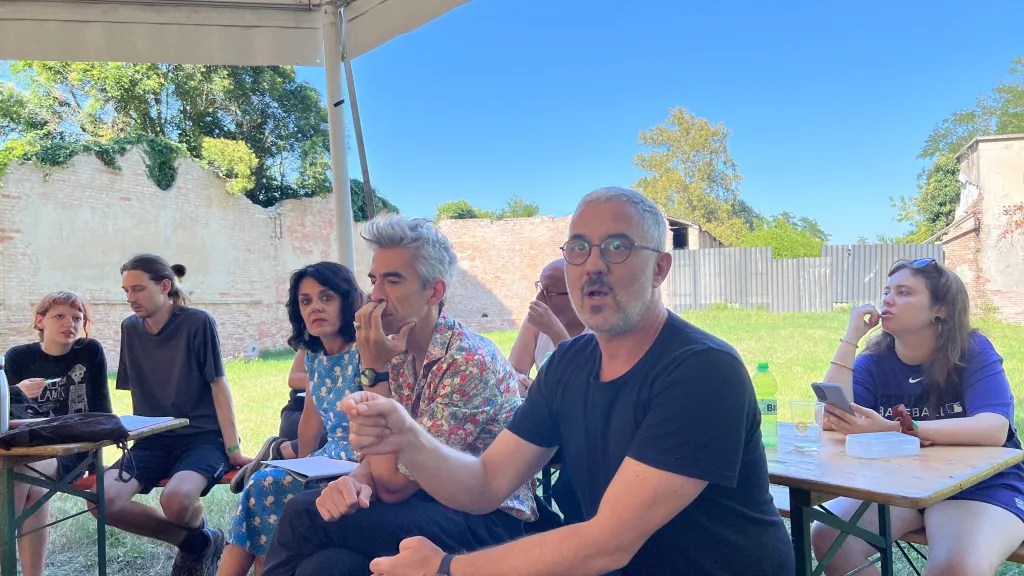
What does ‘radical ecologies’ mean? An appointment to proceed in the collective writing of a manifesto that positions the art world in the fight for climate justice.
Follow up to the Art for Radical Ecologies Assembly opended at Venice Climate Camp 2022, to move towards the Art for Radical Ecologies (manifesto)
Institute of Radical Imagination con Marco Baravalle, Emanuele Braga, Gabriella Riccio, Federica Timeto
9 Settembre alle 15:30
Cosa significa “ecologie radicali”? Un appuntamento per procedere nella scrittura collettiva di un manifesto che posizioni il mondo dell’arte nella lotta per la giustizia climatica.
Il seguito all’Assemblea Art for Radical Ecologies aperta al Venice Climate Camp 2022, per andare verso Art for Radical Ecologies (manifesto)
Institute of Radical Imagination joined IASC International Association for the Study of the Commons and is taking part to the international conference The Commons we want: between historical legacies and future collective actions held in Nairobi, Kenia June 19-24 2023 in the following two panels:
Sub-theme 8. Opportunities and challenges of digital commons
PANEL 8.7. June 20, 2023 09:00 (10:00 CEST)
New approaches to commons governance from the blockchain ecosystem
Co-Chairs: Seth Frey (University of California Davis, USA) and Andy Tudhope (Independent scholar and practitioner, South Africa)
3. Technological Tools for the Commons. Dissident Algorithms’ Organizations
Emanuele Braga (Institute of Radical Imagination, Italy) and Maddalena Fragnito (Coventry University, UK)
This paper focuses on relational and technological tools for self-organization that have been developed within movements for the commons during the last 10 years between the financial and the pandemic crisis and beyond. Within the self-managed spaces taken into account, horizontal, non-hierarchical decision-making processes have been developed, mostly based on the sharing of means of production, and a supportive and non-competitive distribution of knowledge. This research would like to update the concept of DAO, a Decentralized Autonomous Organization, in the context of the process of commoning. In the international debate, DAO contains the challenge to shape the life of an organization on the basis of the set of tools using mainly blockchain technologies to automatize different autonomous peer initiatives. I would like to raise the question: which of these sets of tools is really sustainable to foster collaboration instead of competition by going beyond the capitalistic mode of production? The project aims to introduce a survey and map the most interesting tools and methodologies in use within the European panorama of activism for a post-capitalist ecological transition. The survey and the mapping process aim both at making technological tools available and experimenting with them in the specific context of the Institute of Radical Imagination’s productive and collaborative platform. The Institute of Radical Imagination was born in 2017 as a monster/alternative institution by artists, activist researchers and cultural operators.
Sub-theme 10. Local institution building and radical futures for the commons
PANEL 10.12. B June 20, 2023 11:00 (12:00 CEST)
From the governance of the commons to a wider commons-inspired governance: obstacles and institutional changes inside the State and the Market
Co-Chairs: Margherita D’Andrea (University of Naples Federico II , Italy) and Giuseppe Micciarelli (University of Salerno/DISPC, Italy)
4. Intersections between arts, militant research and the commons
Gabriella Riccio (Institute of Radical Imagination, Italy)
What is the relation between artistic practices and the commons? Is it just a matter of providing cultural opportunities for the community and those that are not able to have access to it? Could art practices in the commons open up to popular cultures? Could this coming together foster new publics, opening new possibilities for appreciating a variety of cultural productions? Does it aim to create contradictions in the cultural production system? Is it a way to give asylum to productions outside the market? Or all these things together? As the Institute of Radical Imagination, we are a group of curators, activists, scholars and cultural producers with a shared interest in co-producing research, knowledge, and artistic and political research interventions for a transition to post-capitalism. We will discuss issues we face with our artistic, academic and political activism: How do the voices/careers of artists who approach the commons intersect and/or change and transform their art, performances, and way of sharing? How does artistic education affect the way that artists can engage with the commons? How do IRI or other forms of activism based on culture, arts and commons influence the policies of traditional cultural institutions? Is it possible? Can we imagine an alternative way to create festivals that are not mere exhibitions of ideas, or that are not connected to and based on mainstream proposals? Are there some interesting case studies on distributing resources and opportunities in a horizontal and non-hegemonic way between commoners even when individual careers, productions, and lives are involved?
Endless growth is impossible on a planet with limited resources. The transition into one post growth society is inevitable. And yet the free performing arts are also the dogma of growth determines: So much research has been done in the past three pandemic years, confirmed and produced like never before. Based on working conditions and social security, it has changed to the vast majority of artists nothing has changed, they remain precarious. How do we get out of this hamster wheel? The academy addresses this issue in several lectures and three multi-day workshops. Students and actors from artistic practice, production, dramaturgy, administration, Unions and social services join forces in the search for new employment and production conditions: What does a different theater work look like, if less, but more sustainable? is being produced? When labor, ideas and material are not heated quickly, but used long term will be? When the concern for each other and the creation of common goods and practices is at the center push ?
Workshop 1: Commoning our work, commoning our institutions. A post-capitalist training of shared work and production
With Gabriella Riccio & Emanuele Braga (Institute of Radical Imagination)
Can artistic practice be a model for ways out of the crisis? In the workshop “Commoning our work, commoning our institutions”, artists and activists from the Institute of Radical Imagination report on their practice: They try to create spaces for the growth of the commons against privatization, gentrification and exploitation – from the micro level of the individual to the reconquest or occupation of urban space and the influencing of planning and politics. Together with the participants, they try to develop the idea of a theater of the commons. The concept of the commons is based on the experience in self-governing art and cultural spaces such as L’Asilo (Naples) or MACAO (Milan), in which the focus is on joint work for a shared space in the city that belongs to everyone.
GERMAN
WENIGER PRODUZIEREN, BESSER ARBEITEN!
DIE FREIEN DARSTELLENDEN KÜNSTE JENSEITS DES WACHSTUMS
Unendliches Wachstum ist auf einem Planeten mit begrenzten Ressourcen nicht möglich. Der Wandel zu einer Postwachstumsgesellschaft ist unausweichlich. Und doch sind auch die Freien Darstellenden Künste vom Dogma des Wachstums bestimmt: Gerade in den vergangenen drei Pandemiejahren wurde so viel recherchiert, konferiert und produziert wie nie zuvor. An den Arbeitsbedingungen und der sozialen Absicherung hat sich für die allermeisten Künstler*innen allerdings nichts geändert, sie bleiben prekär. Wie kommen wir raus aus diesem Hamsterrad? Die Akademie bearbeitet diese Frage in mehreren Vorträgen und drei mehrtägigen Workshops. Studierende sowie Akteur*innen aus künstlerischer Praxis, Produktion, Dramaturgie, Verwaltung, Gewerkschaften und Förderwesen begeben sich gemeinsam auf die Suche nach neuen Arbeits- und Produktionsbedingungen: Wie sieht eine andere Theaterarbeit aus, wenn weniger, aber dafür nachhaltiger produziert wird? Wenn Arbeitskraft, Ideen und Material nicht schnell verheizt, sondern langfristig genutzt werden? Wenn die Sorge umeinander sowie die Schaffung gemeinsamer Güter und Praktiken in den Mittelpunkt rücken?
10.00–13.00 Uhr und 15.00–17.00 Uhr Arbeit in den Workshops
Workshop 1: Commoning our work, commoning our institutions. Ein postkapitalistisches Training geteilten Arbeitens und Produzierens
Mit Gabriella Riccio & Emanuele Braga (Institute of Radical Imagination)
Kann künstlerische Praxis ein Vorbild für Wege aus der der Krise sein? Im Workshop „Commoning our work, commoning our institutions“ berichten Künstler*innen und Aktivist*innen des Institute of Radical Imagination aus ihrer Praxis: Sie versuchen, Räume für das Wachstum der Commons gegen Privatisierung, Gentrifizierung und Ausbeutung zu schaffen – von der Mikroebene des Individuums bis hin zur Rückeroberung oder Besetzung von städtischem Raum und der Beeinflussung von Planung und Politik. Gemeinsam mit den Teilnehmenden versuchen sie, die Idee eines Theaters der Commons zu entwickeln. Der Begriff der Commons stützt sich dabei auf die Erfahrung in selbstverwalteten Kunst- und Kulturräumen wie L’Asilo (Neapel) oder MACAO (Mailand), in denen die gemeinsame Arbeit für einen geteilten Raum in der Stadt, der allen gehört, im Mittelpunkt steht.
Emanuele Braga, Gabriella Riccio (Institute of Radical Imagination) & Anna Rispoli
TEXT
Emanuele Braga, Gabriella Riccio (Institute of Radical Imagination) & Anna Rispoli + 11 inhabitants of Milan
INTEINTERVIEWS
Laila Sit Aboha, Iman Salem
WITH THE PARTICIPATION OF
Samuel Adoma, Fabrizio Bassani, Nadia Belatik, Ale Cane, Ivan Carozzi, Yuri Simone D’Ostuni, Osasele Eromosele/Iman Salem, Simona Franzé, Federico Fumagalli, Roberto Mastroianni/Lorenzo Fidanzi, Vincenzo Pizzolante/Dario Leone, Gabriella Riccio e Anna Rispoli.
A PRODUCTION BY
Institute of Radical Imagination
PARTNERS
Base Milano, Le Alleanze dei Corpi, Landscape Choreography
UNCONDITIONALLY. Life Income Love
What would the world be like if everyone had enough money to lead a worthy life? What if everyone got a universal and unconditional basic income?
Starting from the Art for UBI (manifesto), IRI proposes discussions on the role that art and the world of cultural production should have in the struggle for financial redistribution based on mutualism, on the methods of self-management of resources, on access to the means of production. and other solidarity practices.
With performance UNCONDITIONALLY. Life Income Love, people of different backgrounds and working conditions gather in a choreographed assembly to discuss the impact that a universal and unconditional income would have on their lives. Is the RBUI a “simple” financial measure or a fundamental tool for a radical alternative to the neoliberal reality in which we live? What would it be like if income and working hours weren’t linked? If you could say no to the blackmail of precariousness? End the race and gender asymmetries so common in today’s labor market? Detoxify the planet from ecologically dangerous jobs? Caring and helping each other in the face of the endless invitation to be competitive individuals? These are some of the questions that inspire public dialogue.
On this occasion, an IRI team worked to adapt Anna Rispoli’s proposal and produce a performance that takes up these lines through a series of interviews with a group of people who live and work in Milan and who are interpreters of this representation.
Emanuele Braga
Gabriella Riccio
Anna Rispoli
Emanuele Braga is an artist, theorist and activist. Co-founder of the MACAO assembly of artists (2012), as well as of the dance company Balletto Civile (2003), of the contemporary art project Rhaze (2011), Landscape Choreography (2012), and member of the Institute of Radical Imagination. His research focuses on alternative models of cultural production, processes of social transformation in relation to digital technologies, political economy, labor rights and the institution of the commons.
Gabriella Riccio, choreographer and performer artist lives between Naples and Madrid. She founded Caosmos (2001) and ciagabriellariccio (2003). She is an activist in the movement of commons and self-governing cultural spaces, she is an “inhabitant” of L’Asilo-Ex Asilo Filangieri in Naples (2012) and co-founder member of the Institute of Radical Imagination (2018). Gabriella works at the intersection of aesthetics, ethics and politics in contemporary prefigurative practices on the border between performance, artistic creation and activism.
Anna Rispoli works on the border between artistic creation and activism, to explore in a performative way the triangulation between man-city-identity and to test possible affective appropriations of the public territory. The forms vary according to the conceptual needs of each project. Anna Rispoli is part of the Common Wallet, a red informal de economía solidaria that persuades a “polyamorous relationship with money”.
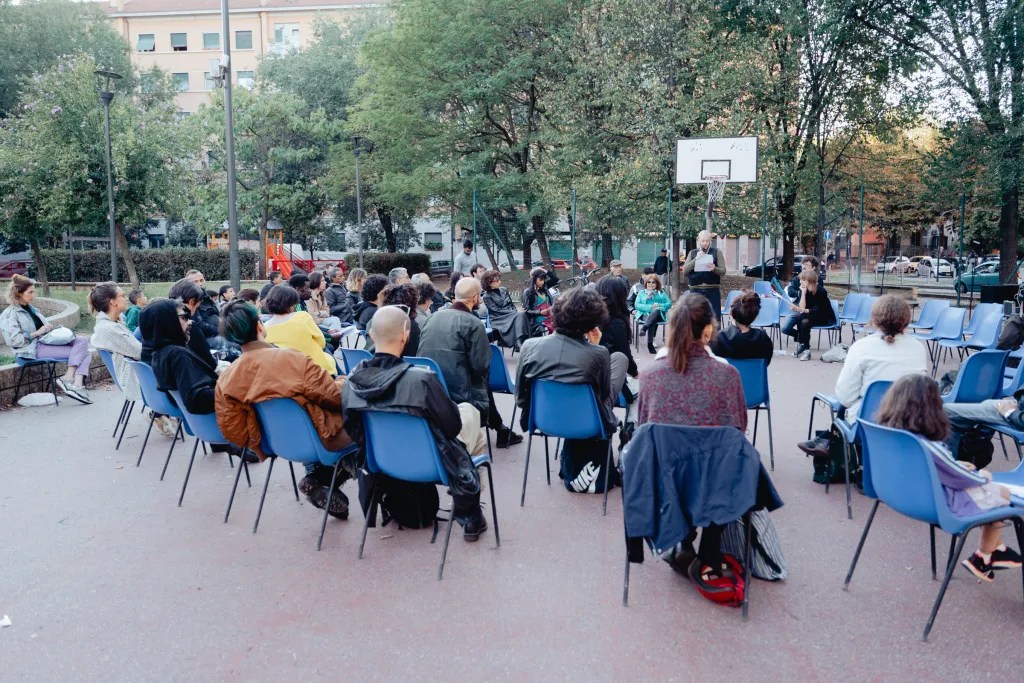
Basket Court, Piazza Selinunte, Milan – September 30th at 7 pm
Free entrance
MODERATOR
Emanuele Braga
WITH
Marco Baravalle, Kuba Szreder, Alberto Cossu, Gabriella Riccio, Massimiliano Mollona
Recent publications will be presented on the theme of precariousness and income: Art for UBI (manifesto), The ABC of the Projectariat: Living and Working in a Precarious Art World, Art/Commons, Autonomous Art Institutions Artists Disrupting the Creative City.
PROFILES
Kuba Szreder is a researcher, lecturer and independent curator, working as an associate professor at the department for art theory of the Academy of Fine Arts in Warsaw. He has co-curated many interdisciplinary projects hybridizing art with critical reflection and social experiments. He actively cooperates with artistic unions, consortia of post-artistic practitioners, clusters of art-researchers, art collectives and artistic institutions in Poland, the UK, and other European countries. In 2009 he initiated the Free / Slow University of Warsaw, and in 2018 he established the Center for Plausible Economies in London, a research cluster investigating artistic economies. His most recent book The ABC of the projectariat. Living and working in a precarious art world, was published by the Whitworth Museum and Manchester University Press in December 2021.
——
Alberto Cossu is a sociologist and media scholar who does research at the intersection between digital media and activism qualitative and digital methods collaborative and digital economies. Before joining the University of Leicester he was Lecturer in New Media & Digital Culture at the University of Amsterdam and previously a Research Fellow at the Department of Social & Political Sciences University of Milan where he has obtained his PhD in Sociology. During his PhD he has conducted research on the mobilisation of knowledge and art workers in Italy; within the EU project P2PValue he was part of an international team led by Prof. A. Arvidsson on peer-to-peer models of organisation and production in Italy and France on digital economy and co-working spaces in Italy and Thailand.
——
Marco Baravalle is a member of S.a.L.E. Docks, a collective and an independent space for visual arts, activism, and experimental theater located in what had been an abandoned salt-storage facility in Dorsoduro, Venice. Founded in 2007, its programming includes activist-group meetings, formal exhibitions, screenings, and actions. In addition to managing the diverse programming at S.a.L.E. Docks, Baravalle is currently a research fellow at INCOMMON (IUAV University of Venice). His fields of research include the relationship between art, theatre and activism, creative labor, gentrification, and the positioning of art within neoliberal economics.
——
Emanuele Braga co-founder of Macao center, an artist, researcher and activist. In addition to his work at Macao, he co-founded the dance and theatre company Balletto Civile (2003), the contemporary art project Rhaze (2011), as well as Landscape Choreography (2012), an art platform questioning the role of the body under capitalism. His research focuses on models of cultural production, processes of social transformation, political economy, labor rights and the institution of the commons.
——
Massimiliano (Mao) Mollona writer, filmmaker and anthropologist. He has a multidisciplinary background in economics and anthropology and his work focuses on the relationships between art and political economy. He conducted extensive fieldworks in Italy, UK, Norway and Brazil, mainly in economic institutions, looking at the relationships between economic development and political identity through participatory and experimental film projects. His practice is situated at the intersection of pedagogy, art and activism. Mollona is a founding member of the LUC Laboratory for the Urban Commons (LUC), Athens.
——
Gabriella Riccio is an artist, activist and independent researcher. Since 2000 she has been active as choreographer, as well as cultural advisor. Since 2010 Gabriella is engaged in the movement for the commons, artworkers struggles and the Italian movement of self-governed cultural spaces, where as a resident member of L’Asilo – Ex Asilo Filangieri in Naples, she contributed to the Declaration of urban civic and collective use. She is regularly invited as keynote, public speaker and lecturer on practices of commoning and governance. She contributed to EU participatory policy development within the framework of EU Citizen’s Engagement and Deliberative Democracy Festival, EU projects Cultural and Creative Spaces and Cities, DISCE Developing Inclusive Sustainable Creative Economies, Creative Lenses. She contributed to several publications, a.o. Home of Commons,online toolkit for participatory development 2021, Per un approccio sistemico al patrimonio culturale: usi civici e beni comuni. Il caso dell’Ex Asilo Filangieri di Napoli in Visioni al Futuro 2018, La pratica dell’uso civico come scelta estetica etica e politica per il sensible comune in Stefano Rodotà, I beni comuni. L’inaspettata rinascita degli usi collettivi, 2016, L’Asilo as a case study for Creative Lenses, and L’Asilo in Models to Manifestos, 2019. Gabriella is a co-founding member of the Institute for Radical Imagination.
Idea Drammaturgia Regia: Emanuele Braga, Gabriella Riccio (Institute of Radical Imagination) & Anna Rispoli
Testo: Emanuele Braga, Gabriella Riccio (Institute of Radical Imagination) & Anna Rispoli + 11 abitanti di Milano
Interviste: Laila Sit Aboha, Iman Salem
Con la partecipazione di: Samuel Adoma, Fabrizio Bassani, Nadia Belatik, Al Cane, Ivan Carozzi, Yuri Simone D’Ostuni, Osasele Eromosele/iman Salem, Simona Franzé, Federico Fumagalli, Roberto Mastroianni/Lorenzo Fidanzi, Vincenzo Pizzolante/Dario Leone, Gabriella Riccio e Anna Rispoli.
Una produzione Institute of Radical Imagination
Partners: Base Milano, Alleanze dei Corpi, Landscape Choreography
Campo di Basket, Piazza Selinunte Milano, Settembre 2022
Come sarebbe il mondo se tutt* avessero sufficiente denaro per condurre una vita degna? Se tutt* ricevessero un reddito di base universale e incondizionato?
Partendo dall’Art for UBI (manifesto), l’IRI propone discussioni sul ruolo che l’arte e il mondo della produzione culturale dovrebbero avere nella lotta per la redistribuzione finanziaria basata sul mutualismo, sulle modalità di autogestione delle risorse, sull’accesso ai mezzi di produzione e altre pratiche solidali.
Con la performance INCONDIZIONATAMENTE. Vita Reddito Amore, persone di diversa estrazione e condizione lavorativa si riuniscono in un’assemblea coreografata per discutere dell’impatto che un reddito universale e incondizionato avrebbe sulle loro vite. Il RBUI è una “semplice” misura finanziaria o uno strumento fondamentale per un’alternativa radicale alla realtà neoliberista in cui viviamo? Come sarebbe se guadagno e ore di lavoro non fossero legati? Se si potesse dire no al ricatto della precarietà? Porre fine alle asimmetrie di razza e genere così comuni nel mercato del lavoro di oggi? Disintossicare il pianeta da lavori ecologicamente pericolosi? Prendersi cura e aiutarsi a vicenda di fronte all’infinito invito a essere individui competitivi? Queste sono alcune delle domande che ispirano il dialogo pubblico.
In questa occasione, un team dell’IRI ha lavorato per adattare la proposta di Anna Rispoli e produrre una performance che riprende queste linee attraverso una serie di interviste ad un gruppo di persone che vivono e lavorano a Milano e che sono interpreti di questa rappresentazione.
What would the world be like if everyone had enough money to lead a worthy life? What if everyone got a universal and unconditional basic income?
Starting from the Art for UBI (manifesto), IRI proposes discussions on the role that art and the world of cultural production should have in the struggle for financial redistribution based on mutualism, on the methods of self-management of resources, on access to the means of production. and other solidarity practices.
With performance UNCONDITIONALLY. Life Income Love, people of different backgrounds and working conditions gather in a choreographed assembly to discuss the impact that a universal and unconditional income would have on their lives. Is the RBUI a “simple” financial measure or a fundamental tool for a radical alternative to the neoliberal reality in which we live? What would it be like if income and working hours weren’t linked? If you could say no to the blackmail of precariousness? End the race and gender asymmetries so common in today’s labor market? Detoxify the planet from ecologically dangerous jobs? Caring and helping each other in the face of the endless invitation to be competitive individuals? These are some of the questions that inspire public dialogue.
On this occasion, an IRI team worked to adapt Anna Rispoli’s proposal and produce a performance that takes up these lines through a series of interviews with a group of people who live and work in Milan and who are interpreters of this representation.
The Venice Climate Camp 2022 is the opportunity to bring together art and performing arts workers to initiate a discussion that will lead to the collective writing of a manifesto on the role of art in the struggle for climate justice and in the creation of new ecologies (which take into account the intersection of environmental and social facts). If the pandemic had already dramatically underlined the consequences of extractivist anthropization, the war in Ukraine (in addition to its immediate death toll) is a manifestation of what Andreas Malm has called ‘fossil fascism’, a mix of authoritarianism and fossil fuels that weakens the already insufficient measures to combat global warming. The scarcity of Russian gas has brought coal back into vogue and, in Italy, the construction of new re-gasifiers is on the agenda. The decision to organize the workshop at the Venice Climate Camp (promoted by Rise Up For Climate Justice and Fridays For Future) reflects our belief in the importance of freeing art from the capture of institutional circuits. We want to experience, as participants in social movements, aesthetic-political concatenations that interpret creativity as a radical character of the social and not as a commodity. The participants also share the conviction that the fight for climate justice is, necessarily, a fight against and beyond extractive capitalism, even in its green version (actually an attempt to turn the crisis into new accumulation).
The workshop will be a moment of discussion based on the practices of the invited guests, who convoke some central themes: the use of art as a method of inquiry and visualization in the climate crisis; the production of activist art forms that look at the performativity of direct action; art as a ground for radical imagination in designing new ecologies that reshape the relationship between human and non-human; art as an archive of movement practices and so on.
During Camp days, in addition to the main meeting moment, there will be a screening of films by Oliver Ressler, a workshop by Paolo Cirio and collective performative practice by Andreco.
First participants: Sale Docks, Institute of Radical Imagination, Caracol Olol Jackson, Rise Up For Climate Justice, Andreco, Annaclara Basilicò, Paolo Cirio, Terike Haapoja, Rosa Jijon, Francesco Martone, Teresa Masini, Oliver Ressler, Federica Timeto
The Venice Climate Camp 2022 is the opportunity to bring together art and performing arts workers to initiate a discussion that will lead to the collective writing of a manifesto on the role of art in the struggle for climate justice and in the creation of new ecologies (which take into account the intersection of environmental and social facts). If the pandemic had already dramatically underlined the consequences of extractivist anthropization, the war in Ukraine (in addition to its immediate death toll) is a manifestation of what Andreas Malm has called ‘fossil fascism’, a mix of authoritarianism and fossil fuels that weakens the already insufficient measures to combat global warming. The scarcity of Russian gas has brought coal back into vogue and, in Italy, the construction of new re-gasifiers is on the agenda. The decision to organize the workshop at the Venice Climate Camp (promoted by Rise Up For Climate Justice and Fridays For Future) reflects our belief in the importance of freeing art from the capture of institutional circuits. We want to experience, as participants in social movements, aesthetic-political concatenations that interpret creativity as a radical character of the social and not as a commodity. The participants also share the conviction that the fight for climate justice is, necessarily, a fight against and beyond extractive capitalism, even in its green version (actually an attempt to turn the crisis into new accumulation).
The workshop will be a moment of discussion based on the practices of the invited guests, who convoke some central themes: the use of art as a method of inquiry and visualization in the climate crisis; the production of activist art forms that look at the performativity of direct action; art as a ground for radical imagination in designing new ecologies that reshape the relationship between human and non-human; art as an archive of movement practices and so on.
During Camp days, in addition to the main meeting moment, there will be a screening of films by Oliver Ressler, a workshop by Paolo Cirio and collective performative practice by Andreco.
First participants: Sale Docks, Institute of Radical Imagination, Caracol Olol Jackson, Rise Up For Climate Justice, Andreco, Annaclara Basilicò, Paolo Cirio, Terike Haapoja, Rosa Jijon, Francesco Martone, Teresa Masini, Oliver Ressler, Federica Timeto
THE DEMOCRACY PAVILION FOR EUROPE Ljubljana, March 9-11, 2022 ZRC SAZU
The Democracy Pavilion is a conference in Ljubljana organized by L’Internationale association and Zrc Sazu . Part of the #TheEuropeanPavilion program by European Cultural Foundation
Plans for this conference were first drawn up some months ago and we doubted whether to carry it on. We decided to use this platform to stand in solidarity with the Ukrainian people and condemn the war.
We will begin the sessions on March 9 with news from artists and cultural workers in Ukraine and the Ukrainian diaspora, to listen to what they want and need.
Our question: what does democracy mean in these current, bleak conditions? How do we both seek to defend the limited space to think and act that we still have and push for a new sense of living well and caring for the planet we share?
📺 online at European Cultural Foundation YT channel
Plans for the Democracy Pavilion were first drawn up some months ago. However, with the current Russian’s army invasion of Ukraine in our minds, L’Internationale association wants to use this platform to stand in solidarity with the Ukrainian people and condemn the military invasion that affects the lives of millions of civilians.
During the three days, we will discuss many issues of democracy, Europe, colonial legacies and contemporary empires. We will do this with Ukraine in our minds and our hearts. We share the urgency of stopping the war and we are taking the actions that are in our hands as civilians to demand an immediate end to the attacks. In addition to solidarity with those who directly suffer from Russian aggression, we also want to stand with those who resist from inside Russia and who risk their own lives and well-being to defend others. Together, we must try to use art to imagine a society that will prevent such conflicts in future, and then go on to build it. We hope our conference can contribute a little to all these urgencies.
While condemnation of the war is crucial, it is in itself only one necessary step. We also find it important to maintain the spaces for public debate and analysis of the causes of the war and the position of arts and culture when life and democratic values are under threat. In that light, we carry the pain of ongoing conflicts in Syria, Yemen, Afghanistan and elsewhere, as well as the histories of exploitation and erasure that still manifest themselves in the present. Our question remains what does democracy mean in these current, bleak conditions? How do we both seek to defend the limited space to think and act that we still have, and push for a new sense of living well and caring for the planet we share? We will begin the sessions on Wednesday with news from artists and cultural workers in Ukraine and the Ukrainian diaspora. We hope that some of them will be able to travel to Ljubljana so that we can listen to what they want and need. With this invasion, it is more clear than ever that real existing democracy is under existential threat. While it is true that European democracies are imperfect, they have allowed for governments that are to some degree responsive to open, independent elections decided by debate and argument. Today, even that version of democracy is something we need to defend, as well as to nurture the better, more equitable, more joyful versions we hope can yet emerge. Re-energizing our common futures is something to which everyone can contribute; but we believe that the arts can play its role as an initiator of imaginative epistemologies and a new ethic of living together within the limits of the planet. We want to use this opportunity to explore that belief.
Curated by Zdenka Badovinac and Charles Esche, the Democracy Pavilion for Europe aims to contribute to the rethinking and potential revival of communal forms of decision making as a vision and practice, with artists playing a key role in their conception of different and better worlds and an ethics of living together differently on this planet.
The aim of the Democracy Pavilion for Europe conference is to concentrate artistic, activist, and institutional energies. The objective is to find ways for the creative community to understand democracy and its limits, articulate its values, and propose forms through which to build a new commitment to shared control, public interest and the commons.
The Pavilion will start as an international conference in Ljubljana on 9–11 March, organized by the L’Internationale association in cooperation with ZRC SAZU. This is the first step in the Pavilion’s planned programme that will unfold through local workshops at L’Internationale confederation member locations and transform into an online pavilion at: http://www.internationaleonline.org.
The Democracy Pavilion for Europe is part of The European Pavilion – an initiative by the European Cultural Foundation that aims to support and promote artistic projects that imagine desirable and sustainable futures for Europe. The European Pavilion was initiated by the Amsterdam-based European Cultural Foundation and is developed in partnership with the Camargo Foundation, the Kultura Nova Foundation, and Fondazione CRT.
Over the course of 2021, seven arts and cultural organizations in various countries across Europe have joined this exciting new initiative: ARNA (Sweden), Brunnenpassage (Austria), INIVA (London), OGR Torino (Italy), State of Concept (Greece), Studio Rizoma (Italy) and L’Internationale (Ljubljana, Belgium, Netherlands, Spain and Poland).
More information at: theeuropeanpavilion.eu
Coordination of the Democracy Pavilion: Nika Ham, Maria Mallol
PROGRAM
9 March, Day 1
Should we stay or should we go? Leaving or reforming liberal democracy
This day will be devoted to looking at people/groups/organizations that are questioning their experience of existing democracy and investigating an “elsewhere”, thinking about cultural efforts in communities, in cultural education, in other forms of change. Is existing liberal democracy a viable way towards emancipation, inclusion, and social justice? What is the potential relation between culture, social justice, and democracy? What cultural forms might sensibly contribute to these aims?
10:00–10:30 Welcome. Oto Luthar, Zdenka Badovinac, Charles Esche. On zoom: André Wilkens (Director of the European Cultural Foundation) and Lore Gablier (ECF program manager) presenting the European Pavilion Program and the European Culture for Solidarity Fund.
10:30–12:00 Artists and Democracy – Panel 1 Emergency action. Contributions from / for Ukraine.
Open panel. Artists and cultural workers in the Ukraine and the Ukrainian diaspora. including Nikita Kadan (artist and curator) and others depending on the current situation.
COFFEE BREAK
12:15–12:45 In conversation with Iskra Geshoska (zoom) 12:45- 14:00 Artists and Democracy – Panel 2 Gabriella Riccio – IRI Nika Autor
Moderator: Charles Esche
14:00h- 15:00 Lunch 15:00–17:00 Artists and Democracy – Panel 3 Dmitry Vilensky (zoom) Antifascist Year Eszter Szakács Moderator: Charles Esche
17:00–17:30 In conversation with Hazal Halavut (zoom) COFFEE BREAK
18:15 EVENING LECTURE Peter Klepec
10 March, Day 2
Using Democracy
On the second day, actors are invited who are active in politics, theory and institutional organisation and who make use of culture and art in their work. They are working within and around the liberal democratic nation state and the public sector, often looking for the opportunities it affords for dissent and for taking democratic power. How to use or access the languages of art and culture to question democracy or hold the state to its stated ideals? What is the relationship between democracy and public cultural institutions and subsidies? What is needed to reshape existing liberal democracy away from its apparent capture by the conservative and revolutionary right? 10:00–11:00 Conversation (zoom): Manuel Borja-Villel and Joanna Mytkowska Towards the Museum of the Commons.
What is the use of apparently democratic public institutions today? Moderator: Zdenka Badovinac
COFFEE BREAK
11:00–13:00 The Use and Abuse of Existing Structures
Asta Vrečko Tomislav Medak Aleksei Borisionok
Moderator: Bojana Piškur
13:00–14:00 – Lunch
14:00- 17:30 Constituting and reconstituting: practices and repairs
15:20-15:40 Rolando Vasquez 15:40-16:10 Marcelo Expósito 16:10-16:30 Jonas Staal
16:30-17:30 Questions and open discussion
Moderator: Corina Oprea
COFFEE BREAK
18:15 EVENING LECTURE, Tomaž Mastnak
11 March, Day 3
Kakšna sramota! (What a shame!) The Case of Slovenia
The case of Slovenia: what is happening here and why? What is to be done about it in the cultural field? Artists, cultural workers, and activists from Slovenia are invited to discuss their role in the fight for democracy as it is currently threatened in Slovenia. The day will be dedicated to the sustainability of such resistance – to its economy, structure, networking, and archiving.
10:00 Introduction of the Historical Context Oto Luthar, historian and director ZRC SAZU (introduction by Zdenka Badovinac)
COFFEE BREAK
11:00–12:30 Artists and Activists – Panel I
NON-GRUPA Protestna ljudska skupščina (The Protest People’s Assembly) Aktiv delavk in delavcev v kulturi (The Culture Workers Active): Petja Grafenauer, Miha Zadnikar Vladozlom (via Zoom) 12:30-14:00 LUNCH 14:30–15:30 Artists and Activists – Panel II Miha Blažič, N’toko Tjaša Pureber COFFEE BREAK 15:30-17:30 WORKSHOPS Workshop 1: Artistic approach as basic tool of non-violent protests, Jaša Jenull (representative of The Protest People’s Assembly) The workshop will discuss the mechanisms, experiences, and practical approaches that have helped us carry out more than 90 mass protests and a large number of small artivist interventions over the past two years of struggle against the far right government in Slovenia. Through practical examples, we will present our answers to some of the key questions we have faced in our two years of constant presence on the street. Among others: How to make the invisible visible? How to effectively utilize mass media? How to maintain protest mobilization with the help of art in the long run? How to empower and connect the wider community of protesters using artistic approaches. The second part of the workshop will present a concrete protest action that will take place on the same day and offer participants the opportunity to participate in the protest itself.
Workshop 2: Culture, art, and political activism – key problems today, Miha Zadnikar (representative of the Culture workers active) This workshop will touch on crucial points of the (quite changed) activism / art / culture relationship that are critically seen from a critical perspective today.
The main topics will be:
a) older, recent, and unconscious traps of liberal / illiberal democracies
b) aggressive times of biopolitics; radical state repression and “predatory capitalism”
c) disintegrated subjects within the so-called cultural and creative sectors; cultural fetishism; defetism; recent unexpected difficulties in shaping heterogeneous political movements
d) questioning the “activism of names and family names”; personal career-making activism; grass-roots vs. NGO trends; autonomy and non-hierarchical politics
e) spontaneous inclinations towards a liberal political worldview / liberal jargon
f) opportunities and obstacles in attempts to move away from ideological struggles (with using reorganized and sharpened “national culture”) towards more productive (class) ways of struggle.
Participants:
Antifascist Year (Bogna Stefanska and Jakub Depczinsky), Nika Autor, Zdenka Badovinac, Miha Blažič – N’toko, Aleksei Borisionok, Tania Bruguera, Charles Esche, Marcelo Expósito, Iskra Geshoska, Petja Grafenauer and Miha Zadnikar (representatives of The Culture workers active), Hazal Halavut, Sandi Hilal, Jaša Jenull (representative of The Protest People’s Assembly), The Protest People’s Assembly, Nikita Kadan, Peter Klepec, Oto Luthar, Tomaž Mastnak, Tomislav Medak, Joanna Mytkowska, NON-GRUPA, Corina Oprea, Tjaša Pureber, Gabriella Riccio, Jonas Staal, Eszter Szakács, Rolando Vásquez, Dmitry Vilensky, Asta Vrečko, Miha Zadnikar (representative of the Workers in Culture Task Group), Vladozlom
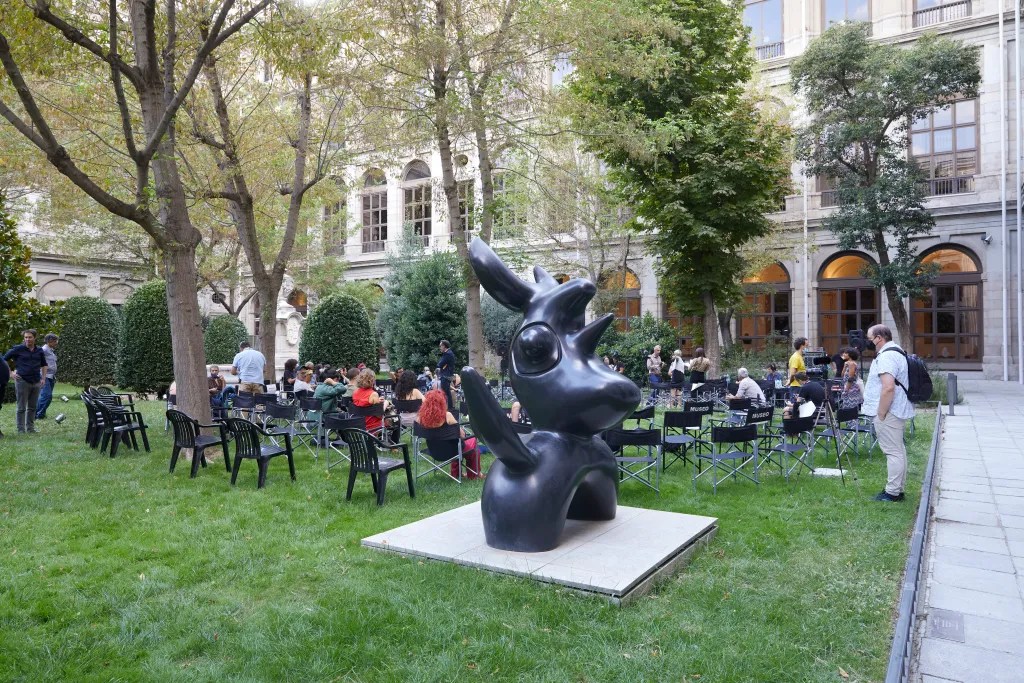
Location / Lugar:Museo Reina Sofia, Jardin Edificio SabatiniDate / Fecha:September 17, 18:00 Language / Idioma: Español Access / Entradas: Free until full capacity, free tickets available from Reina Sofia Museum website (here) from September 15
Text / Texto Marco Baravalle, Elena Blesa, Emanuele Braga, Gabriella Riccio, Anna Rispoli and 14 citizensof Madrid and Barcelona
Direction / Dirección: Gabriella Riccio
Research & Interviews / Investigación y Entrevistas: Gabriella Riccio with the collaboration of Ana Campillos, Maite Gandulfo, Maria Mallol, Celina Poloni
With the support of / Apoyan Hablarenarte / Planta Alta
With the participation of / Con la participación de: Miguel Ángel Álvarez Tornero, Andrei Alexandru Mazga, Sara Babiker Moreno, Elena Blesa Cabéz, Amalia Caballero, José Antonio Campillos Martín-Consuegra, Constanza Cisneros, Ana Gutiérrez Borreguero, Sebastián Laina, Mar Núñez, Lucía Núñez Ortega, Gabriella Riccio, Juan Manuel Rodriguez, Hella Spinelli
A production by / Una producción de: Institute of Radical Imagination, FfAI Foundation for the Arts Activities / Museo Reina Sofia
Sabatini Gardens, Museo Reina Sofía, Madrid, September 21, 2021
Con el Manifiesto ART FOR UBI [Arte por la Renta Básica Universal] como punto de partida, el IRI viene proponiendo discusiones sobre el papel que el arte y el mundo de la producción cultural deben tener en la lucha por una redistribución financiera basada en el mutualismo, los métodos de autogestión de recursos, el acceso a los medios de producción y otras prácticas solidarias. Esta actividad comienza en el Jardín de Sabatini del Museo, con “Una renta muchos mundos” mesa redonda performativa basada en la propuesta de la artista Anna Rispoli, que trabaja regularmente temas como la remuneración, los ingresos y la RBU (renta básica universal), mezclando performance, investigación social y realizando experimentos reales sobre cómo compartir bienes y recursos financieros.
En la performance Una Renta, Muchos Mundos (One Income, Many worlds) un grupo diversificado de personas interpretará una asamblea ficticia en forma de discurso público coral donde se analiza el hipotético impacto en sus vidas de una renta universal, básica e incondicional en el contexto de la actual crisis pandémica. ¿Es la RBU una medida financiera “simple” o una herramienta fundamental para una alternativa radical a la realidad neoliberal que vivimos? ¿Qué pasa con ganar dinero no relacionado con el trabajo y las horas de trabajo? ¿Y la posibilidad de decir no al chantaje de la precariedad? ¿Qué hay de poner fin a las asimetrías de raza y género tan comunes en el mercado laboral actual? ¿Qué hay de desintoxicar el planeta de trabajos ecológicamente peligrosos? ¿Qué pasa con el cuidado y la ayuda mutua frente a la interminable invitación a ser individuos competitivos? Estas son algunas de las preguntas que inspiran el diálogo público La actuación será seguida por el panel Art For Ubi # 3 en el Museo Reina Sofía.
En esta ocasión, un equipo del IRI ha trabajado para adaptar la propuesta de Rispoli y realizar una dramaturgia que retome estas líneas a partir del diálogo con un grupo de personas que viven y trabajan en España, y que han participado en una serie de entrevistas que han dado lugar a la dramaturgia de esta performance. Esta fase de investigación, se enmarca dentro del Programa Abierto de DESVÍO una herramienta de diálogo y trabajo colectivo impulsada por hablarenarte / Planta Alta que se propone accionar y afectar nuestro contexto inmediato.
Using the ART FOR UBI [Art for Universal Basic Income] Manifesto as its starting point, IRI has been proposing discussions on the role that art and the world of cultural production should play in the fight for financial redistribution based on mutualism, methods of self-management of resources, access to the means of production and other solidarity practices. This activity begins in the Sabatini Garden of the Museum, with “One income many worlds” performative round table based on the proposal of the artist Anna Rispoli, who regularly works on topics such as remuneration, income and the UBI (universal basic income), mixing performance, social research and conducting real experiments on how to share assets and financial resources.
In the performance Una Renta, Muchos Mundos (One Income, Many worlds) a diversified group of people will perform a fictional assembly in the form of a public coral speech, where the hypothetical impact on their lives of a universal, basic and unconditional income is analyzed on the background of the current pandemic crisis. Is UBI a “simple” financial measure, or is it an essential tool for a radical alternative to the neoliberal reality we are experiencing? What about earning money unrelated to jobs and working hours? What about the possibility to say no to the blackmail of precarity? What about putting and end to race and gender asymmetries so common in today’s labor market? What about detoxing the planet from ecologically dangerous jobs? What about care and mutual aid in front of the endless invitation to be competitive individuals? These are some or the questions inspiring the public dialogue.The performance will be followed by the panel Art For Ubi #3 at the Museum Reina Sofia.
On this occasion, an IRI team has worked to adapt Rispoli’s proposal and carry out a dramaturgy that takes up these lines from dialogue with a group of people who live and work in Spain, and who have participated in a series of interviews that have given rise to the dramaturgy of this performance. This research phase is part of the DESVÍO Open Program, a tool for dialogue and collective work promoted by hablarenarte / Planta Alta that aims to actuate and affect our immediate context.
UNA RENTA MUCHOS MUNDOS, Sabatini Gardens, Museo Reina Sofía, Madrid, September 21, 2021
within the framework of the residency Program DESVÍO by Planta Alta / Hablar en Arte, in collaboration with the Institute of Radical Imagination, with the hospitality of Museo en Red / Museum Reina Sofia – Thursday May 25th, 17:00-21:00
RES EXTENSA
Res Extensa is a project idea, a hybrid format combining the dimension of critical thinking with the somatic-sensory erotic experimental (experiential) dimension of physical thought; its theme / matter / object / starting point is the body in its relationship with other bodies.
Res Extensa in its experiential form is a participatory event that proposes a framework for experimentation and physical thinking. Res Extensa is proposed as a way to participate in a collective dialogue: enter a choreographic system that does not depend on physical ability, has no audience and only works through its action. Using choreographic practices, Res Extensa invites participants to reflect from their bodies, to critical thinking, wanting to find the exception to the norm, to active listening, to sharing experiences and perspectives among them. Res Extensa moves from pleasure, it is a strategy to reestablish social bonds, re-eroticize other ways of inhabiting the world, reduce the distance and somatize in action. It does not accommodate, and it does not anesthetize, swimming against the current, it says no to the autonomy of aesthetics, it can only be experienced from the inside.
“I am interested in exploring how dance and choreography can contribute to an understanding of the political in our times. I am interested in Movement and Movements of ideas and of the individual or collective bodies. At its chore choreography moves around the relationship between body, space and time, and the possibilities of their reconfigurations. As a choreographer, my creative and investigative process develops through systems of rules and exceptions to the rule: in other words, I can say that the choreography creates systems and atmospheres where to observe the rupture point – deviations – that transforms them into other configurations. I am interested in this moment of transformation: the manifestation of the rupture, which always seems to me like a form of “withdrawal” to let something different appear, from a need, a desire, an imagination in a process that has something aleatory and necessary at the same time: allowing, welcoming, letting appear, being open to change, transformation, by letting other bodies affirm themselves in space and time. Therefore, as an activist committed with the movement for the commons, I also understand the gestures of reconfiguration of our way of being in the world as choreographic gestures that are manifested through a reconfiguration of bodies or space and tautologically of the law.”
Res Extensa dialogues with the theoretical elaboration of contemporary researchers and philosophers: – Andreas Philipopoulos Mihailopoulos and his concepts of Spatial Justice, Normorama and Atmosphere; – Andre Lepecki and his concept of Choreopolitics and Agency in the era of control.
After joining the Art for UBI (manifesto) Platformin 2020, Anna Redi presented the first performance based on the Art for UBI (manifesto) for the opening of the Wiener Festwochen 2021 in collaboration with Institute of Radical Imagination. Since then the Institute of Radical Imagination & Anna Redi have realised all the following performaces based ion the Art for UBI (manifesto) in Madrid, Milan, Venice.
In collaboration with Emanuele Braga, Maddalena Fragnito, Britt Hatzius, Irena Radmanovic, Common Income, ART for UBI, Institute of Radical Imagination, Volksbegehren Grundeinkommen: Runder Tisch Grundeinkommen Österreich, Generation Grundeinkommen, Verein Das Grundeinkommen, Attac Österreich, Runder Tisch Grundeinkommen Salzburg, Netzwerk Grundeinkommen Research,
Interviews Magdalena Fischer
Text Anna Rispoli, Katja Dreyer and 15 citizens of Vienna Production management Marine Thévenet
How would we organise our lives if we didn’t have to earn a living? Indeed, what would we do if our livelihood was secured? In 2021, the Wiener Festwochen will once again open with a discursive debate; artist and activist Anna Rispoli is elaborating a choral speech on unconditional basic income. It is an appeal to reflect on distributive justice, precarity and sustainability. Based on interviews with Viennese citizens and against the backdrop of a work environment thrown even more out of sync by a virus, Income. The unconditional speech sees our present-day utopia as tomorrow’s realities. How would unconditional basic income redesign our lives, our towns and cities, society, and the world as a whole? Rispoli’s interventionist art practices aim to change the public space and are founded on the principle of affective mutual contamination. When words uttered by others pass through our own mouths, a form of non-monetary exchange is able to occur. An economy like we have never seen before!
Wie würden wir unser Leben organisieren, wenn wir nicht von Erwerbstätigkeit abhängig wären? Wenn für unsere Lebenserhaltung gesorgt wäre – was würden wir tun? 2021 eröffnen die Wiener Festwochen erneut mit einer diskursiven Debatte; die Künstlerin und Aktivistin Anna Rispoli gestaltet eine chorische Rede zum bedingungslosen Grundeinkommen. Ein Appell, über Verteilungsgerechtigkeit, Prekarität und Nachhaltigkeit nachzudenken. Basierend auf Interviews mit Wiener*innen und vor dem Hintergrund einer durch ein Virus erst recht aus dem Lot geratenen Arbeitswelt begreift das leidenschaftliche Plädoyer die Utopien von heute als die Realitäten von morgen. Wie würde ein bedingungsloses Grundeinkommen das Leben neu gestalten, die Stadt, die Gesellschaft, die ganze Welt? Rispolis interventionistische Kunstpraktiken zielen auf Veränderung des öffentlichen Raums und fußen auf dem Prinzip der gegenseitigen affektiven Ansteckung. Wenn die Worte anderer durch den eigenen Mund wandern, kann eine Form von nichtmonetärem Austausch geschehen. Eine Ökonomie wie noch nie!
Online Assembly ART for UBI (Manifesto) N°2 on Thursday, December 17th at 18:30 CET. With Ilenia Caleo, Dena Beard, Julio Linares, Anna Rispoli, Emanuele Braga, Marco Baravalle. The School of Mutation within the framework of the iteration Art for UBI. Join us on Zoom https://us02web.zoom.us/j/87252121414 Meeting ID: 872 5212 1414
We continue our collective debate towards the drafting of the ARTS FOR UBI Manifesto. In this session we will address the mobilizations of art workers in Italy during the pandemic. We will analyze the experimental basic income for artists implemented by the city of San Francisco. We will talk about basic incomes models on blockchain and about art as a possible field of experimentation of alternative economic models
Art for UBI (manifesto) online assembly #2 December, 2nd 2020
Marco Baravallle (S.a.L.E. Docks – ITA) http://www.saledocks.org/ Marco is a member of S.a.L.E. Doks, a self-managed art space in Venice. His intervention will focus on the importance of UBI and dis-identification in the organization of art and culture living labor.
Gabriella Riccio (L’Asilo – ITA) is an artist, activist and researcher, member of L’Asilo, art & culture common in Naples IT. L’Asilo elaborated on UBI within the framework of The commons as ecosystems for culture on EU scale.
Ilenia Caleo: Performer and researcher in queer studies and feminist epistemologies at the IUAV University of Venice. She is among the co-founders of Campo Innocente, a network founded after the pandemic outbreak to defend art workers rights and to promote UBI. (https://ilcampoinnocente.blogspot.com/)
Dena Beard: Executive Director of The Lab in San Francisco. She received her M.A. in Art History, Theory, and Criticism from the School of the Art Institute of Chicago and was previously Assistant Curator at the Berkeley Art Museum and Pacific Film Archive.
Julio Linares: researcher at Circles, a blockchain based basic income made to promote local economies. https://joincircles.net/
Anna Rispoli: (Common Wallet) Common Wallet is a community based practice in Brussels created by artists. They are socializing their personal income basing the access to liquidity on mutual aid principles.
Giuseppe Micciarelli (L’Asilo – ITA) jurist and political philosopher. PhD in Public Law, Theory of National and European Institutions and Legal Philosophy at the University of Salerno, Italy. He is member of Laboratorio filosofico-giuridico e filosofico-politico ‘Hans Kelsen and editor of Soft Power, Euro-American Journal of Historical and Theoretical Studies of Politics. L’Asilo elaborated on UBI within the framework of The commons as ecosystems for culture on EU scale.
3rd online Assembly with Brigate Volontarie per l’Emergenza (Italy), Territorio Doméstico (Spain), Skart (Serbia), Open School for Immigrants of Piraeus (Athens), Obiezione Respinta (Italy), Mesa de mayores de Usera (Madrid). The School of Mutation within the framework of the iteration Raising Care holds this online workshop based on exchange of practices on NOVEMBER 12th at 17:30 CET. Join us on Zoom https://us02web.zoom.us/j/89525339150 Meeting ID: 895 2533 9150
NEW PARADOXES OF THE POLITICS OF CARE
Both ethics of care and care practices have moved forward during this last crisis. One of the aims of this collective 3-sessions-iteration would be to analyse this new tension among groups whose “care practices” were active from before the Covid-19 turn and also with groups which have been rising during covid.
We plan to start a conversation among collectives by asking:
who cares and who is cared for?
what needs of “socialising care” (redistributing) are we meeting now?
which tools are we using or building new because of new needs?
how have reconfigured the public language/space/media.
how care is becoming a term of the power, governments, media?
which conflict in our practices are we finding?
which relations we found among our “autonomous” practices of care and the role of the public sector nowadays?
Profiles
Brigate Volontarie per l’Emergenza (Italy) Fighting fear together to defeat the virus. This initiative was created to address the risk of the collapse of the national health system during the Covid-19 emergency. Volunteers in support of the population, together with Emergency ONG, we organize intervention teams to make our active contribution to overcoming this emergency. https://www.facebook.com/brigatevolontarieMilano
Mesa de mayores de Usera (Madrid) is an organization of elderly people from Usera, a southern neighborhood of Madrid. Facing the lack of hedge during covid pandemia, the Usera Senior Board are self-organizing alternative tools with the aim of offering support to the elderly. Through social networks and email, the board faces isolation, provides information about the resources of the neighborhood and brings mutual care support. http://mayoresusera.alonsodiez.com/
Obiezione Respinta (Italy) is a movement fighting for sexual and reproductive self determination. Facing the increase of obstetric violence and general disinformation on medical / health practices aimed at women and lgbtqi subjects cases in Italy, Obiezione Respinta have created a self-managed platform that allows to report the places where the objection of conscience is in a common map. The platform offers a free service of access to information that is commonly not easily available. https://obiezionerespinta.info/info
Open School for Immigrants of Piraeus (Athens) has been active in the field of solidarity education since 2005, while in 2006 it took the legal form of an association, with its ultimate aim being the educational and training support and the cultural advance of immigrants and refugees residing in Greece. Last year, it had more than 670 registered students from 43 different national backgrounds and 38 volunteers in teaching and supporting roles. http://solidarityschools.gr/?page_id=12341&lang=en
Škart (Serbia) Škart (rejects/ausschus/scarto) group was founded in 1990 at the Architecture Faculty in Belgrade, Serbia-Yugoslavia. Through permanent inner conflict, together with various collaborators, the group survived 3 decades as a collective which is questioning edged forms of poetry, architecture, graphic design, publishing, music, performance, alternative education and social activism. http://www.skart.rs
Territorio Doméstico (Spain) is a feminist and transborderist collective in Madrid, formed by women, many of them housekeepers, climing visibility and social reorganization of care work. TD has been fighting for more than 14 years for the recognition of rights in household employment, the valuation of care work in a system that devalues them, makes them invisible and precarious, despite the fact that they are essential sustaining life. https://www.facebook.com/territoriodomestico
Raising care – is an iteration and a working group for the School of Mutation, by members of IRI and its network, that came together to reflect, organise and instigate a new approach to care as commons. The group consists of Elena Blesa Cábez, Emanuele Braga, Sara Buraya Boned, Jesus Carrillo, Maddalena Fragnito, Elena Lasala Palomar, Theo Prodromidis, Gabriella Riccio and Pablo García Bachiller.
2nd online Assembly with Brigate Volontarie per l’Emergenza (Italy), Territorio Doméstico (Spain), Skart (Serbia), Open School for Immigrants of Piraeus (Athens), Obiezione Respinta (Italy), Mesa de mayores de Usera (Madrid). The School of Mutation within the framework of the iteration Raisin Care holds this online workshop based on exchange of practices on NOVEMBER 5th at 18:30 CET. Join us on Zoom https://us02web.zoom.us/j/85257147600 Meeting ID 852 5714 7600
NEW PARADOXES OF THE POLITICS OF CARE
Both ethics of care and care practices have moved forward during this last crisis. One of the aims of this collective 3-sessions-iteration would be to analyse this new tension among groups whose “care practices” were active from before the Covid-19 turn and also with groups which have been rising during covid.
We plan to start a conversation among collectives by asking:
who cares and who is cared for?
what needs of “socialising care” (redistributing) are we meeting now?
which tools are we using or building new because of new needs?
how have reconfigured the public language/space/media.
how care is becoming a term of the power, governments, media?
which conflict in our practices are we finding?
which relations we found among our “autonomous” practices of care and the role of the public sector nowadays?
Profiles
Brigate Volontarie per l’Emergenza (Italy) Fighting fear together to defeat the virus. This initiative was created to address the risk of the collapse of the national health system during the Covid-19 emergency. Volunteers in support of the population, together with Emergency ONG, we organize intervention teams to make our active contribution to overcoming this emergency. https://www.facebook.com/brigatevolontarieMilano
Mesa de mayores de Usera (Madrid) is an organization of elderly people from Usera, a southern neighborhood of Madrid. Facing the lack of hedge during covid pandemia, the Usera Senior Board are self-organizing alternative tools with the aim of offering support to the elderly. Through social networks and email, the board faces isolation, provides information about the resources of the neighborhood and brings mutual care support. http://mayoresusera.alonsodiez.com/
Obiezione Respinta (Italy) is a movement fighting for sexual and reproductive self determination. Facing the increase of obstetric violence and general disinformation on medical / health practices aimed at women and lgbtqi subjects cases in Italy, Obiezione Respinta have created a self-managed platform that allows to report the places where the objection of conscience is in a common map. The platform offers a free service of access to information that is commonly not easily available. https://obiezionerespinta.info/info
Open School for Immigrants of Piraeus (Athens) has been active in the field of solidarity education since 2005, while in 2006 it took the legal form of an association, with its ultimate aim being the educational and training support and the cultural advance of immigrants and refugees residing in Greece. Last year, it had more than 670 registered students from 43 different national backgrounds and 38 volunteers in teaching and supporting roles. http://solidarityschools.gr/?page_id=12341&lang=en
Škart (Serbia) Škart (rejects/ausschus/scarto) group was founded in 1990 at the Architecture Faculty in Belgrade, Serbia-Yugoslavia. Through permanent inner conflict, together with various collaborators, the group survived 3 decades as a collective which is questioning edged forms of poetry, architecture, graphic design, publishing, music, performance, alternative education and social activism. http://www.skart.rs
Territorio Doméstico (Spain) is a feminist and transborderist collective in Madrid, formed by women, many of them housekeepers, climing visibility and social reorganization of care work. TD has been fighting for more than 14 years for the recognition of rights in household employment, the valuation of care work in a system that devalues them, makes them invisible and precarious, despite the fact that they are essential sustaining life. https://www.facebook.com/territoriodomestico
Raising care – is an iteration and a working group for the School of Mutation, by members of IRI and its network, that came together to reflect, organise and instigate a new approach to care as commons. The group consists of Elena Blesa Cábez, Emanuele Braga, Sara Buraya Boned, Jesus Carrillo, Maddalena Fragnito, Elena Lasala Palomar, Theo Prodromidis, Gabriella Riccio and Pablo García Bachiller.
1st online Assembly with Brigate Volontarie per l’Emergenza (Italy), Territorio Doméstico (Spain), Skart (Serbia), Open School for Immigrants of Piraeus (Athens), Obiezione Respinta (Italy), Mesa de mayores de Usera (Madrid). The School of Mutation within the framework of the iteration Raisin Care holds this online meeting on 29 OCTOBER at 18:30 CET. Join us on Zoom https://us02web.zoom.us/j/84259733096
NEW PARADOXES OF THE POLITICS OF CARE
Both ethics of care and care practices have moved forward during this last crisis. One of the aims of this collective 3-sessions-iteration would be to analyse this new tension among groups whose “care practices” were active from before the Covid-19 turn and also with groups which have been rising during covid.
We plan to start a conversation among collectives by asking:
who cares and who is cared for?
what needs of “socialising care” (redistributing) are we meeting now?
which tools are we using or building new because of new needs?
how have reconfigured the public language/space/media.
how care is becoming a term of the power, governments, media?
which conflict in our practices are we finding?
which relations we found among our “autonomous” practices of care and the role of the public sector nowadays?
Profiles
Brigate Volontarie per l’Emergenza (Italy) Fighting fear together to defeat the virus. This initiative was created to address the risk of the collapse of the national health system during the Covid-19 emergency. Volunteers in support of the population, together with Emergency ONG, we organize intervention teams to make our active contribution to overcoming this emergency. https://www.facebook.com/brigatevolontarieMilano
Mesa de mayores de Usera (Madrid) is an organization of elderly people from Usera, a southern neighborhood of Madrid. Facing the lack of hedge during covid pandemia, the Usera Senior Board are self-organizing alternative tools with the aim of offering support to the elderly. Through social networks and email, the board faces isolation, provides information about the resources of the neighborhood and brings mutual care support. http://mayoresusera.alonsodiez.com/
Obiezione Respinta (Italy) is a movement fighting for sexual and reproductive self determination. Facing the increase of obstetric violence and general disinformation on medical / health practices aimed at women and lgbtqi subjects cases in Italy, Obiezione Respinta have created a self-managed platform that allows to report the places where the objection of conscience is in a common map. The platform offers a free service of access to information that is commonly not easily available. https://obiezionerespinta.info/info
Open School for Immigrants of Piraeus (Athens) has been active in the field of solidarity education since 2005, while in 2006 it took the legal form of an association, with its ultimate aim being the educational and training support and the cultural advance of immigrants and refugees residing in Greece. Last year, it had more than 670 registered students from 43 different national backgrounds and 38 volunteers in teaching and supporting roles. http://solidarityschools.gr/?page_id=12341&lang=en
Škart (Serbia) Škart (rejects/ausschus/scarto) group was founded in 1990 at the Architecture Faculty in Belgrade, Serbia-Yugoslavia. Through permanent inner conflict, together with various collaborators, the group survived 3 decades as a collective which is questioning edged forms of poetry, architecture, graphic design, publishing, music, performance, alternative education and social activism. http://www.skart.rs
Territorio Doméstico (Spain) is a feminist and transborderist collective in Madrid, formed by women, many of them housekeepers, climing visibility and social reorganization of care work. TD has been fighting for more than 14 years for the recognition of rights in household employment, the valuation of care work in a system that devalues them, makes them invisible and precarious, despite the fact that they are essential sustaining life. https://www.facebook.com/territoriodomestico
Raising care – is an iteration and a working group for the School of Mutation, by members of IRI and its network, that came together to reflect, organise and instigate a new approach to care as commons. The group consists of Elena Blesa Cábez, Emanuele Braga, Sara Buraya Boned, Jesus Carrillo, Maddalena Fragnito, Elena Lasala Palomar, Theo Prodromidis, Gabriella Riccio and Pablo García Bachiller.
A platform and a Manifesto on the role of art and art workers in the struggle for social justice
While the art market confirms his status as a safe-haven assets provider for the financial elite, the current pandemic has highlighted the fragility and precarity of art workers around the world, a condition common to a growing portion of humanity. In this situation a UBI (Universal Basic Income) would then represent a solution and indeed an urgent measure to implement. But UBI is not “only” a response to poverty, it is a necessary condition in order to rethink our extractivist ecological model, to correct many race and gender asymmetries and, last but not least, to change the art world’s present neoliberal structure. UBI must be seen as a tool to open up new subjective spaces, alternative to the dominating entrepreneurial individualism and focused instead on commons and care. If artists are already creating new collective economy models and alter-institutions, these small scale experiments will be much more valuable when connected with those growing social movements around the world fighting for a Universal Basic Income.
Lo stipendio da 3,96 euro all’ora è contro la Costituzione. “Sentenza storica” a Milano. La lavoratrice sarà risarcita con 6.700 euroIl Fatto Quotidiano, April 2023
SALE DOCKS ASSEMBLEA BIENNALOCENE 2023 Towards the Metropolitan Chart of Cultural Workers in Venice
With the collaboration of the Solidarity School Mesopotamia and the Open School Piraeus, the Institute of Radical Imagination created a space to reflect on practices of radical pedagogy and set up together with solidarity schools for social activation and political prefiguration of education in the commons.
MASTER in Urban Commons, the Ingobernable and various social centres in Madrid and across Spain will collectively discuss and re-define the vocabularies, practices and strategies of urban commoning starting by sharing the experience of I beni comuni emergenti developed by l’Asilo Ex Asilo Filangieri in Naples.
The second gathering of the Institute of Radical Imagination takes place from 28th of May to 2nd of June 2018 at the Ingobernable, Madrid.
The five-days event in Madrid will consist in two parallel sets of events: a MASTER in Urban Commons, organized by La Ingobernable in collaboration with IRI and involving various Spanish urban commons and social centres and a three-day workshop about the Institute of Radical Imagination’s forms of governance, sustainability, future projects and potential collaborations with social centres and urban commons across Europe’s south, the Mediterranean and the global South.